- By Dotbooker
- Oct 02, 2026
- 12
7 Booking Mistakes Salon Booking Software Can Help You Fix
There is a point every year when salon appointments begin to change.
Customers who normally book a few days ahead start asking for appointments weeks in advance. Friday evenings become harder to find. Saturdays fill quickly. Color treatments, nail appointments, styling sessions, facials, and other longer services begin competing for the same popular hours.
For salon owners, this is usually the signal that the year-end booking season has started.
The natural response is to open more availability wherever possible. But before adding extra hours or trying to fit another customer into an already busy day, there is a more important question to ask:
Is the current booking setup ready for higher demand?
A busy season tends to expose small scheduling problems that remain almost invisible during quieter months. An inaccurate service duration can push several appointments behind. Missing preparation time can create delays between clients.
An outdated employee schedule can make an unavailable stylist appear bookable. A poorly handled cancellation can leave a valuable Saturday slot empty.
These are not necessarily customer-demand problems. They are booking-setup problems.
This is where salon booking software can help. When service durations, employee availability, appointment rules, payments, and customer bookings are managed as connected parts of the same process, salons can make better use of the hours they already have.
Before year-end demand builds, here are seven booking mistakes worth finding and fixing.
Why Holiday Booking Problems Often Begin Before December?
Holiday scheduling problems rarely begin on December 1. They begin when future availability is open.
A customer might book a December haircut in October. Other reserves a long color appointment several weeks ahead. Staff submit holiday leave requests, the salon extends the selected opening hours. Regular customers begin securing their preferred stylists before the best times disappear.
By the time December arrives, much of the calendar may already have been shaped by decisions made weeks earlier.
That is why the period before the rush is so valuable.
Salon owners can review whether their salon scheduling software reflects how the business actually works before customers begin filling out the calendar.
Instead of asking only:“How many appointments can we take?”
Ask: “How many appointments can we deliver properly?”
The difference comes down to service timing, buffers, employees, peak availability, cancellations, payments, and customer communication.
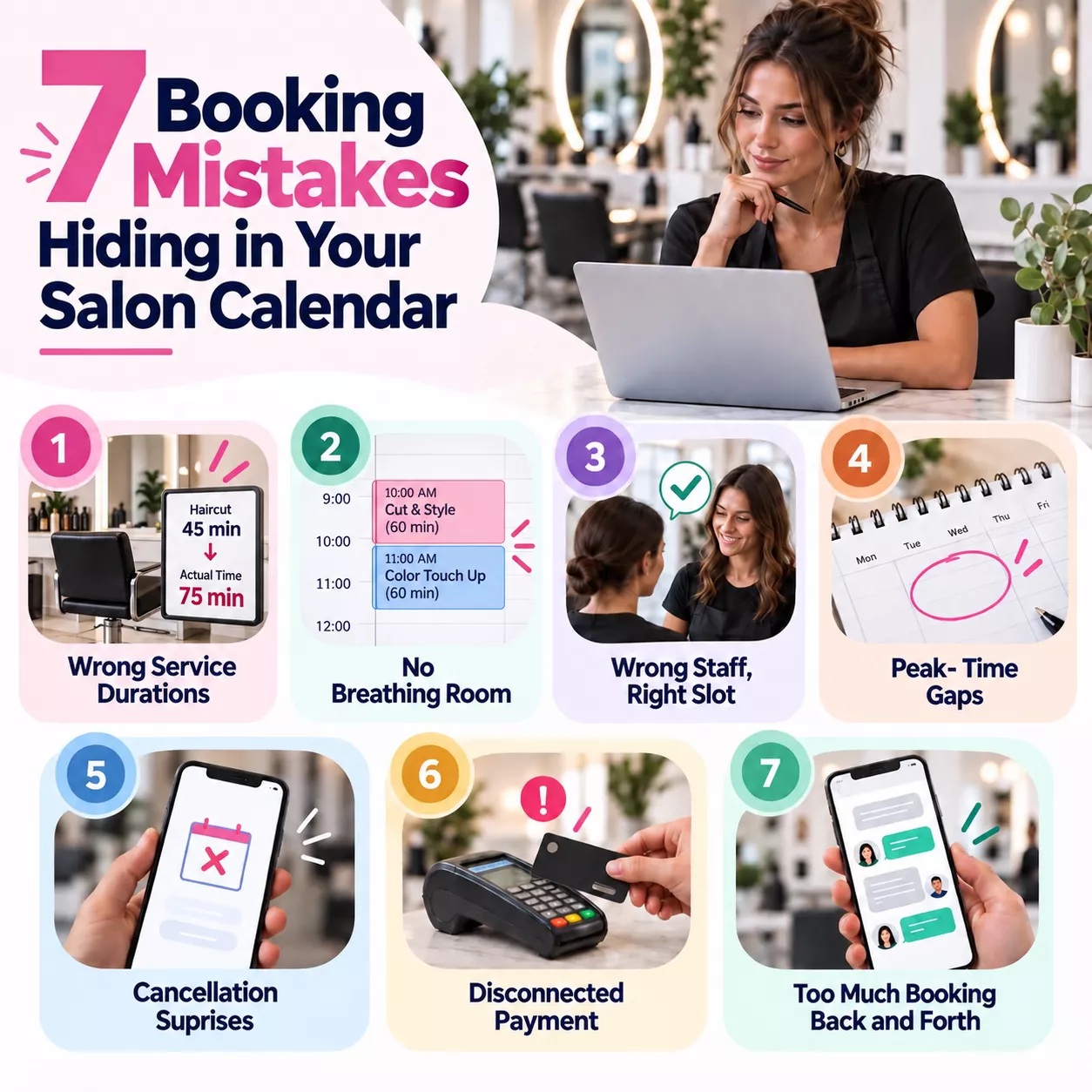
Mistake 1: Using the Same Duration for Different Services
Salon services do not fit naturally into identical calendar blocks.
- A basic haircut and a haircut with styling may require different amounts of time.
- Simple manicure and detailed nail art are not the same appointment.
- A root touch-up cannot necessarily be scheduled for full color treatment.
- Yet it is easy for appointment calendars to become filled with standard 30-minute, 45-minute, or 60-minute blocks.
The problem is not immediately obvious. If a service that normally requires 75 minutes is consistently given a 60-minute appointment, the salon effectively starts the next booking 15 minutes late.
Do that several times in one day and the delay grows. The opposite is also costly. If a 40-minute service is routinely given a 60-minute slot, 20 minutes of potentially usable time disappears.
This becomes especially important during high-demand periods, when a small amount of wasted capacity repeated across several employees can add up to hours.
A salon appointment system should allow salons to assign realistic durations according to the service being booked.
How to Fix It
Review your service menu before peak bookings arrive. Talk to the people delivering each treatment and ask:
- How long does this service usually take?
- Does it change depending on hair length, treatment type, or service variation?
- Are there services that regularly run beyond their allocated time?
- Are we reserving too much time for simpler appointments?
Then configure appointment durations around realistic service delivery. The calendar should reflect the service, rather than forcing every service into the same calendar block.
Mistake 2: Booking Back-to-Back Without Setup or Cleanup Time
There is another type of appointment time that customers rarely see. The minutes between services. Depending on the salon and treatment, employees may need to:
- Clean the station.
- Sanitize tools.
- Reset a treatment room.
- Prepare products.
- Replace towels or equipment.
- Update customer information.
- Get ready for the next appointment.
If the calendar assumes one customer can leave at 11:00 and another service can begin at exactly 11:00, it may be offering time that does not genuinely exist. This is where buffers become important.
Suppose a treatment takes 50 minutes but requires another 10 minutes for preparation and cleanup. If the salon scheduling software only reserves those 50 minutes, every booking creates a small scheduling deficit.
- One missing 10-minute buffer may be manageable.
- Six of them across a day are not.
How to Fix It
Identify services that genuinely require preparation, processing, or cleanup time. Then make sure those minutes are accounted for when availability is calculated.
This does not mean placing large gaps between every customer. It means protecting the time employees genuinely need to provide the next service properly. This is one reason salon management software becomes useful when appointment volume increases. The calendar needs to represent operational availability, not simply open hours.
Mistake 3: Opening Appointments Without Checking Staff Schedules
Your salon is open from 9 AM to 7 PM. That does not mean every service should be available from 9 AM to 7 PM.
- One stylist may finish at 5 PM.
- Another may start at noon.
- A nail technician may not work Tuesdays.
- A senior stylist may already have approved holiday leave.
- Another employee may provide only selected services.
This distinction matters even more when customers use online salon bookings. If the booking page shows an appointment that the assigned employee cannot actually deliver, the convenience of online booking quickly turns into a rescheduling conversation.
The salon has to contact the customer. Another time has to be found. The customer may already have planned the original appointment. It is unnecessary friction for everyone involved.
How to Fix It
Employee availability and customer availability should work together. Review:
- Working days.
- Shift times.
- Approved leave.
- Holiday schedules.
- Service assignments.
- Extended seasonal hours.
- Temporary staffing changes.
A useful salon appointment system should help ensure the appointment options being offered reflect the employees who can actually perform them.
Mistake 4: Managing Peak Hours Like Ordinary Hours
Most salon owners already know their difficult periods without checking a report.
- Friday evening.
- Saturday morning.
- The weekend before Christmas.
- The final days before New Year's Eve.
These hours behave differently because demand is concentrated. Yet salons sometimes make exactly the same booking decisions during peak periods as they do during quiet weekday mornings.
Consider a two-hour block during a highly requested Saturday afternoon. Several shorter appointments may fit into it. But if they are positioned awkwardly, the calendar can be left with gaps that are too small for another meaningful booking.
The salon looks busy, the employee feels busy, and but some capacity remains unusable.
This is why salon management software should help owners see more than the number of bookings. The structure of those appointments matters, too.
How to Fix It
Review previous busy periods and look for patterns.
- Which times filled first?
- Which employees are requested most often?
- Which services became difficult to accommodate?
- Where did awkward calendar gaps appear?
- Which long-duration services were the hardest place to place?
The goal is not to prevent customers from booking particular services during popular periods. It is to understand the value of your available time and manage it deliberately.
Mistake 5: Waiting Until a Cancellation Happens to Think About Cancellations
A customer books a long Saturday appointment. That time becomes unavailable to everyone else. Then, shortly before the appointment, the customer cancels.
Now the salon has an empty period during one of its most valuable days. Cancellations are unavoidable.
People get sick, plans change, and unexpected things happen. The booking mistake is not allowing customers to cancel. It is no clear process until a cancellation happens. Before busy season, salons should already know:
- How much notice customers should provide.
- Whether appointments can be rescheduled.
- Whether certain services require deposits.
- Whether high-value appointments need different booking conditions.
- How customers are informed of those conditions.
- What happens after repeated no-shows.
How to Fix It
Build cancellation expectations into the booking process rather than dealing with them only when a problem occurs. With online salon booking, important reservation conditions can be communicated while the appointment is being made.
Where appropriate, deposits can also help protect longer or high-demand appointments. The aim should not be to make customers nervous about cancelling. It should be to make the agreement around reserved time clear to both sides.
Mistake 6: Keeping Appointment and Payment Information Apart
Booking information tells you one thing, payment information tells you another. When those two records are disconnected, the front desk often becomes responsible for putting the story back together.
- Has the customer already paid a deposit?
- How much was collected?
- Is there a balance?
- Was this service supposed to require advance payment?
- Was an exception agreed over the phone?
During quiet periods, staff may have time to investigate. During the year-end rush, every unnecessary check adds friction. A customer should not reach reception before the salon discovers that nobody is sure what has already been paid.
How to Fix It
Decide which services require payment or deposits during booking and keep the process consistent.
This may be particularly useful for:
- Long appointments.
- Premium treatments.
- Special packages.
- Peak period reservations.
- Services require additional preparation.
Online payment capabilities can support salons that choose to include payments within their booking journey. When payment and reservation information are easier to follow, salon booking software becomes more useful to the team handling the appointment, not just the customer making it.
Mistake 7: Making Customers Work Too Hard to Book
Imagine a customer remembers at 9:45 PM that they need an appointment before an upcoming party. They open the salon's Instagram page.
They send:
“Anything available Saturday?”
The salon replies the next morning:
“What service?”
The customer answers later.
“What time works for you?”
Another message.
“Can I book with Sarah?”
By the time the conversation is finished, the appointment they originally wanted may already be gone. Some bookings genuinely require consultation, many do not.
A returning customer who knows the service they need should not necessarily have to exchange several messages just to discover an available time.
That is where online salon booking becomes useful. Customers can check the availability the salon has chosen to offer and make standard reservations without waiting for someone at reception to respond.
How to Fix It
Test your own customer journey. Take your phone and try to make an appointment as though you were visiting for the first time.
Ask:
- Can I understand the service choices?
- Can I see suitable availability?
- Can I select an appropriate employee if needed?
- Can I understand how long the appointment will take?
- Can I complete the booking easily?
- Can I do it outside the salon opening hours?
A well-designed salon scheduling software experience should reduce unnecessary steps without removing the personal service salons are known for.
What Should Salon Booking Software Actually Help You Manage?
A salon owner comparing systems should ask more than: “Can customers book online?” That matters, but it is only one part of the process. A more useful salon appointment system should support the operational decisions behind the booking.
Service Management
Different services should be configured around realistic appointment requirements rather than identical default durations.
Dynamic Calendar
The team should be able to understand booked time, available time, and the day's schedule without working across several disconnected calendars.
Advanced Booking
The salon should have greater control over how appointments are offered and managed.
Employee Management
Bookable availability should reflect employee schedules and the services team members provide.
Online Payments
Where the salon chooses to use deposits or advance payments, payment should fit naturally into the reservation journey.
Customer Self-Service
Online salon booking should make it easier for customers to reserve standard appointments while keeping salon employee availability under business control.
These areas become more valuable when they work together. That is what separates simply digitizing a diary from creating a more structured booking process.
Busy Calendar and a Well-Managed Calendar Are Not the Same Thing
It is easy to measure success by how many appointment blocks are filled. But consider two salons with identical booking numbers.
The first is constantly running behind. Employees are being rescheduled. Customers call to confirm appointments. Deposits are checked manually. Small gaps appear throughout the day.
The second has realistic service durations, appropriate buffers, current employee availability, clear booking conditions, and a straightforward customer reservation process.
Both calendars may look full. The working day feels completely different. That is the value of salon management software when it is configured around real operations.
The objective is not to squeeze the maximum possible number of customers into every day. It is to use available time intelligently while protecting the experience of the customer and the people providing the service.
Before the Holiday Rush Arrives, Give Your Calendar a Better Plan
Your customers should be thinking about their next haircut, color, manicure, facial, or beauty treatment. Your team should not be thinking: “How are we going to fit all of this in?”
Dotbooker brings Salon Management, Dynamic Calendar, Advanced Booking, Employee Management, and Online Payments into a connected booking process designed to make appointment management clearer for both the salon and its customers.
Set realistic appointment times. Keep employee availability current. Give customers an easier way to book. Manage your calendar with greater visibility. Connect payments where they belong in your process.
The year-end rush will still be busy. That is the point, but with the right salon booking software behind the calendar, busy does not have to mean disorganized.
Popular Blogs

- Oct 20, 2022
- 6162
- Sep 08, 2024
- 5646

- Nov 11, 2022
- 5021

- Oct 13, 2025
- 4075
Ready to Transform
Your Business?

Get expert guidance to streamline your business operations.