- By Dotbooker
- Jul 06, 2026
- 495
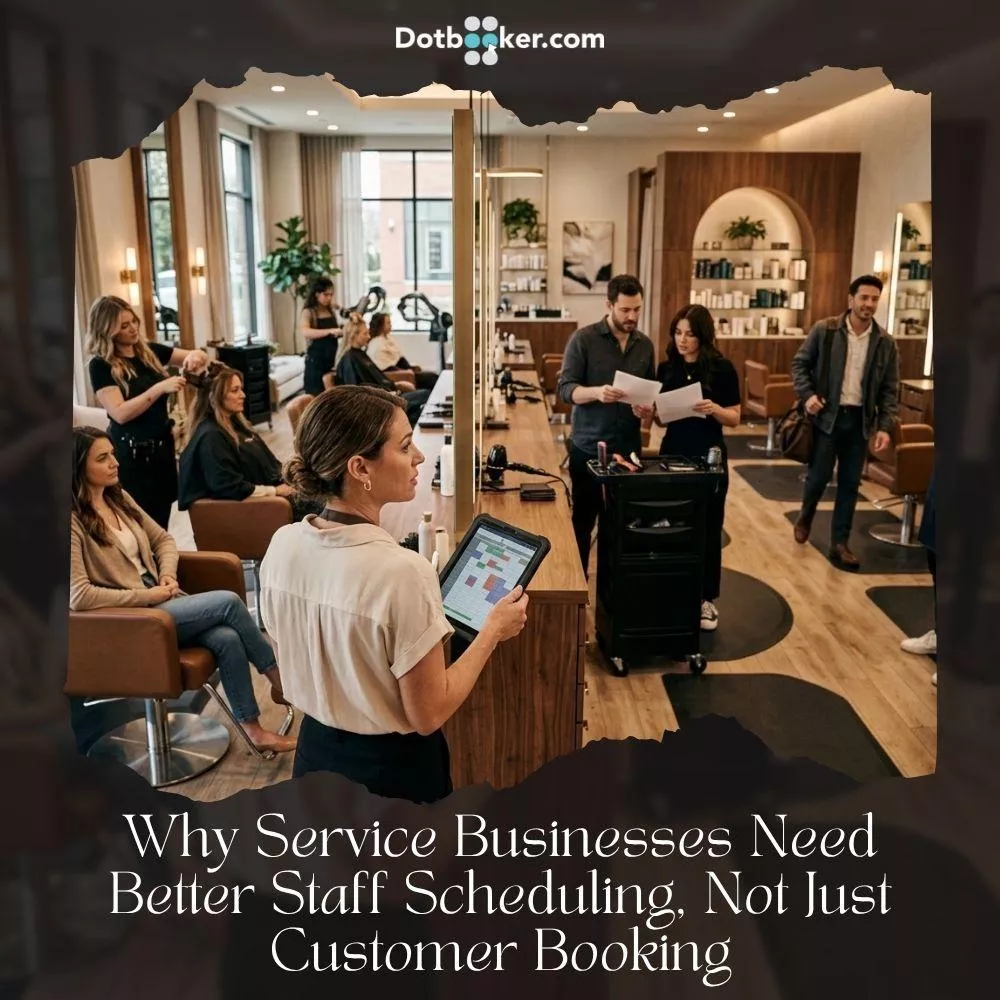
Why Service Businesses Need Better Staff Scheduling, Not Just Customer Booking
The Booking Looks Simple. The Back-End Reality Does Not.
A customer books a massage at 4 PM. Another book a haircut at 4:15 PM. A third book a fitness class for the evening. From the customer’s side, everything feels smooth. They choose a service, pick a time, receive confirmation, and move on with their day.
But inside the business, a different question appears.
Who is actually available?
That one question can decide whether the day runs smoothly or turns into a chain of last-minute calls, rushed employees, delayed services, double bookings, and unhappy customers.
This is the part many service businesses miss. Online booking is only the front door. Staff scheduling is what keeps the whole operation standing once customers walk in.
For salons, spas, wellness centers, fitness studios, clinics, pet care businesses, repair services, and other appointment-based businesses, customer bookings alone are no longer enough. The real strength comes from knowing exactly who is working, what they can do, when they are available, and how much workload they can realistically handle.
That is why staff scheduling software has become more than an internal planning tool. It is now one of the most important parts of running a service business properly.
Staff Scheduling Software Completes Every Booking
A booking slot is not the same as service readiness
A booking calendar can show that 3 PM is open. But that does not always mean the business is ready to serve that customer.
- Is the right employee available?
- Does that employee have the required skill?
- Is the treatment room free?
- Is the chair, machine, equipment, or workspace ready?
- Is the staff member already assigned to another service?
- Will this appointment push the employee into overtime?
These questions matter because service businesses do not sell time alone. They sell time supported by people, skills, equipment, and experience.
A customer booking system helps customers book appointments. Staff scheduling software helps the business ensure appointments are handled properly.
The hidden gap between “booked” and “ready”.
Many businesses appear organized because their booking calendars are full. But behind that full calendar, managers may still be handling schedules manually through spreadsheets, messages, printed rotas, or memory.
That gap creates daily pressure.
- A stylist may be booked for a service they do not specialize in.
- A therapist may be assigned back-to-back treatments with no recovery time between them.
- A trainer may be unavailable, but the class remains open for booking.
- A front desk employee may not know about a shift change until the last minute.
- A manager may spend the morning fixing a schedule that should already be clear.
This is where employee scheduling software becomes valuable. It connects the people side of the business to the appointment side.

Why Manual Staff Scheduling Hurts Growth
The spreadsheet looks harmless until the day gets busy
At first, manual scheduling feels easy. A small team can manage shifts in a spreadsheet or shared message group. Everyone knows each other. Changes are handled quickly. The business feels manageable.
Then the business grows.
- More employees join.
- More services are added.
- More customers book online.
- More locations open.
- More part-time shifts enter the picture.
- More changes happen during the week.
Suddenly, the same spreadsheet becomes a daily risk.
One missed update can lead to a staffing gap. One wrong shift can affect several appointments. One forgotten leave request can create a customer service issue.
Manual scheduling does not usually fail loudly. It fails quietly, one small mistake at a time.
Managers lose time fixing the day instead of growing the business
When schedules are not clear, managers become problem-solvers all day long.
- They call employees to confirm shifts.
- They check who can cover an absence.
- They adjust bookings around staff availability.
- They respond to “Am I working today?” messages.
- They check who is trained for which service.
- They manage complaints when appointments are delayed.
This is not the best use of a manager’s time.
A good work schedule software gives managers one place to plan shifts, check availability, adjust coverage, and share updates with the team. It reduces confusion before the day begins.
The Hidden Cost of Poor Scheduling
It affects customers before they even complain.
Customers may not know what went wrong behind the scenes, but they can feel it.
- They feel it when the appointment starts late.
- They feel it when the staff member seems rushed.
- They feel it when the wrong person is assigned.
- They feel it when the front desk looks confused.
- They feel it when a service has to be moved or shortened.
A booking confirmation creates an expectation. Poor scheduling breaks that expectation.
For service businesses, customer trust is built through small moments. Starting on time, assigning the right employee, giving proper attention, and maintaining service quality are all connected to scheduling.
It affects employees more than owners realize.
Poor scheduling also creates pressure on employees.
Some employees may get too many busy shifts. Some may receive last-minute updates too often. Some may feel their availability is ignored. Some may be assigned services they are not comfortable performing. Some may work long hours without enough balance.
Over time, this can lead to frustration, burnout, and staff turnover.
This matters because service businesses depend heavily on employee performance. A tired or confused employee cannot consistently deliver the best experience to customers.
Staff Scheduling software helps create fairer, clearer, and more manageable schedules. Employees know when they are working, managers know who is available, and the business can avoid repeatedly overloading the same people.
Staff Scheduling Software Improves Service Quality
Every service needs the right person.
In service-based work, availability is only one part of the picture. Skill is just as important.
- A salon cannot assign every stylist to every treatment.
- A spa cannot assign every therapist to every massage type.
- A fitness studio cannot assign every instructor to every class.
- A clinic cannot assign every staff member to every treatment.
- A pet grooming business cannot assign every groomer to every breed or service.
This is why staff scheduling software should support skill-based planning.
The system should help managers match services with employees who are trained, available, and suitable for that appointment. This protects the business from awkward service mistakes and protects employees from being placed in situations they are not prepared for.
Better scheduling protects the quality of premium services
Premium services usually need more attention, more preparation, and more skilled staff. If a business treats all time slots equally, service quality can drop.
For example, a premium hair color treatment may need a senior stylist, extra time, and a proper gap between appointments. A deep-tissue massage may require a therapist trained in that technique. A private fitness session may need an instructor with a specific background.
When the schedule understands skills, service quality becomes more consistent.
Work Schedule Software Aligns Staff Demand
Busy hours should not surprise the business every week
Most service businesses have patterns.
- Salons are often busier before weekends and special events.
- Spas may see stronger demand in the evenings, on weekends, or during tourist seasons.
- Gyms and fitness studios often peak early in the morning and after work.
- Clinics may receive more bookings outside regular office hours.
- Pet grooming businesses may see seasonal demand before the holidays.
If staffing does not match these patterns, the business either overstaffs during quiet hours or understaffs during busy ones.
Both are costly.
Employee scheduling software helps managers plan around real customer behavior. Instead of guessing, they can schedule staff based on demand, service type, location, and availability.
Better planning means better use of paid hours.
Staff time is one of the highest costs in a service business. Every paid hour should support the business in some way.
If too many employees are scheduled during slow hours, payroll costs rise without enough revenue. If too few employees are scheduled during peak hours, customers wait, and revenue may be lost.
Better scheduling helps businesses place people where they are needed most.
This is especially useful for businesses in the Cayman Islands, the US, and Canada, where labor costs, customer expectations, and service quality standards can strongly affect profitability.
Staff Rota Software Simplifies Multi-Location Operations
Growth becomes harder when every branch runs differently
A single-location business can sometimes manage manual scheduling for a while. But once a business has multiple locations, scheduling becomes much more difficult.
- One branch may be fully booked, while another has staff available.
- One employee may work across locations.
- One manager may need to move coverage quickly.
- One location may have more demand for a specific service.
- One staff member's absence may affect several appointments.
Without staff scheduling software, this becomes hard to control.
A digital scheduling system helps owners and managers see staff coverage across locations. They can understand who is working where, which location needs help, and whether employees can be moved without creating conflicts.
Multi-location businesses need one clear view.
When each branch manages its own schedules, leadership loses visibility. This can lead to uneven staffing, inconsistent service levels, and poor use of employee time.
A connected scheduling system provides the business with a single view of operations. It helps maintain consistent standards across locations while still allowing each branch to manage its own daily needs.
For growing service businesses, this is not a small benefit. It is a serious operational advantage.
Staff Scheduling Software Supports Payroll Accuracy
Bad schedules create payroll confusion
Scheduling and payroll may seem like separate tasks, but they are closely linked.
- Scheduled hours affect expected pay.
- Extra shifts affect payroll.
- Over time, it affects the cost.
- Leave affects attendance records.
- Late changes affect manager approvals.
- Missed updates can lead to disputes.
When schedules are managed manually, payroll teams often need to verify hours through messages, timesheets, manager notes, and attendance records. This wastes time and increases the chance of mistakes.
A proper work schedule software helps create cleaner records. Managers can compare planned shifts with actual hours and reduce confusion before payroll is processed.
Clear records protect both the business and the employee
Employees want to be paid correctly. Businesses want accurate payroll costs. Managers want fewer disputes.
Better scheduling supports all three.
It gives everyone a clearer record of who was expected to work, who worked, and what changed during the pay period.
Employee Scheduling Software Needs Mobile Access
Service teams rarely sitting at a desk.
Staff in service businesses are usually active throughout the day. They may be serving customers, moving between rooms, checking equipment, handling classes, visiting clients, or helping at the front desk.
They need scheduling access that fits their work style.
Mobile-friendly employee scheduling software allows staff to check shifts, receive updates, request changes, and stay informed from anywhere.
This reduces the need for printed schedules, repeated calls, and long message threads.
Faster updates reduce daily confusion
Schedules change. That is normal.
- An employee may call in sick.
- A customer may reschedule it.
- A service may take longer than planned.
- A location may need extra coverage.
- A manager may need to adjust to a shift quickly.
With mobile scheduling, updates can be shared faster. Employees can see changes clearly, and managers do not need to depend on scattered messages.
Employee Scheduling Software Enables Controlled Shift Swaps
Flexibility should not create chaos.
Employees often need flexibility. They may request shift swaps, time off, or schedule changes. This is normal in-service businesses, especially with part-time staff, weekend workers, and rotating teams.
But uncontrolled shift swapping can create problems.
- The replacement employee may not have the right skill.
- They may already be working another shift.
- They may not be approved for that service.
- The manager may not know if the change happened.
- The booking calendar may not reflect the update.
Staff scheduling software can support shift swap requests while maintaining manager approval. This gives employees flexibility without putting the business at risk.
The goal is not strict control. It is clear control.
Good scheduling should not make employees feel trapped. It should make schedule changes easier to manage.
When employees can request changes properly, and managers can approve them with full visibility, the whole team benefits.
To understand how better staff coordination prevents appointment clashes, explore Dotbooker’s guide on smart scheduling and double-booking prevention.
Staff Scheduling Software Strengthens Compliance Records
Accurate records matter as the business grows.
Different regions have different rules around working hours, overtime, breaks, leave, and employment records. Businesses in the Cayman Islands, the US, and Canada may face different requirements, but one thing remains common: records matter.
A manual schedule can make it harder to track who worked, when they worked, and what changes were approved.
Digital staff scheduling software gives businesses a clearer record of shifts, availability, changes, and approvals. This can help reduce disputes and support better internal control.
Compliance is easier when scheduling is organized.
Scheduling does not replace legal advice or payroll compliance. But it does give businesses better data and clearer records.
For growing service businesses, this can make a big difference. What feels easy with a team of five can become difficult with a team of twenty, fifty, or more.
Choosing the Right Staff Scheduling Software
The right tool should fit real service business problems
A basic calendar is not enough. Service businesses need scheduling features that match daily operations.
Look for features such as:
- Shift planning
- Employee availability tracking
- Time-off requests
- Skill-based staff assignment
- Multi-location scheduling
- Mobile access
- Staff notifications
- Shift swap approvals
- Overtime visibility
- Calendar view
- Booking system connection
- Payroll-ready reports
- Role-based access
- Service and resource matching
The most useful staff scheduling software is not the one with the longest feature list. It is the one that helps the business avoid the problems it faces every day.
Booking and scheduling should speak to each other.
The best setup is when customer booking and staff scheduling work together.
- When a customer chooses a service, the system should know which employees can provide it.
- When a staff member is unavailable, the booking calendar should respond.
- When a shift changes, appointment availability should update.
- When a room or resource is already booked, the system should prevent conflicts.
This connection reduces manual checking and makes the business feel more professional from both sides.
How Staff Scheduling Software Prevents Chaos
Picture a spa on a busy Saturday.
The calendar is full. Customers arrive every few minutes. Two therapists are booked back-to-back. One employee requested leave, but the printed schedule was not updated. A couple’s treatment was booked, but only one suitable room is available. The front desk is trying to fix everything while customers are waiting.
This is not a customer booking problem. The bookings came in successfully.
This is a staff scheduling problem.
Now picture the same spa with proper staff scheduling software.
- The system knows which therapists are available.
- It knows who is trained for each treatment.
- It blocks unavailable employees.
- It helps avoid room conflicts.
- It gives managers a clear view of the day.
- It updates staff through notifications.
- It helps prevent overload before the day begins.
The customer still sees a simple booking experience. But behind the scenes, the business is far more prepared.
Why Staff Scheduling Software Drives Success
Staff scheduling used to be seen as a back-office job. Create the rota, send it to the team, adjust when needed, and move on.
That mindset no longer works.
Today, scheduling affects revenue, customer experience, employee satisfaction, payroll accuracy, manager time, and business growth.
An inadequate schedule can undermine the customer's journey, even if the booking system works perfectly. A strong schedule can make the business feel calm, organized, and dependable even on a busy day.
That is why staff scheduling software is becoming a core business tool, not just an extra for planning.
Work Schedule Software Powers Better Service
A great customer experience does not begin when the customer walks in. It begins when the business prepares properly behind the scenes.
That preparation depends on the schedule.
- The right person must be available.
- The right skill must be matched.
- The right time must be planned.
- The right resource must be ready.
- The right workload must be balanced.
This is where Dotbooker can help service businesses manage more than just bookings. With Dotbooker, businesses can consolidate customer appointments, staff schedules, services, resources, and daily operations into a single, clearer system.
For salons, spas, gyms, wellness studios, clinics, and other service-based businesses, Dotbooker helps reduce the gap between “customer booked” and “team ready.” It gives businesses better control over the moving parts that shape every service experience.
Because in the end, more bookings only matter when the business is prepared to deliver them well.
Staff scheduling is not just about filling shifts. It is about protecting the customer experience, supporting employees, controlling daily operations, and helping the business grow with fewer avoidable problems.
Popular Blogs

- Oct 20, 2022
- 6174
- Sep 08, 2024
- 5658

- Nov 11, 2022
- 5035

- Oct 13, 2025
- 4085
Ready to Transform
Your Business?

Get expert guidance to streamline your business operations.