
Salary Management Software for Commission-Based Service Teams

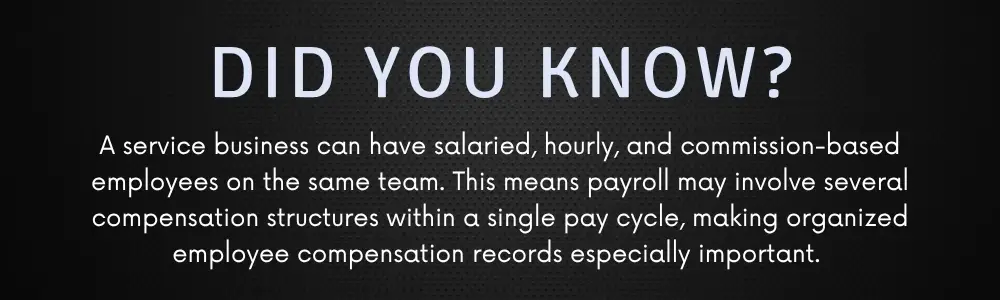
Paying employees sounds simple until everyone is paid differently.
- One employee receives a fixed salary.
- Another is paid by the hour.
- A stylist earns commission on services.
- A fitness trainer receives a bonus for certain sessions.
All of them work for the same business, but calculating their pay can involve very different steps.
This is common for Cayman salons, spas, wellness centers, fitness studios, and other service businesses where employee earnings may depend on working hours, services performed, commission arrangements, bonuses, or a combination of these.
As the team grows, managing all these calculations through spreadsheets can become difficult. Salary management software gives businesses a more organized way to manage different compensation structures and maintain clearer employee pay records.
Instead of asking, “How much do we pay this employee?” Every payroll cycle, the business can have a defined compensation structure for each team member.
Why Does Service Team Compensation Get Complicated?
Imagine three employees working at the same Cayman beauty business.
- Maya-Fixed monthly salary
- Chloe-Hourly pay
- Daniel-Base pay + service commission
They may work in the same business, but their earnings cannot necessarily be calculated in the same way. Now add:
- Different services
- Different working hours
- Bonuses
- Deductions
- Benefits
- Pension contributions
- Commission
- Changes in compensation arrangements
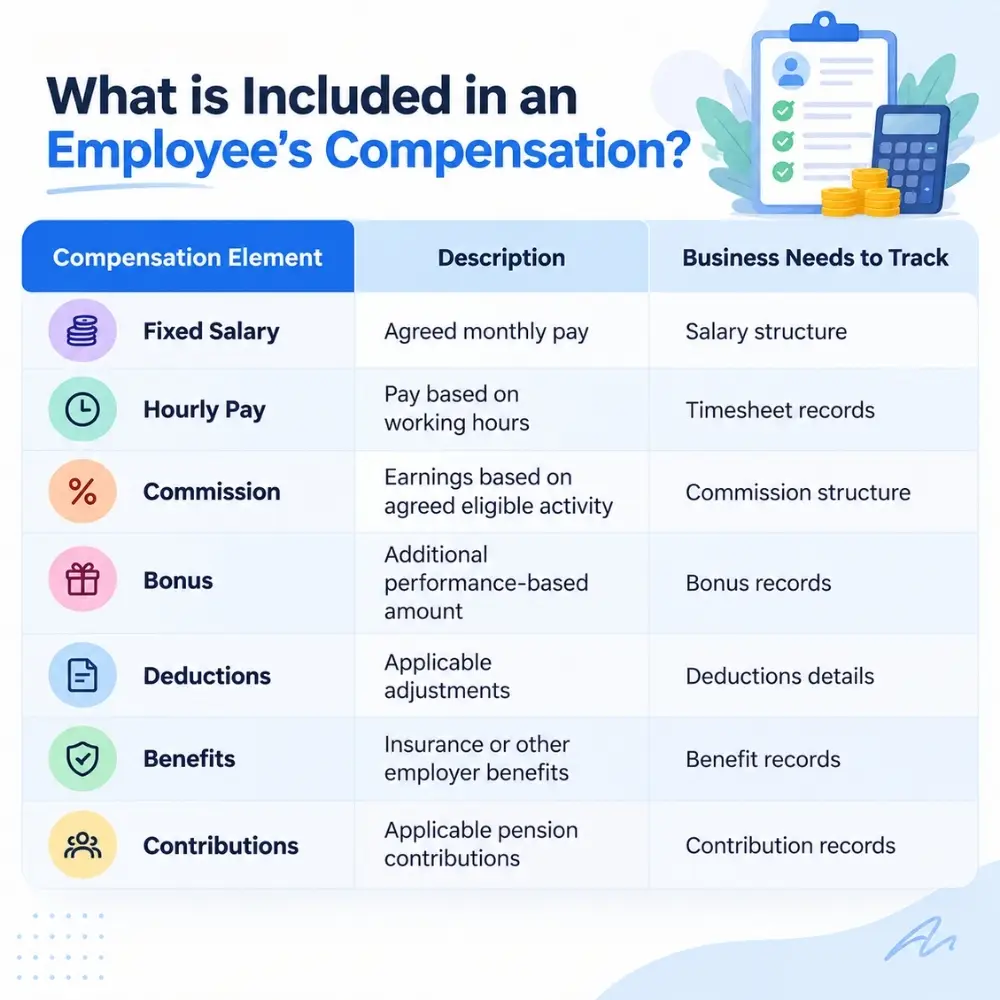
A spreadsheet may handle a few calculations initially. As the team grows and compensation rules become more varied, however, maintaining everything manually becomes harder. Employee compensation software gives businesses a more structured way to organize these different pay components.
Salary & Compensation Management feature supports customizable payroll structures for salaried, hourly, and commission-based personnel, as well as bonuses, deductions, insurance benefits, and pension contributions.
Fixed Salary vs. Commission: What Is the Difference?
A fixed salary is generally predictable. If an employee has an agreed monthly salary, the starting point for each payroll cycle remains consistent unless another adjustment applies.
The Commission works differently. Part of the employee's earnings depends on an agreed commission structure.
For example, imagine a beauty professional performs eligible services worth CI$5,000 during a period and the business's agreed commission arrangement pays 10% on those services.
For illustration:
Eligible Service Value: CI$5,000
Example Commission Rate: 10%
Commission: CI$500
That example is deliberately simple. Real compensation arrangements can include different eligibility rules, rates, bonuses, deductions, or base-pay structures.
This is why commission management software becomes valuable: the business needs a consistent method for applying its agreed compensation structure rather than relying on someone to reconstruct it manually every payday.
What Are the Benefits of Commission-Based Compensation?
The Commission is not automatically the right model for every employee or every Cayman service business. The compensation structure should fit the role, employment arrangement, business model, and applicable requirements.
When appropriate, however, commission-based compensation can offer several practical advantages.
Connect Earnings with Performance
When commission is based on clearly defined activity, employees can understand how qualifying work contributes to earnings.
Support Service Sales Goals
Businesses may use carefully structured incentives around particular services or performance objectives.
Creates Flexibility
A business does not necessarily have to choose between salary and commission. A team member might receive:
Base salary + commission
OR
Hourly earnings + incentive
OR
Another agreed structure.
Make Performance Conversations More Measurable
When compensation is linked to defined activities, managers and employees can discuss results using records rather than assumptions.
The important word here is defined. The Commission becomes much harder to manage when employees and managers do not have a clear record of how earnings were determined.
Commission Management Software Makes Service-Based Earnings Easier
The Commission becomes particularly interested in businesses where employees perform different services.
Imagine a stylist performs:
12 haircuts
6 colour treatments
4 styling services
3 other eligible treatments
Depending on the business's compensation arrangement, those services may contribute differently to earnings. If the calculation is being done manually, someone may need to gather records, identify qualifying activity, apply the appropriate compensation rules, and check the result.
Now repeat that process across ten employees. Commission management software can make a commission-based payroll structure easier to administer because compensation rules and employee pay types can be handled within a structured system.
For employees, clearer records can also make it easier to understand how compensation was determined.
For management, it reduces dependence on scattered calculations.
What About Bonuses and Incentives?
The Commission is only one type of variable compensation. A Cayman service business might also use bonuses or incentives based on its own compensation policies. For example, an employee might have:
Base Pay
Commission
Performance Bonus
− Applicable Deductions
= Compensation for the Period
This is where employee compensation software becomes more useful than a basic salary list. Compensation features specifically accommodate bonuses and deductions alongside different payroll types. The objective is not to make compensation more complicated. It is to make an already varied compensation structure easier to manage.
Working Hours Still Matter in Commission-Based Teams
The Commission should not make working time invisible. An employee may generate strong service revenue while also working significantly longer hours than another team member. That gives the business two different pieces of information:
What did the employee earn?
AND
How much time did the employee work?
For businesses using hourly components or where working-time records are relevant to payroll, timesheets become particularly useful.
Timesheet Management feature tracks employee working hours and attendance and is designed to support accurate records and payroll. A staff payroll software setup becomes more informative when compensation records can be considered alongside actual employee working time.
From Service Performed to Commission Earned
For a commission-based employee, the service itself can become an important part of the compensation process. Imagine a beauty professional who performs several types of eligible services during a pay period. At payroll time, the business needs to determine compensation according to its agreed commission structure. When this is handled manually, someone may need to:
- Review the employee's activity.
- Identify relevant services.
- Apply the agreed commission structure.
- Add any applicable bonuses.
- Include relevant deductions.
- Review the final compensation.
Repeat this across several commission-based employees, and payroll becomes a significant administrative task. Commission management software helps create a more structured process for managing variable compensation instead of relying entirely on manual calculations.
Staff Payroll Software Can Reduce the Monthly Spreadsheet Hunt
Payroll day should not begin with:
- “Where is last month's commission sheet?”
- “Did anyone update Chloe's bonus?”
- “What hours did Daniel work?”
- “Which version of this spreadsheet is correct?”
Yet this is how compensation administration can develop when information lives in different places.
Staff payroll software helps businesses create a more repeatable process. It automates complex salary and compensation calculations and includes payroll deadline reminders. Its system also maintains records relating to salaries, insurance, and pension contributions for reporting purposes.
Reducing manual work does not mean payroll should never be reviewed. It means the person reviewing it can spend less time assembling basic information first.
Compensation Management System Can Create Clearer Records
Pay is personal, and employees understandably want confidence that their compensation has been calculated according to the agreed structure.
Managers need records they can review. That makes transparency important.
A compensation management system provides a more structured approach than informal notes and disconnected calculations. Salary management functionality as tracking fixed payments, bonuses, and deductions to support consistent compensation records. It also provides reporting records for salaries and contribution information.
For Cayman service businesses, maintaining organized compensation records can also make internal reviews and reporting easier.
Reducing Manual Calculations Is About More Than Saving Time
It is easy to think automation is only about speed. There is another benefit: consistency. Imagine calculating commission manually for 15 employees.
Even if each calculation takes only a few minutes, you still need to collect the right records, apply the right compensation structure, add bonuses, account for deductions, and check the result. Then you do it again next payroll cycle.
- Salary management software can make that process more repeatable.
- Commission management software helps organize commission-based structures.
- Employee compensation software helps businesses manage different compensation elements.
- And staff payroll software gives the business a clearer process for bringing those records into payroll.
The goal is fewer opportunities for information to become disconnected.
What Should You Look for in Salary Management Software?
If you operate a Cayman salon, spa, fitness studio, wellness business, or another service-based company, look beyond the ability to enter a monthly salary.
Ask whether the system can support the way your team is actually paid.
Multiple Payroll Structures
Your salary management software should be able to accommodate different employee arrangements where the business uses them. It supports salaried, hourly, and commission-based payroll types.
Bonuses and Deductions
A useful employee compensation software setup should provide a structured way to manage additional compensation elements.
Commission-Based Payroll
For teams using variable pay, commission management software should support the business's defined commission compensation structure.
Timesheet Connection
Working-hour records can provide important context for hourly and mixed compensation structures.
Benefits and Contributions
A broader compensation management system may also need to handle applicable pension contributions and employer-provided benefits such as insurance.
Reporting
Compensation records should be easy for authorized managers to review when payroll questions or reporting needs arise.
Also Read the Blog: How Salon Management Software Can Simplify Your Daily Operations
Salary Management Software Match Team Actually Earns
A service team is rarely as simple as a list of employee names followed by monthly salaries.
One stylist may be salaried.
Another may work hourly.
A therapist may have a commission-based arrangement.
A trainer may receive a bonus.
And working hours may still need to be recorded alongside all of it.
That is why the right salary management software needs to reflect the compensation structures a business actually uses.
Dotbooker brings Salary & Compensation Management together with Employee Management and Timesheet Management, helping Cayman service businesses organize salaried, hourly, and commission-based payroll structures alongside bonuses, deductions, benefits, working-hour records, and employee information.
With commission management software, variable earnings become easier to administer. A structured compensation management system creates clearer compensation records, while connected employee and timesheet information gives payroll better operational context.