- By Dotbooker
- Feb 02, 2026
- 1127
How Staff Scheduling Software Is Transforming Workforce Management in 2026
In the past, managers lived with handwritten whiteboards and highlighters in their pockets. Instead of being a strategy, scheduling was a juggling act. For each designated shift, there was a coin toss between accuracy and chaos. The workplace has evolved in 2026. Employees expect clarity. Managers need to be adaptable. Businesses need to move quickly.
The hidden revolution driving contemporary workforce management solutions is staff scheduling software, which is more than just a tool.
This isn't a manual. You get to see firsthand how we're changing the way we operate.
Why Manual Scheduling No Longer Works in Modern Workforce Management
Before diving into the benefits, it’s important to remember why change was necessary in the first place.
Traditional scheduling was a logistical nightmare:
- Managers spent hours each week juggling staff availability, peak hours, and time-off requests.
- Shifts were often misaligned with actual business demand, causing either overstaffing (wasted payroll) or understaffing (customer dissatisfaction).
- Employees had limited visibility or input into their schedules, leading to missed shifts, frustration, and high turnover.
- Compliance with labor laws (overtime limits, rest periods, etc.) was hard to enforce manually.
These problems weren’t just “inconveniences”; they translated to real business losses in time, morale, and money.
The Strategic Power of Intelligent Employee Scheduling Software
What if you could turn your weekly schedule routine into a tactical advantage rather than a logistical burden?
In 2026, employee scheduling software will do just that.
This is a fundamental change in how organizations function, not merely a flashy technological advancement. From being a reactive task to a proactive approach, scheduling has changed. Businesses are gaining a new level of control, flexibility, and insight through the integration of digital tools across every aspect of operations.
Today's shift scheduling software handles the heavy lifting and more, in contrast to antiquated methods that required managers to chase shift confirmations or rush to cover last-minute gaps constantly.
Here’s what sets it apart:
- Smart Preferences Engine: The system automatically considers each worker's roles, qualifications, preferred shifts, and availability. The system respects these limitations while maximizing coverage, whether the user is a yoga instructor who avoids weekends or a massage therapist who works mornings.
- Real-Time Conflict Resolution: If a shift is unfilled or someone calls in sick, the system immediately identifies the issue and offers quick fixes. It's like having a never-sleeping scheduling assistant.
- Predictive Staffing Analytics: The software predicts how many employees you'll need and when, based on past data such as peak sales days, seasonal trends, and no-show rates. No more underestimating rush hours or overstaffing on slack days.
- End-to-End Ecosystem Integration: Schedules are no longer independent. The system easily interfaces with your leave modules, attendance records, and payroll tools. This guarantees precise tracking, processing, and compliant payment of each authorized hour worked.
Fundamentally, intelligent scheduling is more about maximizing interaction among your people, processes, and performance than about filling gaps. It's a strategic control panel for your company, not just a tool.
How Staff Scheduling Software Gives Managers Complete Control and Clarity
Being a manager in 2026 is no easy task.
You are in charge of workers who are dispersed throughout branches or departments. While some have set timetables, others alternate between different responsibilities. While some are only accessible on weekends, others prefer working at night. And just when you think you've figured it out, someone asks for an emergency leave of absence.
It's mayhem without the proper tools. It's a controlled, deliberate process supported by contemporary staff scheduling tools.
Here’s how:
- Skill-Based Shift Assignment: Do you require a senior therapist or qualified technician during particular hours? To guarantee that you never sacrifice quality, you can select and assign based on certifications, expertise, or service categories.
- Dynamic Availability Tracking: Without having to go through emails or messages, managers may quickly see who is available, on leave, previously scheduled, or working overtime.
- Compliance-First Rule Setting: Labor laws vary by region, especially across the US, Canada, and the Cayman Islands. The software helps enforce those laws by setting rules such as mandatory breaks, daily work-hour limits, and rest periods between shifts.
- Automated Shift Templates & Forecasting: You can save time by using preset templates (e.g., "Weekend Rush" or "Holiday Peak") and then duplicating or adjusting them as needed for upcoming periods. Bonus: the software gives forecasts based on historical performance data.
But perhaps the most significant shift? Managers no longer operate in isolation. They operate with visibility, flexibility, and confidence, which results in better business outcomes and happier teams.
Key Employee Scheduling Software Benefits: Retention, Fairness, and Flow
The best scheduling systems not only solve issues but also prevent disengagement.
Giving your employees more control over their schedule is also one of the quickest methods to build their trust in 2026.
The days of team members looking at a notice board taped behind a water cooler to find out their schedule are long gone. The best employee scheduling software available today has user-friendly, mobile, and empowering features for employees:
- Personal Schedule Access: Employees can log in via desktop or mobile app to check upcoming shifts, request time off, and confirm assignments.
- Availability & Preferences Management: Whether someone prefers morning shifts, only works weekends, or wants alternate Fridays off, they can submit their preferences in advance, and the system remembers.
- Requests for Coverage & Shift Swaps: Must respond to a family emergency? Employees can submit a swap request using the integrated shift switch tools. There is no need for hurried coordination; only qualified, available coworkers are informed, and the manager only needs to approve the best fit.
- Notifications & Reminders: Automated reminders lower late logins and no-shows. Employees are always informed about schedule changes, approval confirmations, and shift updates.
This type of autonomy produces quantifiable results:
- Higher rates of shift fulfillment
- Decreased absenteeism
- Increased employee engagement and morale
- Reduced turnover (particularly in service sectors like hospitality, wellness, and retail)
And remember, autonomy isn’t just a perk. It’s a differentiator in competitive job markets.
Managing Multi‑Location Teams with Cloud‑Based Staff Scheduling Software
When you're managing a single outlet, miscommunication is annoying. When you're managing multiple branches across different cities or countries, it's a threat to your operations.
Imagine you’re running:
- A chain of physiotherapy clinics across Ontario and New York
- A wellness resort in Grand Cayman with a sister facility in Toronto
- A growing franchise of gyms across the Caribbean and Florida
Without centralized visibility, you’re flying blind.
Modern cloud-based staff scheduling software solves that by putting everything in one place, visible, sortable, and actionable.
You can:
- View live shift activity at any location
- Compare staffing levels by day, team, or service line.
- Immediately identify understaffed or overstaffed branches.
- Detect patterns (e.g., one location always requests last-minute coverage)
Because it’s cloud-based, all this data is accessible from anywhere, on a laptop, tablet, or phone.
Does your 6 PM yoga class in George Town have an instructor? Log in, check, reassign if needed, and send a push notification, all within minutes.
This operational clarity doesn’t just make life easier for managers; it creates a better experience for staff and customers alike.
Reducing Operational Risk with Automated Scheduling Tools
Let's be honest: most managers don't have the time to monitor overtime regulations, adjust every shift, or double-check every break. Automation takes control in this situation and provides exceptional value.
Automation is the engine that drives everything behind the scenes in today's scheduling systems, not just a gimmick:
- Auto-Fill Smart Schedules: Based on preferences, roles, availability, and historical demand, the system automatically fills shifts, adhering to all constraints you’ve set.
- Break management lowers the risk of burnout and non-compliance by automatically inserting breaks into shifts in accordance with labor rules and corporate policy.
- Proactive Conflict Alerts: The system notifies you in real time before an error occurs if a shift is overbooked, exceeds overtime restrictions, or leaves a coverage gap.
- Multi-Site Optimization: The program ensures that an employee's schedule doesn't inadvertently overlap when they work across multiple branches or roles.
- Automated Communications: By escalating unresolved issues, sending reminders to employees, and informing teams of updates, the system frees managers from having to follow up constantly.
The result? Hours saved every week, fewer errors, and a business that operates like clockwork even during peak times.
For scaling businesses, this isn’t just useful; it’s essential for dealing with daily payment integration systems.
3 Profit-Driving Benefits of Staff Scheduling Software You Can’t Ignore
Behind every smart workforce is a smarter schedule. Beyond smoother operations and happier staff, modern staff scheduling software plays a direct role in improving your bottom line.
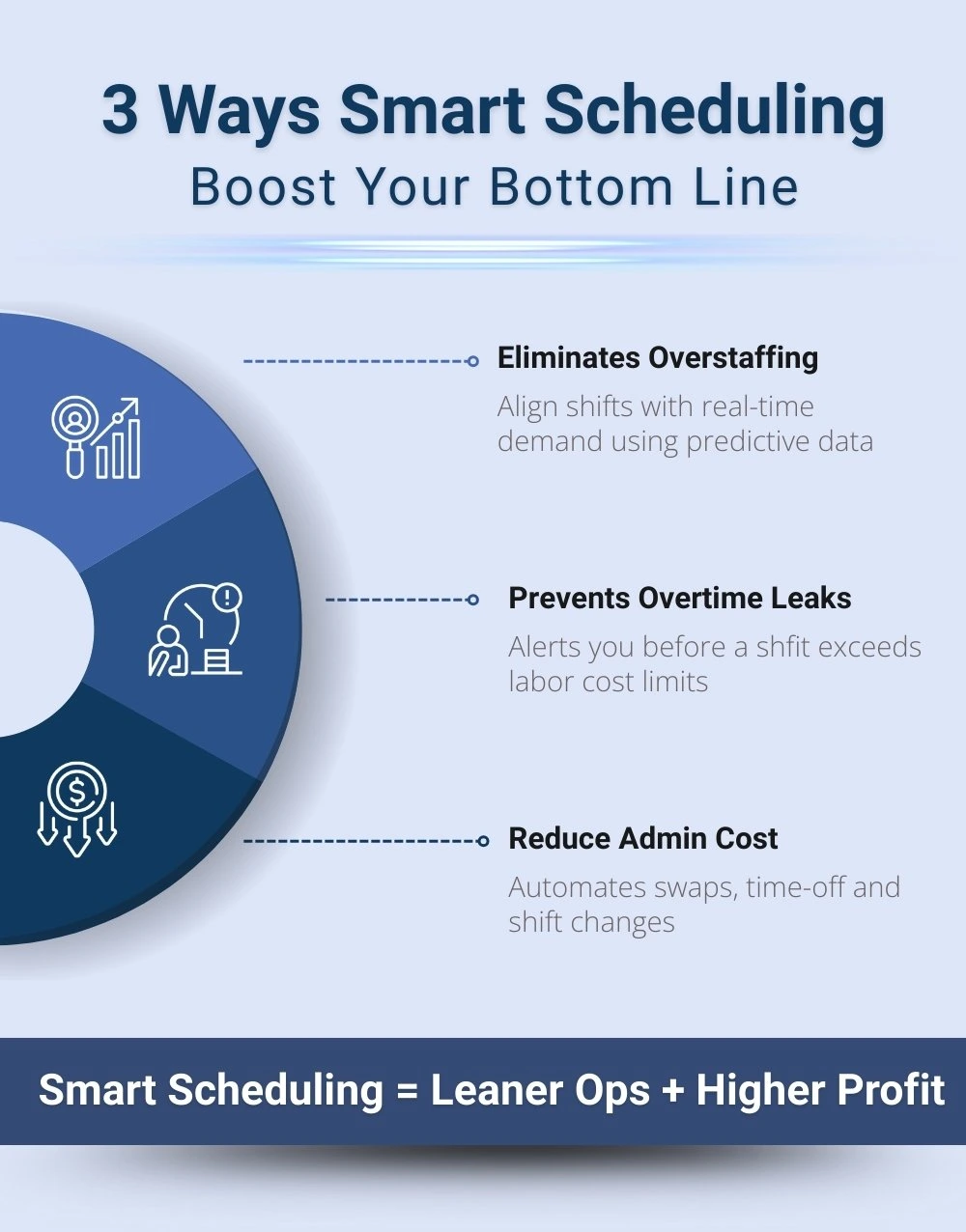
Image Text: 3 Ways Smart Scheduling Boosts Your Bottom Line
- Eliminates Overstaffing: Align shifts with real-time demand using predictive data.
- Prevents Overtime Leaks: Alerts you before a shift exceeds labor cost limits.
- Reduces Admin Costs: Automates swaps, time-off, and shift changes; no manual chasing.
Here’s how it translates into tangible cost savings and operational efficiency:
1. Eliminates Overstaffing with Predictive Insights
No more guesswork. Using historical trends, sales data, and real-time analytics, automated staff scheduling software accurately aligns staffing levels with actual guest or customer flow. That means you're not paying for idle hours—and your customers aren’t left waiting during peak times.
2. Prevents Costly Overtime Leaks
The system actively monitors shift lengths and cumulative hours. If any staff member is at risk of entering overtime, managers are alerted before the shift starts. This allows proactive rescheduling, helping businesses stay compliant with labor laws while controlling unnecessary payroll spikes.
3. Reduces Admin Load and Hidden Costs
Manual shift swaps, time-off requests, and schedule updates typically consume hours of management time. With integrated shift scheduling software, these actions are streamlined, automated, and require minimal supervision. The result? Lower administrative overhead, fewer scheduling errors, and more time for strategic decision-making.
Why Workforce Management Tools Are a Competitive Advantage in 2026
In this new era of work, success doesn’t come from working harder; it comes from working smarter.
Businesses that still rely on static rosters and manual scheduling processes are falling behind. They struggle with:
- Higher staff turnover
- Lower productivity
- Increased admin load
- Poor employee satisfaction
In the meantime, the following people are using contemporary shift scheduling software:
- Growing more quickly
- Providing reliable service
- Recruiting and keeping elite talent
- Proactively controlling labor expenses
Technology isn't the only factor here. It has to do with change.
How Dotbooker Simplifies Scheduling with Smart Workforce Management Tools
At Dotbooker, we understand that scheduling isn't just a back-office task; it's the pulse of your business. That’s why our platform is designed to give you full control, total visibility, and unmatched flexibility across all your locations and services.
Whether you're running a wellness retreat, a physiotherapy chain, or a boutique fitness studio, our cloud-based, automated staff scheduling features let you:
- Build recurring or custom shifts
- Empower your team with self-service
- Balance staffing across multiple service lines
- Avoid burnout and overbooking
- Sync seamlessly with your payroll and reports
In short, Dotbooker helps you simplify the complex, so you can focus on what matters: growing your business and delighting your clients.
Because in 2026, efficiency isn’t a luxury, it’s your greatest strength.
Popular Blogs

- Oct 20, 2022
- 6074
- Sep 08, 2024
- 5554

- Nov 11, 2022
- 4931
- Oct 13, 2025
- 3987
Ready to Transform
Your Business?

Get expert guidance to streamline your business operations.