
How Business Reporting Software Helps Service Owners Make Better Daily Decisions

A service business does not usually fall behind because of one big mistake.
It happens in quieter ways.
A few empty appointment slots go unnoticed. A popular service stays underpriced for too long because the owner does not have clear sales and demand reports. A staff member remains fully booked while another has too many open hours. A discount campaign brings traffic but does not repeat customers. The owner feels the business is busy, yet the cash flow does not feel as strong as it should.
That is the tricky part about running a service business. Activity can look like progress. A packed calendar can look like a profit. More bookings can look like growth.
But smart owners know one thing clearly: what you do not measure can quietly cost you money.
This is where business reporting software becomes a daily advantage. It helps service owners look beyond surface-level activity and understand what is happening inside the business. From sales and bookings to staff performance, client behavior, cancellations, payments, and service demand, reporting turns everyday business movement into decisions that are easier to trust.
For service businesses in the Cayman Islands, US, and Canada, where customer expectations are high and competition can be local, fast, and personal, better reporting is no longer just a management feature. It is a practical way to stay alert, responsive, and ready for the next decision.
Why Daily Decisions Need Business Reporting Software?
Every service owner starts the day with questions, even if they are not written down.
- Will today’s appointments convert into real revenue?
- Are we staffed properly for the busiest hours?
- Which clients need a follow-up?
- Did yesterday’s promotion actually work?
- Why are cancellations increasing this week?
- Which service takes too much time but brings too little return?
These questions may sound simple, but they are not always easy to answer when the business is moving quickly. A salon, spa, gym, wellness studio, clinic, repair service, beauty center, or fitness business can generate a lot of information in a single day. Bookings come in. Payments are processed. Clients reschedule. Staff members complete services. Packages are sold. Discounts are applied. Inventory is used. Reviews are received.
Without proper reporting, all of this information stays scattered.
One part sits on the booking calendar. Another sits in payment records. Some details are remembered by the staff. Some are stored in spreadsheets. Some are only noticed when something goes wrong.
Business reporting software brings those pieces together so owners can make better decisions without chasing information from different places.

Why Service Business Reports Matter Daily
Service businesses sell time, skill, trust, and experience. That makes them very different from product businesses.
If a product does not sell today, it can still be sold tomorrow. But if a 3 PM appointment slot stays empty, that earning opportunity is gone. If a class runs half-empty, the unused space cannot be recovered later. If a therapist, stylist, trainer, or consultant spends the day booked, those hours are lost.
This is why service business reports are so valuable. They help owners protect time, which is one of the most limited resources in any service-based operation.
Service Business Reports Reveal Real Business Health
Many service owners look at a full calendar and feel reassured. But a full calendar can hide serious questions.
- Are the bookings profitable?
- Are clients returning?
- Are discounts too high?
- Are the most valuable services being promoted?
- Are staff hours being used properly?
- Are peak slots filled with high-value appointments or low-margin work?
A full calendar filled with low-value services may not be as strong as a slightly lighter calendar with better-priced services, package sales, and repeat clients. Business analytics software helps owners see that difference.
Small Daily Gaps Can Become Monthly Losses
A missed follow-up may feel minor. A few cancellations may not seem alarming. One slow weekday may look normal. But over a month, these small gaps can become a clear revenue leak.
Reporting helps owners catch these patterns earlier. Instead of waiting until the end of the month to discover that sales have dropped, they can see what is changing during the week and respond sooner.
What Business Reporting Software Actually Shows
The true purpose of business reporting software is not to create more charts. Service owners do not need more noise. They need clear answers.
A good reporting system helps answer questions like:
- How much revenue did we generate today?
- Which services are best performed this week?
- Which staff members are fully booked?
- Which time slots are underused?
- Which clients have not returned?
- Which packages are selling?
- Which discounts are affecting revenue?
- Which services need a pricing review?
- Which payments are pending?
- Where are we losing our bookings?
That is the real value. It turns daily business activity into a clear view of what needs attention.
Business Analytics Software Reduces Daily Guesswork
Many service owners rely heavily on instinct. That instinct is valuable. It comes from experience, customer conversations, and years of understanding the business.
But instinct works better when it is supported by facts.
For example, an owner may feel that Saturdays are the best revenue days. Reports may show that Friday afternoons bring higher-value bookings. A spa owner may believe facials are the top service. Reports may show that massage packages create stronger repeat revenue. A gym owner may think evening classes are the strongest. Reports may reveal that early morning classes have better attendance consistency.
Business analytics software does not replace the owner’s judgment. It sharpens it.
Sales Reporting Software Improves Revenue Decisions
Sales are one of the first things service owners want to understand. But looking only at total sales can be misleading.
A business may have strong daily revenue, yet still have weak profit because of heavy discounts, low-margin services, poor package structure, or inefficient staff planning.
Sales reporting software helps owners get deeper.
It Shows What Is Actually Selling
A daily sales report can show which services, packages, memberships, products, or add-ons are bringing revenue.
For example, a salon may discover that hair color services are performing well, but after-care product sales are low. A spa may find that couple packages sell well on weekends, while individual treatments perform better during weekdays. A fitness studio may notice that personal training sessions bring stronger income than general classes, but classes bring better member retention.
Once owners understand what is selling, they can promote smarter, price better, and train staff more effectively.
It Reveals Which Services Deserve More Attention
Not every popular service is profitable. Some services take too long. Some require expensive supplies. Some need highly skilled staff. Some attract one-time customers but do not create repeat visits.
Sales reporting software helps owners compare revenue with time, demand, and customer behavior.
If a service is popular but not profitable, it may need a price change, shorter duration, better packaging, or a different promotional strategy.
It Helps Owners Stop Overusing Discounts
Discounts can bring short-term traffic, but they can also train customers to wait for offers. Service business reports can show whether discounts are helping or hurting.
Owners can review which discounts bring repeat clients, which offers only attract one-time visitors, and which promotions reduce average order value.
This helps businesses move away from random discounting and toward offers that support long-term revenue.
Business Analytics Software Tracks Customer Behavior
Clients do not always tell you why they return, why they stop booking, or why they choose one service over another. But their behavior leaves clues.
Business reporting software helps service owners read those clues.
New Clients vs Returning Clients
A business may celebrate new customers, but repeat customers often keep a service business stable. Reports can show whether growth is coming from new bookings, returning clients, or both.
If new clients are increasing but repeat visits are low, the issue may be service experience, follow-up, pricing, or lack of rebooking reminders.
If returning clients are strong, but new client growth is weak; the business may need better local marketing or referral campaigns.
Both stories matter.
Client Retention Becomes Easier to Track
Retention is not just a marketing metric. For salons, spas, gyms, clinics, and wellness businesses, it is one of the clearest signs of customer trust.
Business analytics software can help owners identify clients who have not returned within their usual time frame. This allows the business to send follow-ups, special offers, reminders, or personalized messages before the client is lost.
Preferences Can Shape Better Offers
Reports can also show what clients prefer.
- Which services are often booked together?
- Which packages are renewed?
- Which staff members have high repeat bookings?
- Which appointment times are most popular?
- Which services are seasonal?
These patterns help owners design better offers instead of guessing what customers might like.
To understand how reporting tools turn scattered data into clearer business decisions, read Dotbooker’s guide on how reporting software transforms business decision-making
Service Business Reports Improve Staff Planning
Staffing is one of the hardest parts of managing a service business. Too many employees on a slow day increase costs. Too few on a busy day creates delays, stress, and unhappy clients.
Service business reports make staff planning more practical.
Know When the Business Really Gets Busy
Owners can review booking patterns by day, hour, service, and staff member. This helps identify peak times and quiet periods.
A salon may need more coverage on Friday evenings. A spa may need more therapists on Saturday mornings. A gym may need more trainers before work hours and after office hours. A clinic may need extra support during specific days based on appointment volume.
When scheduling is based on reporting, owners can reduce idle time and improve service quality.
Staff Performance Becomes Easier to Understand
Reports can show staff-wise bookings, revenue, client retention, product sales, package sales, and rebooking rates.
This does not mean reports should be used only to judge employees. They should also help owners support employees.
For example, if one staff member has low rebooking numbers, they may need training in client communication. If another has strong package sales, their approach can be studied and shared with the team.
Better reports create better coaching conversations.
No-Shows and Cancellations Stop Feeling Random
Every missed appointment hurts a service business.
It blocks a time slot, wastes staff availability, and reduces daily revenue. But no shows or cancellations often follow patterns.
Business reporting software can help owners understand:
- Which services have the highest cancellation rates
- Which days are most affected
- Which time slots are often missed
- Which clients cancel repeatedly
- Whether reminders are reducing no-shows
- Whether deposits are helping
- Whether online bookings have different cancellation behavior
- Once the pattern is clear, the solution becomes easier.
A business may adjust reminder timing, change cancellation policies, require deposits for high-value appointments, or create a waitlist strategy to refill open slots quickly.
Without reports, cancellations may feel like bad luck. With reports, they become a pattern the business can understand and manage.
Business Reporting Software Improves Marketing Decisions
Marketing can easily become expensive when owners do not know what is working.
A campaign may look good online but bring very few paying clients. A discount may increase bookings but reduce profit. A social media promotion may generate interest but not repeat business.
Service business reports help owners connect marketing with real outcomes.
Look Beyond Likes and Impressions
For service owners, the real question is not only whether people saw the campaign. The better question is whether the campaign brought the right action.
- Did it increase bookings?
- Did it bring new clients?
- Did those clients return?
- Did package sales improve?
- Did revenue grow without hurting profit?
- Did the campaign fill slow time slots?
These answers help owners spend marketing money more carefully.
Campaigns Can Be Improved Faster
When reports show what worked, owners can repeat successful campaigns. When reports show weak results, owners can adjust quickly.
For example, a wellness studio may find that package promotions perform better than single-session discounts. A salon may learn that seasonal hair treatment campaigns bring better repeat bookings. A gym may see that referral offers attract more loyal members than general discounts.
Reporting gives marketing a clearer purpose.
Service Business Reports Help Protect Profit
Revenue is exciting, but profit keeps the business stable.
A service business can look successful from the outside and still struggle with margins. This often happens when owners focus only on total sales.
Business analytics software helps owners review the details behind profit.
Service Duration Matters
If a service takes too long compared to its price, it may reduce earning potential. Reports can help owners identify which services use more time than they should.
For example, a 90-minute service may look profitable because the ticket price is higher. But if two 45-minute services bring more revenue and better repeat bookings, the longer service may need to be reviewed.
Packages Need Careful Tracking
Packages can improve cash flow, but they must be structured properly. If a package includes too many free add-ons or deep discounts, it may reduce profit over time.
Business reporting software can show package sales, usage, renewals, and revenue impact. This helps owners decide which packages to continue, adjust, or replace.
Inventory and Product Usage Can Affect Margins
For salons, spas, clinics, and wellness businesses, product usage matters. High supply costs can reduce service profit.
Reports can help owners identify services that consume more products, track retail sales, and understand whether inventory is being used wisely.
Business Reporting Software Supports Multiple Locations
For owners managing more than one location, reports become even more important.
Each branch may have a different customer profile, staff mix, service demand, and revenue pattern. One location may perform well with memberships. Another may depend more on walk-ins or premium appointments.
Business reporting software helps owners compare locations without confusion.
They can review:
- Location-wise revenue
- Branch-wise bookings
- Staff performance by location
- Popular services in each branch
- Cancellation rates
- Peak hours
- Package sales
- Payment collections
- Customer retention
This allows owners to make decisions based on each location’s reality.
A location in a busy downtown area may need fast-moving services and tight scheduling. A location in a quieter neighborhood may need retention campaigns and package-based offers. A tourist-heavy area may need seasonal pricing and stronger online booking visibility.
Reports help owners avoid treating every location the same when each one needs a different strategy.
Choosing Business Reporting Software for Service Owners
Not every reporting tool is suitable for service businesses. Some tools are too complex. Some focus heavily on finance but miss bookings and staff performance. Some require manual entry, which creates extra work.
The best reporting system should feel practical, clear, and connected to daily operations.
Must-Have Reports for Service Businesses
Service owners should look for reports such as:
- Daily sales reports
- Booking reports
- Service-wise revenue reports
- Staff performance reports
- Client retention reports
- New vs returning client reports
- Package and membership reports
- Payment reports
- Discount and coupon reports
- No-show and cancellation reports
- Inventory or product usage reports
- Location-wise reports
Useful Filters Make Reports More Powerful
Reports become more useful when owners can filter information by:
- Date
- Location
- Staff member
- Service
- Customer type
- Payment method
- Package
- Campaign
- Booking source
These filters help owners move from broad numbers to specific answers.
Reports Should Be Easy to Read
A report is only useful if the owner can understand it quickly.
Service owners do not always have time to study complicated data screens. They need clear dashboards, simple summaries, and practical breakdowns that help them act.
The best reporting tools make decision-making easier, not heavier.
Dotbooker Simplifies Service Business Reports
For appointment-based and service-led businesses, reporting works best when it is connected to the same system used for bookings, clients, staff, payments, packages, and daily operations.
That is where Dotbooker can help.
Dotbooker supports service businesses such as salons, spas, gyms, wellness centers, yoga studios, dance studios, cycling studios, physical therapy practices, nutritionists, tattoo studios, massage centers, and other booking-based businesses with tools for appointment scheduling, client management, staff management, packages, payments, POS, and reporting.
Instead of forcing owners to depend on scattered spreadsheets or disconnected systems, Dotbooker helps bring key business activity into one organized platform. This makes it easier to review bookings, track sales, understand client behavior, manage staff schedules, monitor package activity, and make better decisions from daily reports.
For business owners in the Cayman Islands, US, and Canada, this kind of clarity can be especially useful. Whether the business is managing local customers, seasonal demand, repeat appointments, memberships, or multi-location operations, having better reporting can help owners respond faster and plan with more confidence.
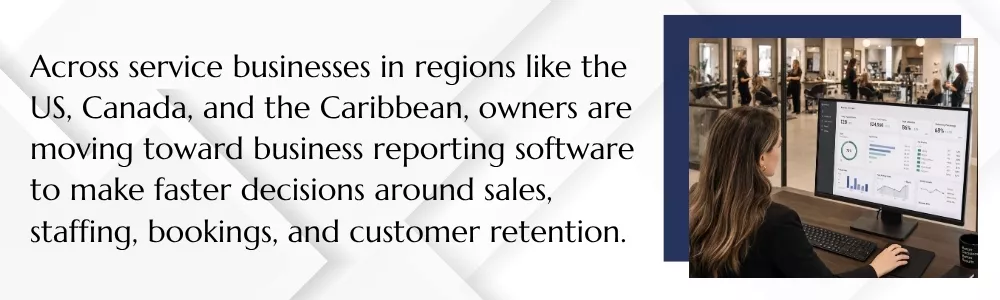
Business Reporting Software Creates Clearer Decisions
A service business does not need more confusion. It needs clearer signals.
- Which service is growing?
- Which client needs a follow-up?
- Which staff member needs support?
- Which package is working?
- Which discount is hurting revenue?
- Which time slot needs promotion?
- Which location needs attention?
These are the questions that shape daily decisions.
Business reporting software gives service owners a better way to answer them. It turns everyday business activity into useful information, helping owners manage sales, bookings, staff, clients, payments, and performance with more confidence.
With the right business analytics software, clear service business reports, and practical sales reporting software, owners can stop relying only on memory or guesswork. They can make decisions based on what the business is actually showing them.
And with Dotbooker, service owners get more than appointment management. They get a platform that helps connect daily operations with the reports needed to run smarter, serve better, and grow in a clearer direction.