- By Dotbooker
- Apr 13, 2026
- 942
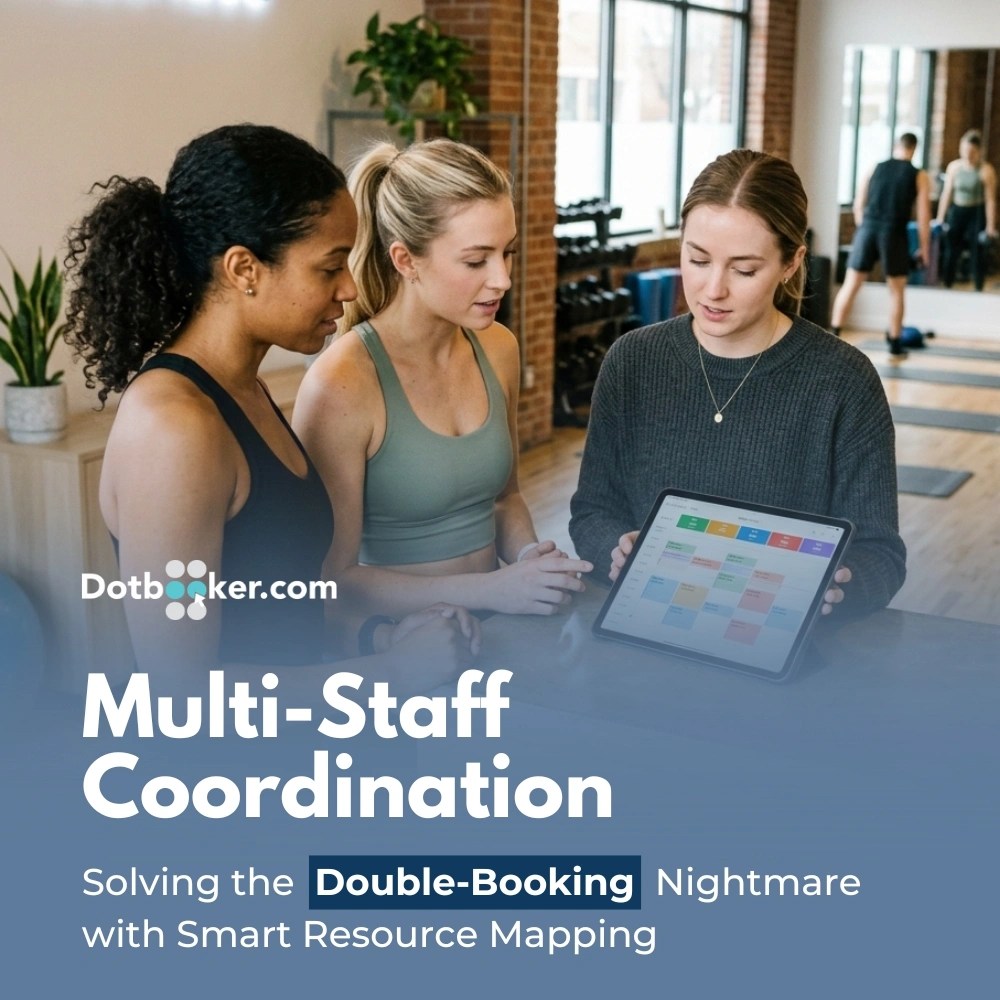
Multi-Staff Coordination: Solving the "Double-Booking" Nightmare with Smart Resource Mapping
Every service company has gone through that awkward situation. When a customer shows up, they expect their appointment to start on schedule, but the employee they reserved is already occupied with another customer. The space needed for the service is already occupied. As they attempt to adjust the timetable, someone has to apologize since confusion swiftly spreads among the crew.
These situations often begin as small administrative errors, but their impact goes far beyond scheduling. Double bookings affect customer confidence, disrupt team productivity, and create unnecessary stress for employees who are simply trying to do their jobs well.
The good news is that managing a busy service firm does not inevitably include scheduling problems. Businesses can improve the clarity and coordination of their everyday operations by implementing intelligent Calendar Sync, automated Staff Scheduling, and structured Resource Management. To ensure that appointments align with actual availability, modern solutions such as Dotbooker help enterprises accurately map their resources.
This shift transforms booking systems from simple calendars into intelligent coordination tools that keep teams organized and customers satisfied.
The Double-Booking Problem in Service Operations That Many Businesses Underestimate
Many service providers believe that multiple bookings are sporadic mishaps caused by overworked receptionists or simple human error. That explanation seems plausible at first glance. After all, an employee may unintentionally select the incorrect time slot or neglect to verify availability before scheduling an appointment.
However, when these conflicts become more common, the problem is typically more complex than a single error. Double bookings frequently highlight fundamental flaws in the management of appointments, staff availability, and service resources.
Consider a wellness studio that offers massage therapy, physiotherapy, and relaxation treatments. At first glance, booking a client may appear to involve nothing more than selecting a time slot. In reality, each appointment depends on several operational elements working together simultaneously.
A single booking may require:
- The correct therapist who specializes in that service
- A treatment room equipped for the procedure
- Specialized tools or equipment
- A service duration that includes preparation and cleanup time
A booking system operates on assumptions rather than actual operational capacity when it merely tracks client appointments and ignores the availability of those resources.
Imagine a normal situation.
Using the online booking system, a client schedules a massage with a professional for 4 PM. Meanwhile, another team member schedules a physiotherapy session at the same time because the calendar appears open. What the system does not recognize is that both services require the same treatment room.
Individually, both bookings seem perfectly valid. Together, they create a scheduling conflict that only becomes visible once the appointment time approaches.
At that point, the team faces an uncomfortable decision. Someone must reschedule the client, reassign the client to a room, or delay the service. Each option creates friction that could have been avoided earlier.
This is why strong Conflict Resolution mechanisms and intelligent scheduling tools play such an important role in modern service businesses. When systems use proper resource mapping, they detect conflicts before appointments are confirmed.
Instead of reacting to scheduling problems after they occur, the system prevents them from entering the calendar in the first place.
Why Growing Businesses Face More Scheduling Conflicts Without Proper Resource Management
When a company first starts, scheduling might seem easy. A simple calendar or even a notebook can be used to quickly keep track of appointments in a tiny salon with just one stylist and one chair. The operational environment is still predictable at that point.
However, scheduling complexity rises quickly as firms expand.
Consider a salon growing from one stylist to five experts. Suddenly, the business must manage multiple chairs, service stations, and overlapping schedules. Add services like hair coloring, treatments, styling sessions, and consultations, and the number of variables multiplies quickly.
Now imagine the same challenge in a wellness center, therapy clinic, or fitness studio where services depend on multiple staff members, rooms, and equipment.
Each appointment might depend on several operational conditions working together:
- Staff availability
- Service duration
- Room allocation
- Equipment availability
- Preparation and cleanup time
These variables must align perfectly for a service to run smoothly.
Without structured Resource Management, these elements remain disconnected. The booking system may see an open time slot on the calendar, yet it cannot verify whether the necessary staff member, room, or equipment is actually available.
The result is a scheduling system that appears functional but frequently produces conflicts behind the scenes.
This explains why many growing businesses eventually reach a tipping point. Manual scheduling methods that once worked well suddenly begin creating operational chaos. Staff members spend more time fixing scheduling issues than focusing on delivering great service.
At this stage, businesses realize that reliable scheduling requires a system capable of coordinating multiple resources simultaneously.
Resource Management Strategies for Reliable Staff Scheduling and Appointment Coordination
One fundamental idea underpinning reliable scheduling is that all services rely on resources.
Modern scheduling systems prioritize structured resource management above treating appointments as discrete calendar entries. This approach tracks every operational element required to deliver a service successfully.
A properly configured system recognizes that a booking involves much more than selecting a time slot. It considers all supporting resources needed to complete the service.
These typically include:
- Staff members and their working hours
- Service rooms or locations
- Equipment or tools required for specific services
- Service duration and preparation time
- Maximum capacity for classes or group sessions
Once these resources are mapped into the system, every booking request is automatically evaluated against real availability.
For example, the system instantly stops another service from being scheduled in the same location if a treatment room is already reserved for a specific time window. Similarly, the system prevents overlapping bookings if a therapist is already working with another client.
This automated verification eliminates guesswork in scheduling.
Rather than relying on staff members to manually track resource availability, the system handles it intelligently in the background.
Businesses may handle these operational resources in a single, centralized setting through platforms like Dotbooker. The system guarantees that each reservation accurately represents operational capacity by combining staff schedules, service spaces, and equipment availability.
This methodical technique increases overall productivity while significantly reducing schedule problems.
Calendar Sync: How Connected Scheduling Systems Prevent Double Bookings
Disconnected calendars are one of the most common causes of scheduling errors in service businesses.
In many organizations, staff members maintain their own personal calendars while the business operates a separate booking system. Managers might track schedules on one platform, while reception staff manage appointments on another.
When these systems do not communicate with each other, availability information quickly becomes unreliable.
A staff member may block personal time on their phone calendar while the business booking system continues accepting appointments during that same period. By the time the conflict becomes visible, rescheduling becomes necessary.
Effective Calendar Sync solves this challenge by integrating all scheduling environments into a single synchronized system.
The staff member's availability is automatically updated on all linked calendars once a new reservation is made. In a similar vein, the booking platform instantly updates when a staff member marks time as unavailable due to meetings, training sessions, or personal obligations.
The organization as a whole benefits from synced calendars.
- Accurate availability tracking
- Reduced scheduling confusion
- Better coordination across departments
- Immediate updates when appointments change
- Clear visibility for managers and employees
With proper Calendar Sync, businesses eliminate the disconnect between personal schedules and operational calendars.
The result is a scheduling environment where everyone works from the same information.
Smart Staff Scheduling Techniques for Better Team Coordination and Service Operations
Assigning workers to shifts is only one aspect of effective staff scheduling. It necessitates awareness of each team member's strengths, availability, and ability to provide specific services.
Employees in many service-oriented businesses eventually acquire specialized knowledge. While one hairstylist specializes in sophisticated styling, another may concentrate on coloring techniques. Sports injuries may be the area of expertise for one physiotherapist, while rehabilitation therapy may be the focus of another.
Appointments may be issued incorrectly when scheduling systems disregard certain expertise, which could cause delays or unhappy customers.
Businesses can specify personnel availability based on operational characteristics using smart scheduling tools.
These include:
- Working hours and shift patterns
- Service specialization
- Maximum daily appointment capacity
- Break periods
- Preferred services
With these configurations in place, the system automatically assigns bookings to staff members who are both available and qualified for the service.
This type of intelligent Staff Scheduling keeps teams balanced and organized. Staff members receive appointments that match their expertise, while customers are connected with the right professionals for their needs.
Over time, this structured scheduling approach improves both service quality and operational efficiency.
How Smart Resource Management and Mapping Prevent Booking Chaos
Every operational component of a booking is connected by smart resource mapping. The system assesses the availability of all necessary resources at once rather than considering appointments as straightforward calendar entries.
Think about scheduling a spa treatment.
The appointment may require:
- A therapist
- A treatment room
- Specific equipment
- A defined service duration
The system determines whether each of these resources is available during the chosen time period before confirming the appointment.
The system either prevents the booking from being finalized or offers alternative times that align with the operational schedule if even one necessary resource is unavailable.
By taking a proactive stance, scheduling conflicts are avoided before they arise.
Businesses using Dotbooker benefit from this intelligent mapping system, which ensures bookings reflect real operational conditions rather than theoretical availability.
Instead of reacting to scheduling issues later, the system prevents them entirely.
Conflict Resolution Strategies for Handling Scheduling Disruptions in Service Operations
Unexpected interruptions can happen to even the most well-planned itinerary.
A therapist may miss work due to illness. Maintenance may be necessary for equipment. A client may request a last-minute scheduling modification. These occurrences can swiftly throw off a day's plan in the absence of organized processes.
Businesses can more easily adapt to these circumstances when they have strong conflict-resolution skills.
This technique is supported by automated support tools in contemporary scheduling systems.
These may include:
- Reassigning appointments to available staff members
- Suggesting alternative time slots for affected clients
- Sending alerts when resource conflicts appear
- Maintaining waitlists for sudden openings
- Updating schedules instantly when availability changes
By identifying conflicts early and automatically offering solutions, the system reduces stress on staff members and helps maintain operational continuity.
Optimizing Service Operations with Smart Scheduling and Resource Management
Customers seldom ever notice how complicated scheduling systems are when they work well. They merely encounter seamless service provision.
Carefully planned service operations are the foundation of any successful appointment schedule. Supervisors are responsible for maintaining a steady flow of appointments throughout the day, balanced staff schedules, and service spaces.
These operational choices are supported by real-time analytics from centralized scheduling platforms.
These insights may include:
- Staff workload distribution
- Appointment patterns during peak hours
- Room utilization rates
- Service demand trends
With access to this information, managers can make informed decisions about staffing levels, service offerings, and operational improvements.
If you want to understand how intelligent scheduling systems reduce human errors and prevent appointment overlaps, you can explore this detailed guide on how automated booking tools reduce errors and boost studio revenue.
How Accurate Staff Scheduling Improves Customer Experience in Service Businesses
Customers rarely think about the scheduling systems used by service businesses. What they do notice is how smoothly their appointments unfold.
When scheduling works well, customers experience:
- On time appointments
- Prepared staff members
- Available service spaces
- Accurate booking confirmations
- Efficient rescheduling processes
These experiences build trust and encourage clients to return.
However, when double bookings occur frequently, the impact is immediate. Customers who experience scheduling confusion may question the business's professionalism, even if the service itself is excellent.
Reliable Resource Management, effective Calendar Sync, and structured Staff Scheduling help businesses maintain the organized, dependable experience customers expect.
Scaling Service Operations Without Losing Control of Resource Management
As service businesses expand, scheduling complexity grows alongside them. New employees join the team, additional services are introduced, and facilities expand to accommodate demand.
Each new element adds another layer to the scheduling puzzle.
Without the right systems in place, managing these variables becomes overwhelming. Staff members begin spending valuable time adjusting calendars rather than focusing on delivering great service.
Smart scheduling platforms help businesses scale confidently by maintaining centralized coordination.
New staff members, services, and locations can be integrated into the system without disrupting existing schedules.
By combining intelligent Resource Management, synchronized calendars via Calendar Sync, and automated Conflict Resolution, businesses can grow while maintaining clear, organized scheduling operations.
Instead of fighting daily scheduling chaos, teams can focus on what truly matters: delivering exceptional service experiences.
Appointment-based industries worldwide, such as healthcare, wellness, and fitness, are increasingly adopting intelligent Staff Scheduling and Resource Management systems to reduce scheduling conflicts and maintain smoother Service Operations.
From Scheduling Chaos to Control with Resource Management and Dotbooker
Although double booking might appear to be a minor scheduling error, it frequently indicates more serious operational issues. To stay organized, service companies that rely on several staff members and resources need more than just a simple calendar.
Through intelligent Resource Management, reliable Calendar Sync, and advanced Staff Scheduling, businesses can coordinate their teams effectively while preventing overlapping appointments.
This degree of operational cooperation is supported by platforms such as Dotbooker. Businesses can avoid scheduling conflicts and ensure seamless service operations every day by mapping employees, rooms, equipment, and services within a single system.
The correct scheduling tool is more than simply a convenience for businesses that wish to manage expanding teams and deliver consistent service experiences. It becomes the foundation of dependable and effective operations.
Popular Blogs

- Oct 20, 2022
- 6211

- Sep 08, 2024
- 5702

- Nov 11, 2022
- 5071
- Oct 13, 2025
- 4141
Ready to Transform
Your Business?

Get expert guidance to streamline your business operations.