
- By Dotbooker
- Jul 01, 2026
- 468
Why Client Management Software Is Becoming Essential for Service Businesses
A customer does not always remember the exact software a business uses. They remember how business made them feel.
They remember whether the receptionist knew their name. They remember whether their previous booking details were available, without having to repeat everything. They remember whether the business followed up at the right time, suggested something relevant, handled a change smoothly, or made them feel like a familiar client instead of a new entry in a spreadsheet.
That is why client management software is no longer something only large companies think about. For service businesses, it is quickly becoming one of the most practical tools for building better relationships, reducing missed opportunities, and creating a smoother experience from the first inquiry to repeat bookings.
Whether it is a salon, spa, gym, wellness studio, training centre, clinic, repair service, consultancy, or any other appointment-based business, one truth is becoming clearer: clients expect businesses to remember more, respond faster, and serve them better.
How Client Management Software Improves First Impressions
A service experience does not begin when the client walks through the door. It starts much earlier.
It may begin with a message on Instagram, a phone call, a website form, an online booking, or a quick question about pricing. At that moment, the client is already forming an opinion about the business.
- Were they answered quickly?
- Did the team understand what they needed?
- Was their inquiry recorded properly?
- Did someone follow up?
- Was the next step clear?
Many businesses lose clients before they ever make a booking because the first interaction is not managed properly. A lead may ask about availability and then get forgotten. A client may request a callback and no one tracks it. A message may sit unread because it is buried under daily communication.
This is where client management software gives service businesses a major advantage. It helps capture inquiries, store client details, track follow-ups, and make sure no potential customer quietly slips away.
For a service business, every inquiry has value. The problem is not always a lack of demand. Sometimes, the real issue is a lack of structure.
Why Client Database Software Beats Spreadsheets Today
Spreadsheets often look harmless at first. They are simple, familiar, and easy to start with. A business can quickly create columns for names, phone numbers, appointment dates, payments, and notes.
But as soon as the business grows, the cracks start showing.
One team member updates the file, another forgets. A client’s name appears twice with different spellings. Notes are placed in the wrong column. Booking history is incomplete. Payment details are stored somewhere else. Follow-up dates are not visible unless someone manually checks them.
At first, this may feel like a small inconvenience. Later, it becomes a customer experience problem.
A client may call to ask about their previous package, but the front desk cannot quickly find the details. A regular customer may expect the team to remember their preferences, but the information is hidden in old notes. A business owner may want to know which clients have not returned in three months, but the spreadsheet cannot show it easily.
Client database software solves this by giving service businesses a cleaner and more reliable way to organize customer information. Instead of scattered rows and outdated files, the team gets one place to view client records, history, preferences, and activity.
The difference is not just technical. It directly affects how professional the business feels.
Why Client Database Software Needs Better Context
Most businesses already have customer data. The issue is that the data is often scattered.
A name may be in one file. A phone number may be in a booking app. A payment record may be in the POS system. A service note may be in a staff member’s notebook. A complaint may be in an email thread. A package balance may be discussed on WhatsApp.
Individually, these details may not seem like much. Together, they tell the full story of the client relationship.
That is why customer management software is so useful. It does not just store information. It brings context together.
A complete client record may include:
- Client contact details
- Booking history
- Service preferences
- Payment and invoice history
- Membership or package details
- Staff notes
- Past concerns or complaints
- Forms or waivers
- Communication history
- Follow-up reminders
- Special dates or milestones
- Preferred staff member or service provider
When this information is available in one place, the business can serve clients with far more confidence.
A salon can see the client’s previous colour notes. A spa can check treatment preferences. A fitness studio can track attendance and package usage. A consultant can review past discussions before the next call. A clinic can prepare better for repeat visits.
This is where customer profile management becomes powerful. It turns a client record into a service guide.
Customer Profile Management Creates Memorable Experiences
People like convenience, but they return for recognition.
A client may not say it directly, but they appreciate when the business remembers small details. Their preferred appointment time. Their usual service. Their package status. Their last feedback. Their birthday. Their preferred communication method. Their favourite staff member.
These details make the experience feel personal.
Without proper customer profile management, personalization depends too much on individual memory. That may work when the business is small, but it becomes difficult when there are more clients, more staff, more services, and more locations.
The problem is simple. One staff member may know the client well, but another staff member may not. If the information is not recorded, the experience becomes inconsistent.
With proper customer profile management, personalization becomes easier to repeat. The business does not need to guess what the client prefers. The information is already available.
That small difference can make the client feel valued.
How Customer Management Software Prevents Lost Revenue
Not every lost sale looks dramatic. Sometimes, it is just a forgotten follow-up.
A lead asks for pricing and never hears back. A customer finishes a package, and no one reminds them to renew. A regular client stops booking, but no one notices. A member misses several classes, but the business does not check in. A customer gives feedback, but no one follows up.
These moments may look minor, but they slowly affect revenue.
Service businesses rely heavily on repeat visits, renewals, packages, memberships, and ongoing relationships. It means manual booking system are hurting your revenue as you are missing the opportunities with it.
Client management software helps businesses stay alert. It can show who needs a callback, who has not booked recently, who has an expiring package, who is due for renewal, and who needs special attention.
This does not mean the business should bombard clients with messages. It means communication can happen at the right time, for the right reason.
A thoughtful reminder often feels helpful. A random promotion may feel forgettable.
How Client Management Software Improves Team Collaboration
In a service business, the client may interact with different people at different times.
They may speak to the front desk, book with one staff member, pay through another, receive service from someone else, and later send feedback to the manager. If these details are not connected, the business can feel disorganized.
The client may have to repeat the same information again and again. Staff may give different answers. Important notes may not reach the right person. The business may appear careless even when the team is working hard.
Customer management software creates a shared view of the client relationship.
This helps teams answer questions such as:
- What did the client ask last time?
- Has the client already paid?
- Which service did they book previously?
- Are there any special notes?
- Is there a pending issue?
- Does the client have an active membership or package?
- When is the next follow-up due?
This is especially useful for businesses with multiple staff members, rotating shifts, or multiple locations. It protects the customer experience from relying on a single person.
When everyone works from the same information, clients receive a more consistent experience.
How Client Database Software Reveals Growth Opportunities
Many business owners rely on daily activity to judge performance. If the schedule looks full, everything feels fine. If the phone is ringing, demand looks strong. If sales are happening, the business feels healthy.
But surface activity can hide deeper issues.
A business may be getting new clients but losing repeat customers. A service may be popular but not profitable. A staff member may be busy but not retaining clients. A campaign may attract inquiries but fail to convert them into bookings.
Client database software helps reveal these patterns.
A business can track:
- Repeat client rate
- Inactive clients
- Top services by booking volume
- Top clients by spending
- Package renewals
- Membership usage
- Lead conversion
- Cancellation patterns
- Client visit frequency
- Customer lifetime value
These insights help business owners make better decisions. They can improve follow-ups, adjust pricing, train staff, update service packages, or identify clients who need attention.
Without organized client data, many decisions are based on guesswork. With the right system, owners can see what is really happening.
Why Customer Profile Management Drives Client Loyalty
There was a time when personalization felt like a premium experience. Now, many customers expect it as part of normal service.
They expect the business to know what they booked before. They expect relevant reminders. They expect faster responses. They expect fewer repeated questions. They expect the business to understand their preferences.
This is why customer profile management matters so much for service businesses. It gives teams the information needed to make communication and service feel more relevant.
For example:
- A salon can remind a client when they are likely due for their next appointment.
- A fitness studio can suggest classes based on past attendance.
- A spa can recommend a package based on previous treatments.
- A consultant can follow up based on the client’s project stage.
- A repair service can remind customers about maintenance schedules.
- A pet grooming business can track grooming preferences and appointment cycles.
Personalization does not have to feel complicated. It starts with knowing the client better.
For service businesses that want to improve the first customer interaction, this guide on how online booking transforms customer experience for wellness centers explains how 24/7 booking helps capture clients at the exact moment they are ready to act.
Why Secure Client Database Software Builds Trust
Service businesses often collect more personal information than they realize.
Client names, phone numbers, email addresses, preferences, booking history, payment details, service notes, forms, and sometimes sensitive information may all be part of daily operations.
When this information is spread across notebooks, spreadsheets, personal devices, and chat messages, it becomes harder to protect.
Proper customer management software helps businesses handle client information more responsibly. It provides structure to records, limits access by role, and reduces the need to store customer details in scattered locations.
For businesses serving clients in the Cayman Islands, the US, and Canada, trust matters. Customers are more aware of how their information is stored and used. A professional approach to client data can strengthen confidence in the business.
Trust is not only built through friendly service. It is also built through responsible systems.
Signs Your Business Needs Client Management Software
Many service businesses wait until things become messy before they look for a better system. But the signs usually appear earlier.
A business may need client management software if:
- Client details are stored in multiple places
- Staff often ask the same client for the same information
- Follow-ups are being missed
- Package or membership tracking is becoming difficult
- Customer history is hard to find
- The business cannot easily identify inactive clients
- Reports take too much manual work
- Staff depend too much on memory
- Leads are coming in, but conversions are unclear
- The owner does not have a clear view of customer retention
If these issues sound familiar, the business may not need more effort. It may need a better system.
Key Features Every Client Management Software Needs
Choosing the right software should not be about selecting the longest feature list. It should be about choosing a system that fits daily operations.
A service business needs software that staff can actually use during busy hours. If the system feels too complicated, people avoid updating it. If the records are hard to search, the team goes back to old habits.
Useful features include:
- Easy client profile creation
- Central client database
- Booking and appointment history
- Follow-up reminders
- Communication tracking
- Package and membership records
- Payment and invoice history
- Staff notes and preferences
- Role-based access
- Reports and client insights
- Mobile-friendly access
- Booking and payment connection
The goal is simple. The system should make the business easier to run and the client easier to serve.
How Client Management Software Strengthens Relationships
For service businesses, the future is not only about getting more bookings. It is about building stronger client relationships.
A booking tells you that someone needs a service. A client record tells you who they are, what they prefer, how often they return, what they value, and how the business can better serve them.
That is why client management software is becoming essential. It helps businesses move beyond one-time transactions and focus on long-term customer value.
The businesses that manage client relationships well are often the ones that clients trust, remember, and recommend.
Why Dotbooker Simplifies Client Relationship Management
Client relationships are built through details. A remembered preference. A timely reminder. A smooth check-in. A quick answer. A relevant offer. A clean record. A service experience that feels connected from start to finish.
When those details are scattered, even a good business can feel unorganized. When they are managed properly, the business feels more professional, more personal, and easier to trust.
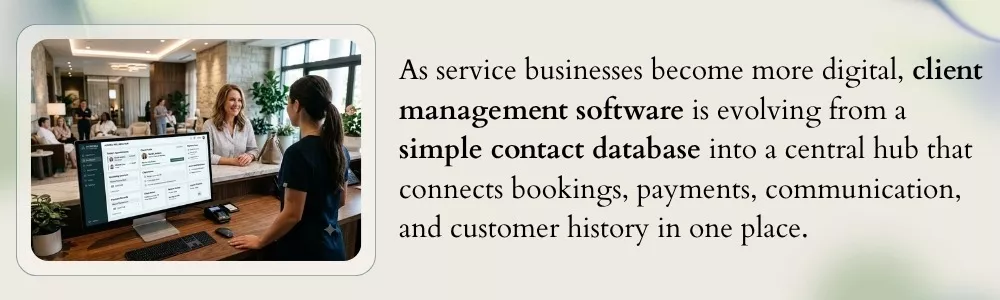
Dotbooker helps service businesses manage bookings, clients, memberships, payments, staff schedules, and daily operations from one connected platform. For salons, spas, gyms, wellness studios, and other service-based businesses, Dotbooker supports a more organized way to manage client relationships without forcing teams to depend on scattered notes, manual records, or disconnected tools.
As service businesses continue to compete on experience, convenience, and trust, better client management is no longer just a back-office improvement. It is becoming part of how modern service businesses grow, retain customers, and create experiences clients want to return to.
Popular Blogs

- Oct 20, 2022
- 6150

- Sep 08, 2024
- 5637

- Nov 11, 2022
- 5012

- Oct 13, 2025
- 4061
Ready to Transform
Your Business?

Get expert guidance to streamline your business operations.