Data Privacy for Spas: Ensuring Your Client's Medical History is HIPAA-Compliant in the Cloud
Think about the last time a new client walked into your spa. Before the candles were lit, before the oils were warmed, before the treatment table was ready, there was a form. A quiet, unassuming sheet of paper or a digital questionnaire asking about blood pressure, skin conditions, medications, allergies, surgeries, and more. Your client filled it out without a second thought because they trusted you. That trust is worth more than any five-star review.
Now here is the question that many spa owners in the United States, Canada, and the Cayman Islands are not fully prepared to answer: Where exactly does that information go after it is filled out, and is it truly safe?
In an era where nearly every spa has shifted its client records to digital platforms and cloud storage, the answer to that question matters more than ever. When health data moves to the cloud without proper safeguards, it creates more than just a compliance problem. It creates a betrayal of the trust your clients placed in your hands.
The Hidden Weight of That Simple Intake Form
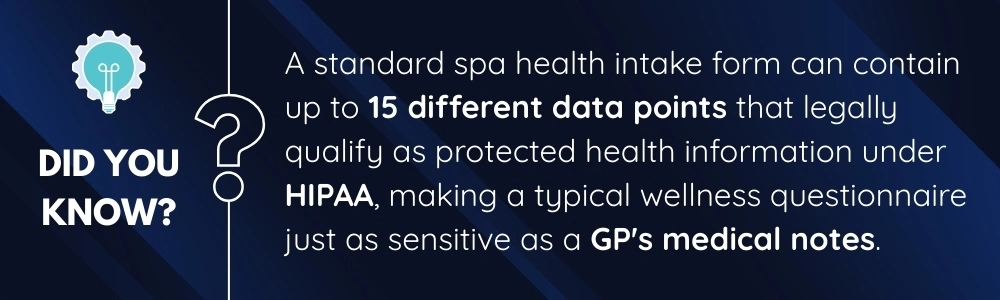
Most spa owners do not think of themselves as healthcare providers. But the moment a client discloses a medical condition, a current medication, or a recent surgery on your intake form, you have entered a space where digital privacy laws apply, and compliance expectations are real.
Here is what that seemingly routine form typically captures:
- Active medications that could interact with treatments or ingredients
- Diagnosed conditions like diabetes, hypertension, epilepsy, or autoimmune disorders
- Pregnancy status or recent medical procedures
- Allergies to chemicals, fragrances, or materials used in treatments
- Skin sensitivities, past adverse reactions, or active infections
- Mental health information in wellness-focused intake questionnaires
Every single item on that list is classified by regulators as protected health information (PHI) when linked to an identifiable person. And once your spa stores it digitally, whether in a cloud-based booking app, a shared drive, an email thread, or a digital form platform, you become legally responsible for how that data is handled, stored, accessed, and protected.
The stakes are not theoretical. They are financial, legal, and deeply personal.
HIPAA Compliance Is Not Just a Hospital Problem
There is a widespread misconception in the wellness industry that HIPAA compliance is only something hospitals, clinics, and insurance companies need to worry about. That belief is incorrect, and it is the kind of assumption that has led to costly penalties for small businesses that handled health data carelessly.
The Health Insurance Portability and Accountability Act applies to any business that collects, stores, or transmits protected health information in the context of providing a health-related service. If your spa collects medical history to inform the treatments you deliver, you are very likely operating within HIPAA's reach.
The Three Rules That Every Spa Owner Needs to Know
Now, let’s focus on three primary rules that spa owners must follow:
The Privacy Rule: Who Can See What
This rule controls how PHI is used and disclosed. Clients must know how their data is being used, and their health information cannot be shared with outside parties without their clear, documented consent. This includes sharing client health forms with third-party vendors, marketing platforms, or even other staff members who do not need access to perform their role.
The Security Rule: How You Protect It
This is where data security gets technical. The Security Rule requires that all electronic PHI be protected through three layers of safeguards: administrative controls, such as policies and training; physical controls, such as device security; and technical controls, such as encryption and access management. If your cloud system lacks these, you are already non-compliant.
The Breach Notification Rule: What Happens When Something Goes Wrong
If a breach occurs and client health data is exposed, your spa is legally required to notify affected clients and, depending on the scale of the breach, the Department of Health and Human Services within a strict time window. Being unprepared for this scenario is not an option because data incidents are not a question of if, but of when.
Why Moving to the Cloud Changed Everything About Data Risk
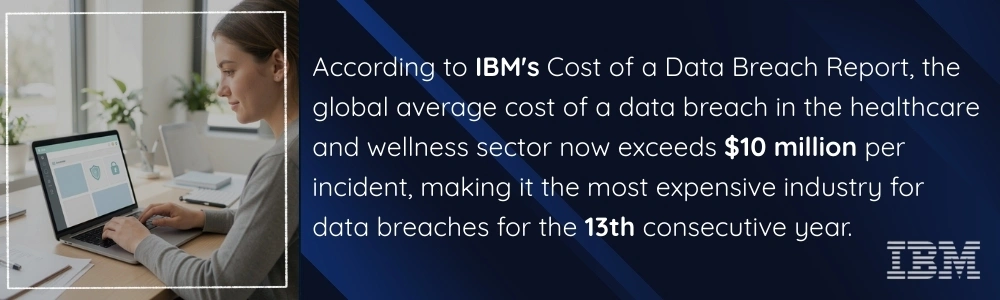
Paper intake forms stored in a locked filing cabinet were not perfect, but their risks were manageable and local. A cloud-based system, on the other hand, means your client records are traveling across the internet, stored on servers in other countries, processed by third-party software vendors, and potentially accessed from multiple devices by multiple staff members at any time.
That is not a reason to avoid the cloud. Cloud-based systems offer enormous advantages for spa management, from seamless appointment scheduling to automated client communications. But the convenience of cloud storage comes with obligations that far too many spa businesses are ignoring.
The Mistakes That Are Already Happening in Spas Right Now
These are not hypothetical errors. They are the real patterns that put spa businesses and their clients at risk every day:
- Using consumer-grade cloud tools for sensitive health data: Standard versions of Google Drive, Dropbox, or iCloud were built for personal file sharing, not for storing medical intake information. They do not carry the legal agreements or technical standards required for HIPAA-compliant data handling.
- Giving everyone the same level of access: A front desk receptionist does not need to see the same health notes as a licensed esthetician. When all staff share the same login or access level, the exposure risk multiplies with every person on your team.
- Skipping encryption entirely: Data that is not encrypted while stored and while being transmitted is readable to anyone who intercepts it. Encryption is a non-negotiable requirement of data security, not an optional upgrade.
- Sending health information over regular email: Standard email is not a secure transmission channel for PHI. Emailing a client's health form to a therapist, even internally, is a compliance violation without the right protections in place.
- No documented data policy: If your spa does not have a written policy for how client health data is collected, stored, accessed, and eventually deleted, you have no framework to defend yourself in the event of an audit or a complaint.
If you are also evaluating how your spa handles financial data alongside health records, understanding how secure payment integration works is equally critical. Read this guide on how payment integration services can boost your spa's security and cash flow.
A Practical Roadmap to HIPAA-Compliant Cloud Operations for Your Spa
Getting your spa to a place of genuine HIPAA compliance does not require a legal team or an IT department. It requires intentional decisions, the right tools, and a consistent culture. Here is exactly how to approach it:
Step 1: Start With the Right Cloud Provider, Not Just Any Cloud Provider
The cloud platform you use to store client health information must offer a signed Business Associate Agreement (BAA). This is a legal contract that makes the vendor formally responsible for protecting PHI under HIPAA. Without a BAA, no cloud platform qualifies for storing health intake data, regardless of how popular or well-reviewed it is.
Providers like Google Workspace for Business, Microsoft Azure, and AWS offer HIPAA-eligible configurations with BAA options. However, simply choosing these platforms does not make you compliant. The way you configure and use them matters just as much.
Step 2: Build Real Access Controls Around Health Data
Role-based access is one of the most effective tools for protecting client records. Set permissions so each team member can see only the data they need to do their job. A therapist reviewing a client's contraindications before a session is an appropriate access. A part-time receptionist browsing all health history files is not.
Require multi-factor authentication for every account that can touch health data. This alone eliminates a significant portion of the risk of unauthorized access, even when passwords are compromised.
Step 3: Encrypt Everything, at Rest and in Motion
Encryption should be a baseline, not an afterthought. All client health data must be encrypted when stored on servers and when transmitted between systems or devices. Look for platforms offering AES-256 encryption as a standard feature.
If your therapists communicate about client needs through messaging apps or regular email, that habit needs to change. Use a secure internal communication channel that meets the same data security standards as your storage platform.
Step 4: Train Your Team Like Privacy Is Part of the Service
Your staff will either be your strongest defense or your greatest vulnerability when it comes to digital privacy. Training is not a one-time onboarding item. It is an ongoing conversation about why this matters, what the rules are, and what to do when something looks wrong.
Training should cover how to recognize a phishing attempt, which data is considered protected, how to handle a client's request to delete or update their information, and what steps to take in the event of a data incident. Make it practical, not just procedural.
Step 5: Document, Review, and Repeat
HIPAA requires documented evidence of your compliance efforts, including privacy policies, risk assessments, staff training records, and breach response plans. This documentation protects you if you are ever audited or if a client raises a complaint.
Conduct a basic risk assessment at least once a year, reviewing every point in your business where health data is collected, stored, and shared. The wellness industry evolves quickly, and your systems need to keep pace.
What Clients in the Cayman Islands, US, and Canada Actually Expect
The clients walking into your spa in Miami, Toronto, or Grand Cayman are not all thinking about data privacy legislation. But they are thinking about trust. They are choosing to share sensitive personal information with your business because they believe you will handle it with care. And increasingly, they are asking questions.
High-net-worth wellness clients in particular, a significant demographic across all three of your target markets, are paying close attention to how businesses handle their personal information. A spa that can speak clearly and confidently about its data security practices, its use of encrypted cloud storage, and its commitment to digital privacy has a meaningful edge over competitors who have never given the subject a thought.
In the United States, non-compliance with HIPAA can result in civil penalties ranging from hundreds to tens of thousands of dollars per violation, with criminal charges possible in cases of willful neglect. In Canada, PIPEDA violations can trigger investigations, public findings against a business, and mandatory remediation. In the Cayman Islands, the Data Protection Act empowers the Office of the Ombudsman to issue enforcement notices and impose monetary penalties on organizations that fail to protect personal data adequately.
The legal landscape is not lenient. And the reputational damage from a disclosed data breach in a luxury wellness space can outweigh any financial penalty.
Choosing Technology That Works With Your Compliance Goals, Not Against Them
One of the smartest investments a spa can make is choosing a management platform built with privacy and data security baked in. Not every spa software vendor treats client health data with the same seriousness, but the right ones do.
When evaluating any platform for managing client records, intake forms, and appointment data, ask these questions before signing a contract:
- Will you sign a Business Associate Agreement with us?
- Is all stored and transmitted data encrypted to industry standards?
- Does your platform offer role-based access controls?
- Do you maintain audit logs of who accessed client data and when?
- Where are your servers located, and what are your data residency policies?
- What is your breach notification protocol and timeline?
If a vendor cannot answer these questions clearly and in writing, that is a serious warning sign. Your clients' health data deserves better than a vague reassurance.
Your Next Step Toward Being a Spa Client Can Truly Be Trusted
Every spa that handles health intake data has a choice to make. It can treat HIPAA compliance, data security, and digital privacy as technicalities to be checked off, or it can treat them as extensions of the care and professionalism it brings to every single treatment.
The most successful wellness businesses in the Cayman Islands, the United States, and Canada are those that clearly understand this: the relationship between a client and their spa is built on discretion. What happens in that treatment room and what is shared on that intake form stays protected. That promise should be just as true in the cloud as it is behind a closed door.
Start with an honest look at where your current systems fall short. Identify gaps in your cloud storage setup, access controls, staff training, and documentation. Then close those gaps, one step at a time, with the right tools and the right mindset.
When a client trusts you with their health history, the least you can do is ensure it is in safe hands, digitally and otherwise.
Looking for a Smarter Way to Manage Your Spa While Keeping Client Data Secure?
Dotbooker is an all-in-one spa management platform built to streamline every aspect of running your wellness business, from appointment scheduling and staff management to client profiles, inventory, and secure payment processing. Designed for spas, salons, and wellness centers, Dotbooker brings your entire operation into one centralized, intelligent system so you can spend less time on administration and more time delivering exceptional client experiences.
With role-based access controls, secure client data management, encrypted transactions, and a platform trusted by spas and wellness businesses across the globe, Dotbooker helps you build the kind of operation that clients return to, not just for the treatments, but for the confidence that their information is in the right hands. Whether you are managing a single-location boutique spa or a growing multi-location wellness brand, Dotbooker scales with your ambitions while keeping your client records and data security front and center.
Visit www.dotbooker.com to explore how Dotbooker can transform the way your spa operates, safely, efficiently, and with your clients' trust always protected.