
- By Dotbooker
- Sep 14, 2026
- 11
Salon Booking Software: The Profit Hiding Between Appointments (Caribbean Edition)
A Cayman salon can have a busy week and still leave money sitting unused in its calendar. Not because customers are missing. Not because stylists sit idle for hours. Loss can happen in much smaller pieces.
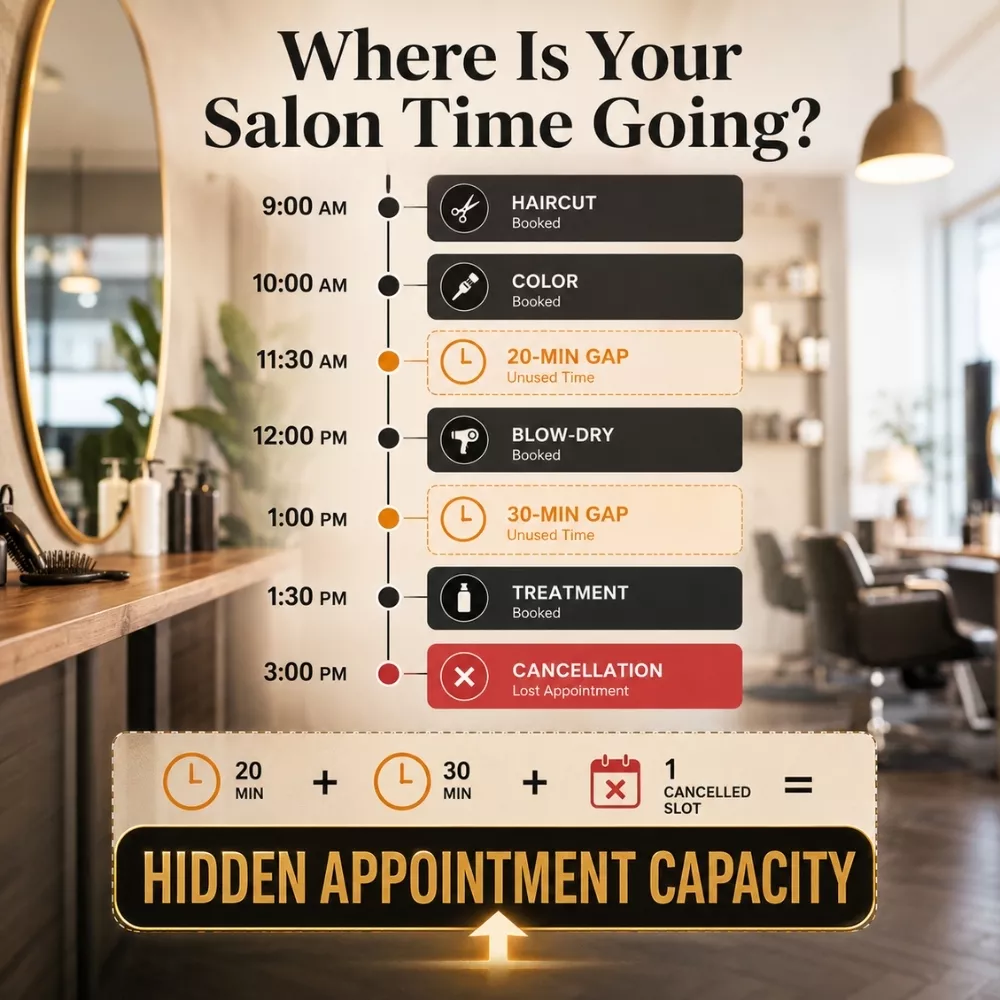
A color treatment is given a two-hour slot but regularly finishes in 90 minutes. A haircut ends at 11:40 AM, but the next appointment begins at noon. A stylist has a 30-minute opening that cannot fit the 60-minute service a customer wants. A cancellation creates an unexpected gap, but nobody on the waitlist is contacted in time. A regular client leaves without rebooking, creating an empty slot six weeks from now.
Individually, these gaps seem harmless.
Together, they represent something every salon sells but can never store for later: appointment time.
That is the real meaning behind the profit hiding between appointments.
For Cayman salons, salon booking software can help turn the calendar from a simple appointment diary into a better way to manage service durations, buffers, stylist availability, waitlists, rebooking, and chair occupancy.
The goal is not to pack every available minute with another customer. It is to understand which gaps necessary and which ones are quietly reducing the salon's earning capacity.
What Is Salon Booking Software?
Salon booking software lets customers book salon services and helps the salon organize those appointments. But that description misses the bigger opportunity.
A useful online booking system should understand that salon time is not sold in equal blocks.
A trim might require 30 minutes. A haircut and blow-dry may need 60. The color service could take two hours. An add-on might need only 15 or 20 minutes.
The salon also needs to consider stylist availability, breaks, preparation, processing time, cancellations, customer preferences, and future rebooking. This is where salon scheduling software becomes closely connected with profitability.
The question changes from: “Is this stylist booked?”
To: “How effectively is this stylist's available time being booked?”
That is a much more useful business question.
Profit Leak Is Often Between Appointments
A Cayman salon with four stylists. Each stylist loses an average of just 30 minutes of potentially usable appointment time per working day because of awkward gaps. That becomes:
30 minutes × 4 stylists = 2 hours per day
Across five working days:
2 hours × 5 = 10 hours per week
Across four weeks:
10 hours × 4 = 40 hours per month
That does not mean all 40 hours could automatically become revenue. Breaks, cleaning, preparation, and natural schedule variations are necessary.
But even if part of that time could accommodate suitable services, the business has found capacity without adding another stylist, another chair, or longer opening hours.
This is why salon calendar software should help owners look at the spaces between bookings, not only the bookings themselves.
Salon Scheduling Software Starts With Getting Service Duration Right
One of the easiest ways to create unnecessary gaps is to give every service a convenient round number.
For example:
Haircut: 60 minutes
Blow-dry: 60 minutes
Color: 120 minutes
Treatment: 60 minutes
Easy to remember.
But are those actual times your salon needs?
If a service consistently takes 45 minutes but is always blocked for 60, 15 minutes disappear every time it is booked.
Book that service four times and an hour is gone.
Different Services Need Different Time
A better setup could look something like:
Consultation: 15 minutes
Express service: 30 minutes
Haircut: 45 minutes
Haircut + blow-dry: 60 minutes
Color treatment: 90 minutes
Complex color service: 120+ minutes
The exact times will differ by salon and stylist.
The point is accuracy.
Salon scheduling software should allow services to reflect realistic durations. This gives the calendar a better chance of creating usable availability instead of accidental dead space.
Processing Time Can Create a Different Kind of Opportunity
Salon scheduling has another interesting layer. Not every minute of a long service requires the stylist's full attention. Consider certain color services. There may be preparation and application time followed by processing time. Depending on how the salon operates, part of that period may create an opportunity for the stylist to handle another appropriate activity.
That could be a consultation, another short service, preparation, or another customer-related task.
This is not something every salon should automatically do. Service quality, safety, staff workload, and the treatment itself come first.
But it shows why salon appointment software needs to reflect on the real service journey rather than treating every appointment as one solid block of identical time.
Buffer Time Protects Service Quality, Until There Is Too Much of It
Buffers are useful. Stylists need time to reset stations, clean equipment, prepare products, complete notes, take payments, and simply breathe between clients. The problem is using the same buffer for everything. Suppose every appointment receives a 15-minute buffer.
Eight appointments create:
8 × 15 minutes = 120 minutes
Two hours of the calendar are now blocked.
Perhaps the salon genuinely needs those two hours. Perhaps it only needs half. That is why salon calendar software should reflect how the salon really works.
Ask things like:
- Does a haircut need the same buffer as a complex color service?
- Could some appointments be used five minutes instead of fifteen?
- Does preparation happen before or during the appointment?
- Which services genuinely need extra cleanup time?
Better timing does not mean rushing stylists. It means stopping unnecessary padding from quietly consuming bookable capacity.

30-Minute Gap Is Not Always an Empty Slot
Now imagine your salon appointment software shows this:
1:00 PM: Haircut
1:45 PM: Available
2:15 PM: Color appointment
There is a 30-minute opening.
A 60-minute haircut will not fit. But perhaps something else will.
A consultation might.
An express service might.
A suitable add-on might.
This is where service-duration settings become valuable.
Instead of asking: “Can we fit another appointment?”
Ask: “Which of our services can fit this appointment gap?”
That changes how the salon thinks about capacity.
Cancellation Creates Time Inventory That Expires
At 10 AM, a customer cancels their 3 PM appointment. Your salon now has something valuable:
An available appointment slot. But unlike a bottle of shampoo, you cannot sell that inventory tomorrow.
At 3 PM, its value begins to disappear.
At 4 PM, it was gone.
This is where waitlists and salon appointment software become particularly useful. If another customer wants an earlier appointment, the salon has a potential match:
Newly available time + waiting customer
The faster the salon can identify that match, the better chance it has of recovering the appointment. A cancellation does not automatically have to become an empty chair.
Salon Rebooking System Protects Revenue That Hasn't Arrived Yet
There is another appointment gap that is harder to see. It is sitting six weeks in the future. A loyal customer finishes today's service.
They are happy, pay and leave. Nobody asks when they would like to return.
Six weeks later, the customer may remember to book. Or they may not.
This is why a salon rebooking system belongs in a conversation about hidden appointment profit. Rebooking helps salons work on future occupancy before the future calendar becomes empty.
Salon Calendar Software Should Reveal Capacity
A calendar covered in appointments can make a salon owner feel confident. But “full looking” and “well-used” are not always the same thing. Suppose Stylist A is booked from 9 AM to 5 PM. Looks perfect. But inside that schedule are:
- 20-minute gap
- 15-minute gap
- 30-minute gap
- 20-minute unnecessary buffer
That is 85 minutes hidden inside what appeared to be a full day. Salon calendar software can give the business a clearer view of these patterns. Over time, owners can start asking:
- Which services regularly finish earlier than scheduled?
- Which services regularly run late?
- Where do gaps appear most often?
- Which days have the most unused capacity?
- How often are cancellations refilled?
- Which customers regularly rebook?
That information can help improve future scheduling instead of repeatedly accepting the same gaps.
Salon Rebooking System Can Make Client History More Valuable
Rebooking becomes even more useful when staff understand the customer.
A client may visit every four weeks.
Another may return every eight.
One prefers the same stylist every time.
Another only books Saturday mornings.
Client history can make the next-booking conversation feel natural.
Instead of: “Do you want another appointment?”
Staff can say: “You normally return in around six weeks. Would you like me to check Saturday morning with the same stylist?”
That is a very different customer experience.
A salon rebooking system combined with client history helps the salon use what it already knows to make future booking easier.
Online Booking Should Sell Only the Time You Actually Have
Customers should be able to book conveniently. But convenience cannot come at the expense of calendar accuracy. Suppose someone selects a 90-minute service.
Your salon appointment software should recognize that a 60-minute opening is not enough.
- If a stylist finishes at 4 PM, customers should not see a 4:30 PM appointment requiring two hours.
- If the stylist is off that day, they should not appear available.
This is why salon scheduling software and online booking need to work from the same availability. The customer sees suitable options. The salon keeps control over capacity. That is much better than accepting a booking first and solving the scheduling problem later.
Your Next Revenue Opportunity May Already Be on the Calendar
Growing a Cayman salon does not always mean finding more customers, hiring another stylist, or extending opening hours.
Sometimes there is another place to look first: between the appointments you already have.
Dotbooker helps salons connect online booking, calendar management, stylist availability, service durations, client history, waitlists, and reports so teams can get a clearer view of how appointment time is being used.
With salon booking software, a 30-minute opening is no longer simply an empty box on the calendar. A cancellation becomes availability that can potentially be offered again. A completed appointment becomes an opportunity to rebook. And reports can help show where valuable time repeatedly disappears.
Because your salon calendar does not only tell you who is coming next. It can also show you where your next opportunity is hiding.
Popular Blogs

- Oct 20, 2022
- 6067

- Sep 08, 2024
- 5543

- Nov 11, 2022
- 4921

- Oct 13, 2025
- 3980
Ready to Transform
Your Business?

Get expert guidance to streamline your business operations.