How Does Pilates Studios Prevent Overbooking When Equipment Is Limited?

A Pilates studio can have an instructor available, an open hour on the calendar and several clients ready to book and still not have enough capacity for everyone.
Why?
Because in an equipment-based Pilates session, availability is not determined by time alone.
Imagine a Cayman studio that has eight reformers. Nine clients want the same reformer class. The instructor can teach nine people, and the room may comfortably accommodate them, but there are still only eight reformers. Accepting the ninth reservation creates a problem before the class begins.
This is why Pilates scheduling needs to answer more than, “Is 10:00 AM free?” It also needs to ask, “Is the instructor available, is there space in the class, and is the required equipment still available?”
Pilates Studio Booking Software can help bring those conditions together. With advance booking, real-time availability, calendar management and scheduling controls, studios can create booking availability around the capacity they can genuinely provide.
Allows Pilates clients to book classes, choose instructors and reserve equipment online, while studios can control class capacity and instructor schedules.
For Cayman Pilates studios where reformers, chairs, barrels and other equipment may be limited, that distinction can help studios avoid accepting reservations beyond the capacity then can provide.
Why Does Limited Equipment Make Pilates Booking Different?
Think about a service business where appointments primarily depend on one employee's time. If another qualified employee becomes available, the business may be able to open another appointment.
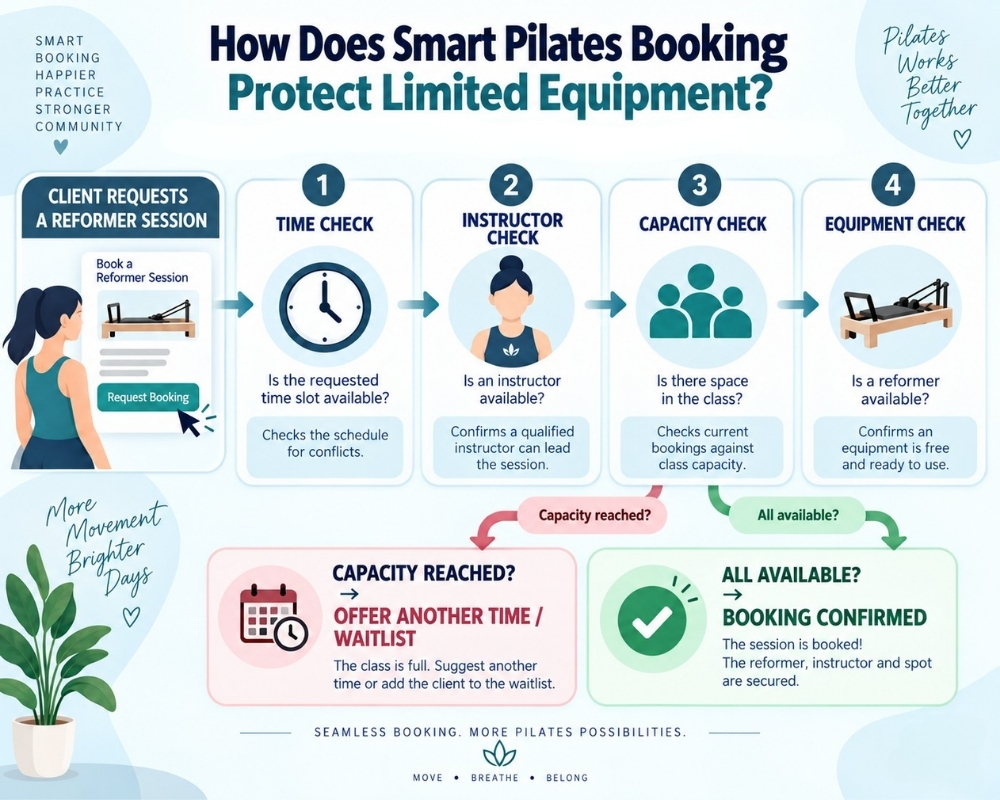
Equipment-based Pilates is different. A studio's capacity can depend on four conditions: Available time + Instructor + Class capacity + Equipment
Suppose a studio runs a reformer class at 6:00 PM with one instructor and six reformers. The sixth reservation fills the equipment capacity.
A seventh customer may see 6:00 PM as an attractive time, but the studio should not accept another reformer reservation simply because there is enough floor space or because the instructor is still working.
That is where scheduling software becomes important. The booking limit should reflect what the studio can deliver, not simply how many people want to attend.
For a Cayman studio with limited equipment, capacity control protects both the schedule and the customer experience.
How Can Studios Set Booking Capacity Around Equipment?
The first step is surprisingly simple: know the real capacity of every session. Do not begin with the maximum number of people who fit in the room. Begin with what the class requires. For example:
Reformer Class
8 reformers available → Maximum 8 equipment-based places
Private Reformer Session
1 instructor + 1 reformer → 1 reservation
Mat Pilates Class
Capacity may instead depend on room size, class policy and instructor availability
This is where appointment management software should distinguish between different session types. Pilates studios include class-size control, instructor assignment, private-session booking and equipment reservation. Its calendar tools also support management of appointments, staff availability, resources, and time slots from a connected view.
Studios do not have to treat every Pilates service as though it has the same capacity. Learn to streamline day-to-day operations with Pilates Studio Software.

How Real-Time Availability Reduce Capacity Issue?
This is where the booking experience matters. Imagine two customers checking out a popular evening Pilates class. If availability is being managed manually across phone calls, messages and separate booking records, staff must continuously know exactly how many places remain.
With connected appointment calendar software, availability can be kept much clearer as reservations enter the calendar.
Booking Mechanisms provide real-time availability for clients and administrators, specifically helping reduce scheduling conflicts and overbooking.
For a Pilates studio, the idea is straightforward as customers reserve available places, the remaining class capacity can be updated so later customers see whether the session is still available.
Once genuine capacity has been reached, another equipment-dependent reservation should not be treated like an ordinary empty slot. That is a major reason Pilates Studio Booking Software is more useful than simply maintaining a list of class times.
Why Should Equipment, Instructor and Time Be Checked Together?
Equipment is only one part of the equation. Suppose your Cayman studio has eight reformers, but only one instructor qualified for a particular session.
Or perhaps all eight reformers are available, but two are already allocated to private sessions during the day.
This means availability needs to be viewed as a combination rather than separate pieces. A practical scheduling system for small business should help the studio answer:
- Is the instructor available?
- Is the session time available?
- Is there any remaining class capacity?
- Is the necessary equipment available?
If one answer is “no,” the appointment may not be genuinely bookable.
Online booking is where clients can choose instructors and reserve equipment, alongside class capacity control and instructor-wise scheduling.
For smaller Cayman Pilates Studios, improve studio capacity planning with scheduling software may be more practical than purchasing equipment whenever demand increases. Better control of existing capacity becomes important.
Can Advance Booking Rules Help Control High-Demand Classes?
Yes, because overbooking is not only about maximum capacity. It is also about how reservations enter the schedule.
Some sessions may fill quickly, particularly before work, after work or on weekends.
With appointment management software, studios can establish booking rules that determine how far ahead or how close to the session customers can reserve.
Booking Mechanisms include customizable rules for advance and last-minute booking, allowing businesses to adjust booking parameters around operational needs.
For example, a studio might decide that a particular equipment-intensive private session cannot be booked at extremely short notice because the team needs time to prepare.
A scheduling system for small businesses should therefore do more than display free hours. It should help determine which free hours can actually become customer reservations.
What Happens When an Equipment-Based Class Is Full?
“Full” should not have to mean “customer lost.”
Suppose an eight-reformer class has reached eight reservations, and a ninth client wants to attend. Instead of squeezing in another booking, the studio can offer another suitable time or manage demand through a waitlist where available.
Pilates functionality includes waitlist management alongside class capacity control.
This creates a much cleaner process: Class reaches equipment capacity → Further booking is restricted → Customer chooses another session or waitlist → Cancellation occurs → Capacity becomes available again
That is better than deliberately accepting more customers than the equipment can support and hoping someone cancels.
Why Is This Particularly Important for Smaller Cayman Pilates Studios?
A smaller studio may not have unlimited space or spare equipment waiting for storage.
If six reformers are available, those six reformers are part of the studio's service capacity.
That makes a scheduling system for small businesses particularly relevant. It should help the owner get clearer control over the resources already available rather than requiring constant manual coordination.
For Cayman businesses, there may also be periods when preferred class times become particularly popular. Clear appointment calendar software can help staff to see where demand is concentrating and where alternative availability remains.
The same principle applies whether a studio operates six reformers or twenty: Do not sell more equipment-based places than you can provide.
What Should Pilates Studios Check Before Opening Online Bookings?
Before making a new class or private session available, ask:
1. What equipment does this session require?
Be specific about reformers or other limited equipment.
2. How many usable units are available?
Base capacity on equipment that can genuinely be assigned.
3. Who can deliver the session?
Connect instructor availability with booking availability.
4. How long is the equipment occupied?
Include necessary setup or turnover time.
5. What happens at capacity?
Offer another session or use a waitlist instead of accepting an unsupported booking.
6. Is availability updated as bookings change?
Your appointment management software should give the team a clear view of current reservations.
These questions turn booking capacity from guesswork into a repeatable process.
How Do Pilates Studios Prevent Overbooking When Equipment Is Limited?
The answer is not simply to stop accepting bookings earlier. Studios need to define what makes each appointment genuinely available.
For equipment-based Pilates, that means connecting time, instructor availability, class capacity, and equipment availability.
Good Pilates Studio Booking Software helps put those pieces into one scheduling process. Real-time availability can prevent customers from selecting capacity that is no longer available, while accurate durations, advance-booking rules and capacity controls help studios build schedules around what they can deliver.
An appointment calendar software view also gives the team greater visibility over when equipment is in use and when capacity remains available.
For a Cayman studio with limited reformers or specialist equipment, that is the difference between a calendar that simply looks busy and one that is workable.
Match Every Pilates Booking With Real Capacity
A full class is positive. An overbooked class is not. For equipment-based Pilates, an available instructor and open time slot are only part of the booking decision. The required equipment and class capacity must also be available.
When equipment is limited, every reservation needs to correspond with real capacity. The instructor may be free, and the hour may appear open, but if the required reformer is already allocated, another booking should not be confirmed for the same resource.
That is why effective Pilates Studio Booking Software needs to look beyond dates and times.
Dotbooker brings Pilates online booking, class capacity control, equipment reservations, instructor scheduling, waitlists and calendar management into a connected platform. Its booking functionality also provides real-time availability and configurable booking rules.
For Cayman Pilates studios, smarter capacity management can mean fewer awkward conversations at check-in, clearer availability for clients, and better use of the equipment the studio already owns.