- By Dotbooker
- May 08, 2026
- 601
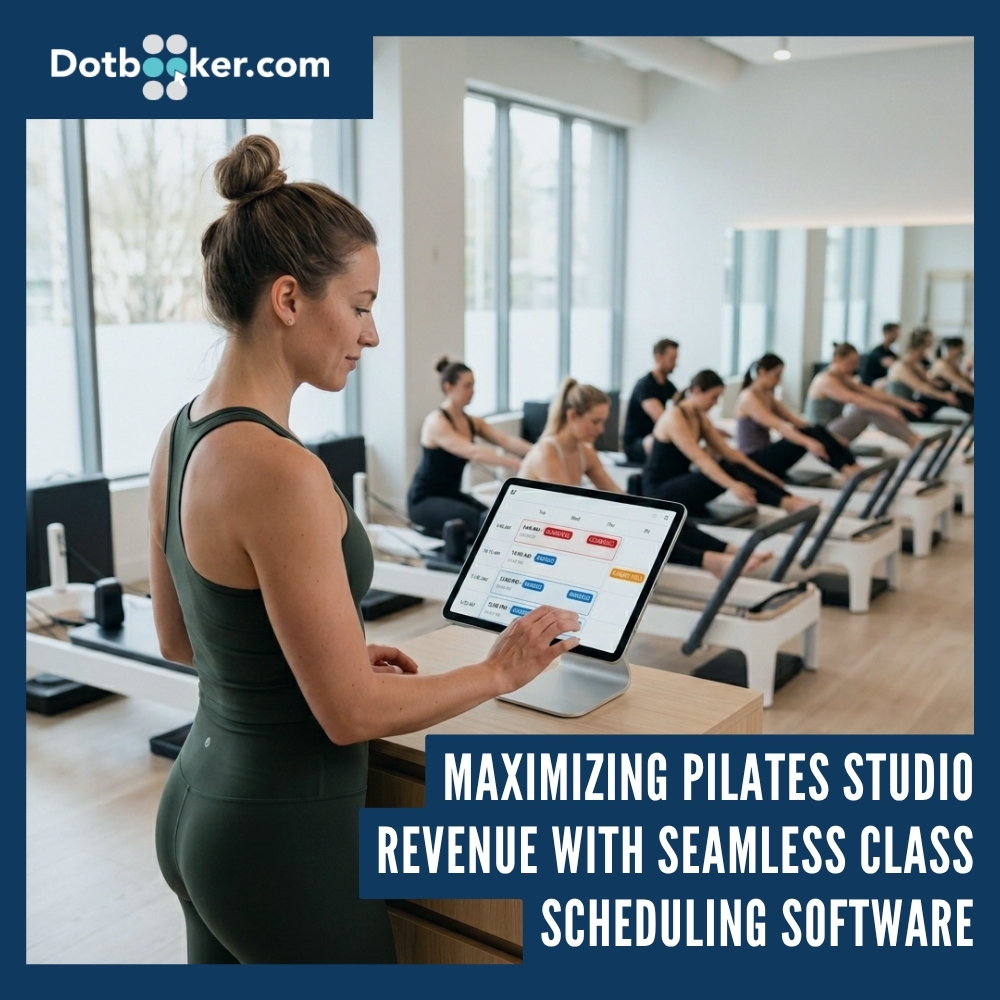
Maximizing Pilates Studio Revenue With Seamless Class Scheduling Software
Let’s start with a scene that might feel a little too familiar.
It’s Tuesday evening. Your 6 PM Pilates class should be buzzing. You glance around. Three reformers are empty. One regular client messages saying she “forgot to book.” Another says the class looked full earlier, so she didn’t even try.
Meanwhile, your instructor is fully present, your lights are on, and your costs are already locked in.
And just like that, revenue quietly slips away.
No dramatic loss. No alarm. Just small gaps that repeat week after week.
Most studio owners don’t notice this as a system problem. They think it’s normal. They think it’s a demand.
But it isn’t.
The Truth Nobody Warns You About in Pilates Studio Software and Booking Experience
Here’s the uncomfortable part.
Most Pilates studios don’t have a demand problem. They have a booking experience problem.
And this truth usually hides in plain sight.
You might see decent footfall. Some classes are full. A few are not. It all feels… normal. Manageable. Nothing alarming.
But if you zoom in just a little, you start noticing patterns.
- Clients are hovering on your booking page but not completing the process.
- Regulars attending inconsistently, not because they lost interest, but because booking felt like a task.
- New clients dropping off after their first visit, not because of your service, but because returning felt inconvenient.
- Clients want to come. They intend to book. They even open your page sometimes. But something interrupts the flow.
And that interruption is rarely dramatic. It is subtle.
- Maybe the schedule looks cluttered and overwhelming at first glance.
- Maybe a class appears full, but in reality, cancellations are happening behind the scenes.
- Maybe they don’t see an easy option to join a waitlist, so they assume there is no chance.
- Or maybe, and this is the most common one, booking simply feels like effort.
And in today’s world, effort is the enemy.
We live in a time where people can order food in seconds, stream anything instantly, and get what they want with minimal friction. So when booking a Pilates class feels slower than ordering coffee, guess what happens?
- They postpone it.
- Then they forget it.
- Then they disappear.
That’s where Pilates studio software quietly changes the game, not as something flashy, but as something that removes these invisible barriers.
It does not chase clients. It clears the path for them.

The “I’ll Book Later” Trap and How Pilates Booking Software Solves It
We all know that one client.
“I’ll book later tonight.”
It sounds harmless. Even responsible.
But “later” is one of the most dangerous words in your booking journey.
Because later, they compete with everything else in their life.
Dinner plans. Work emails. A quick scroll that turns into an hour. A show that auto-plays the next episode. Sleep.
By the time they remember, it is either too late or too inconvenient.
Now multiply that by dozens of clients over weeks and months. That is not just lost bookings. That is lost momentum.
The interesting part is, this is not a motivation issue.
It is a friction issue.
If booking takes too many steps, requires too much thinking, or feels slightly inconvenient, the brain quietly pushes it down the priority list.
Now imagine the opposite.
Booking takes 10 seconds.
- Their previous preferences are already remembered.
- They get a gentle nudge at the right time.
- The system even suggests classes based on their routine.
Suddenly, “I’ll book later” becomes “Booked.”
This is where Pilates booking software works its magic. Not by pushing harder, but by making the process so simple that there is no reason to delay.
Less thinking leads to more doing.
And more doing leads to more consistent revenue.
When Full Classes Still Lose Money Without Class Scheduling Software in Canada
Here’s something that sounds strange at first.
Even “full” classes can lose money.
It feels counterintuitive, right? If all spots are taken, where is the loss?
Let’s break it down.
Your 7 AM class fills up quickly. Great sign. Demand is clearly there.
But what about the five people who tried to book after it was full?
What happens to them?
- They leave.
- They don’t join a waitlist because there isn’t one.
- They don’t get notified if a spot opens.
- They simply move on with their day.
That is five missed opportunities in a single class.
Now imagine this happening across multiple classes, every week.
That “fully booked” schedule is quietly leaking revenue.
Studios in Canada using class scheduling software handle this very differently.
When a class fills up, clients can instantly join a waitlist. No extra steps. No confusion.
If someone cancels, the next person is notified immediately. Sometimes within seconds.
No calls. No manual tracking. No chaos.
And here’s the interesting part.
Clients start trusting the system.
They know that even if a class looks full, they still have a chance. So they stay engaged instead of dropping off.
That is how a full class finally behaves like a truly optimized one.
The Magic of Reminders in Pilates Studio Software That Improves Attendance
Let’s talk about reminders.
Not the annoying kind. The perfectly timed kind.
Because here’s the truth. People forget things they are genuinely excited about.
Pilates is no exception.
A client books a class in the morning. By evening, their day has taken over. Meetings, errands, conversations, distractions.
Without a reminder, that booking slowly fades into the background.
And then comes the classic message.
“I’m so sorry, I forgot.”
Now, from a business perspective, that is an empty slot. Lost revenue. Disrupted flow.
But from the client’s perspective, it was never intentional.
This is where Pilates studio software becomes quietly powerful.
A simple reminder at the right time can completely change behavior.
It turns:
“I forgot again.”
into
“I’m already getting ready.”
It is not about discipline. It is about being present at the right moment in your client’s day.
And when reminders become part of the experience, attendance becomes more consistent without any extra effort from your side.
How Fitness Scheduling Software Acts as a Data-Driven Coach for Your Studio
If your schedule were a person, it would probably be guessing most of the time.
- “Let’s try a 3 PM class.”
- “Maybe Saturdays will work better.”
- “Let’s add one more morning session and see what happens.”
And to be fair, sometimes these guesses work.
But sometimes they don’t.
And every wrong guess costs you time, energy, and revenue.
Modern fitness scheduling software replaces that guesswork with clarity.
Instead of assumptions, you start seeing patterns.
- You notice which classes consistently fill up within hours.
- You see which time slots struggle week after week.
- You understand which instructors bring clients back again and again.
It is like having a quiet coach in the background, observing everything and guiding your decisions.
No opinions. Just patterns.
And once you start making decisions based on real behavior instead of gut feeling, your schedule becomes sharper, smarter, and far more profitable.
How a Pilates Class Booking System Changes Client Behavior Over Time
Here’s something most studios underestimate.
Convenience does not just improve experience. It changes behavior.
When booking feels effortless, clients don’t treat it like a task anymore. They treat it like a habit.
Think about it.
If your system remembers their favorite class, their preferred instructor, and their usual time slot, booking becomes almost automatic.
No searching. No thinking. No friction.
And when something is easy to repeat, people repeat it more often.
That is how a simple Pilates class booking system moves from being just a tool to becoming part of a client’s routine.
You are no longer asking clients to come back.
You are quietly becoming part of their weekly rhythm.
The Day You Stop Chasing Bookings With the Right Pilates Studio Software
At some point, something unexpected happens.
You stop chasing bookings.
That constant background worry, “Why is this class empty?” slowly fades.
Instead, your questions change.
“Should we open another slot?”
“Do we need another instructor for this time?”
That shift is subtle, but powerful.
Because now, you are no longer reacting to problems. You are responding to growth.
Your energy moves from fixing gaps to expanding capacity.
And this only happens when your scheduling system is doing its job silently in the background.
Not demanding attention. Not creating chaos. Just working.
If you want to explore how smarter booking systems reduce no-shows and improve client retention, this guide breaks it down in a practical way.
What Actually Matters When Choosing Class Scheduling Software Canada for Your Studio
Let’s keep this real.
There are many tools out there. Many promises. Many features sound impressive on paper.
But when you are running a studio, what matters is not how advanced the system looks. It is how naturally it fits into your day.
Focus on what truly impacts your experience:
- Can a new client book their first class without asking for help?
- Does the system handle cancellations and waitlists without your involvement?
- Are reminders sent automatically, without you having to double-check everything?
- Can you quickly understand what is working and what is not?
- Does it connect smoothly with payments and memberships, or does it create more steps?
Studios using class scheduling software often prioritize simplicity over complexity. Because when a system is easy for your clients, it becomes easy for your business.
And simplicity always wins in the long run.
Why Pilates Studio Software Gives You Better Control Over Revenue and Operations
This isn’t really about software.
It is about control.
- Control over how your day flows.
- Control over how your classes fill.
- Control over how your revenue behaves from week to week.
Without the right system, things feel reactive. Unpredictable. Slightly chaotic.
With the right system, everything feels aligned.
- You know what to expect.
- You see patterns early.
- You make decisions with confidence.
And perhaps the most underrated benefit of all?
Peace of mind.
Where Everything Finally Clicks With Seamless Pilates Booking Software
Let’s go back to that Tuesday evening.
But this time, everything feels different.
- The class is full not just on paper, but in reality.
- The waitlist is active. Quietly doing its job.
- A cancellation happens, and within minutes, someone else steps in.
Clients arrive on time. No confusion. No missed bookings. No last-minute scrambling.
You are not running around fixing things.
You are simply observing a system that works.
And the best part?
You did not have to push harder, market more, or stretch yourself thinner.
You just removed friction.
And when friction disappears, everything starts to click.
Turning Bookings Into a Revenue Engine With Pilates Studio Software
At some point, every studio owner realizes that growth is not always about doing more. It is about doing things better.
When scheduling becomes seamless, everything else starts falling into place. Clients show up more often. Classes stay full. Revenue becomes consistent instead of unpredictable.
This is exactly where platforms like Dotbooker step in.
Dotbooker brings together class scheduling, bookings, payments, and client management into one connected system. Instead of juggling multiple tools or relying on manual processes, everything works together in a way that feels natural for both the studio and the client.
For a Pilates studio, that means:
- Fewer missed bookings
- Better class utilization
- Stronger client retention
- And a smoother day-to-day experience
Because in the end, it is not about adding complexity. It is about removing friction.
And when friction disappears, revenue follows.
Popular Blogs

- Oct 20, 2022
- 6099
- Sep 08, 2024
- 5579

- Nov 11, 2022
- 4967

- Oct 13, 2025
- 4012
Ready to Transform
Your Business?

Get expert guidance to streamline your business operations.