- By Dotbooker
- Jan 02, 2026
- 1162
Automated Booking: How Smart Scheduling Tools Reduce Human Error & Boost Studio Revenue
You’ve prepped the studio, the playlist is perfect, your staff is on time, and just as the day starts flowing… a client walks in with, “But I booked the 10 AM slot?”
Your gut sinks. The trainer is already busy. The slot was never blocked. Someone forgot to update the sheet. This is exactly where Studio Scheduling Software saves the day.
Sound familiar?
Now imagine a world where this never happens. Where schedules don’t clash, reminders go out automatically, and waitlisted clients quietly replace no-shows. That’s not a dream, it’s the promise of automated booking. And the best part? It’s not just about convenience; it’s about boosting your bottom line while keeping your sanity intact.
Let’s pull back the curtain on how innovative scheduling tools quietly revolutionize the daily grind for studios, turning messy calendars into revenue-generating machines.
The Chaos Beneath “Simple” Scheduling
If your current system involves WhatsApp messages, notebook scribbles, or a worn-out Excel sheet… you’re not alone. Plenty of studios start there. But here’s the catch:
- A missed entry becomes a missed client.
- A double booking becomes an awkward apology.
- A forgotten cancellation becomes wasted time.
Human error isn’t personal; it’s inevitable when your booking process is held together with hope and manual effort.
This is precisely where automated booking systems shine. They replace crossed wires with clean logic, give your clients control, and hand peace of mind back to your team.

What Is Automated Booking? (And Why It’s Much More Than a Digital Calendar)
Let’s be clear, automated booking isn’t just about letting someone book online instead of calling.
It’s about creating an intelligent, self-regulating ecosystem that manages your availability, schedules, confirmations, cancellations, and payments without involving your team at every step.
Here’s what a robust automated booking system typically handles:
- Real-time availability updates
- Integrated class/staff/resource calendars
- Self-service booking portals for clients
- Automated confirmations and rescheduling
- Cancellations and waitlist logic
- Payment and package selection at booking
- Auto-reminders via email or SMS
- Daily/weekly analytics reports on bookings and revenue
It’s not just about booking slots. It’s about handing off every possible manual task that clutters your team’s workflow, while creating a seamless experience your clients love.
The Hidden Cost of Human Error in Studio Scheduling
At first glance, one scheduling slip-up may seem like a minor issue, something you can smooth over with a quick apology or a free session. But in a busy studio environment, even a single mistake can have cascading effects that ripple through your operations, staff morale, client trust, and monthly revenue.
What makes this more dangerous is that these costs often go unnoticed. They don’t show up as line items on your balance sheet, but they quietly drain your resources day after day.
Let’s take a deeper look at where these errors show up, what they actually cost you, and why fixing them should be a top priority.
1. Double Bookings: More Than Just a Calendar Mistake
This is one of the most visible and damaging errors in any service business. Two clients show up expecting the same appointment, but only one can be accommodated.
Here’s what typically happens:
- The client who has to wait (or is turned away) leaves disappointed and often doesn’t come back.
- Your team comes across as unprofessional or disorganized, even if it wasn’t their fault.
- The situation disrupts your session flow, possibly affecting the next few appointments.
But it doesn’t stop there. A double booking leads to:
- Refunds or discounts to make up for the error
- Negative reviews on social media or Google
- Word-of-mouth damage that deters new clients
- A loss of trust in your reliability, which takes much longer to recover than the revenue you just lost
All because two systems weren’t in sync, or a human forgot to block off a time slot. These moments are exactly what automated booking software is designed to prevent.
2. No-Shows Due to Missed Reminders: The Silent Killer
Most clients aren’t skipping on purpose. They’re busy, distracted, or simply forgot they had a session.
The issue? If you rely on your front desk to send manual reminders (calls, texts, emails), those reminders can easily be missed, especially during peak hours. A single missed reminder could mean:
- One fewer appointment was completed that day
- A wasted trainer or therapist hour
- A domino effect, if you had someone waitlisted who could have taken the spot
- No revenue, even though that slot was technically “booked.”
Now multiply that across your weekly schedule. If you average even 3 no-shows a week, and each session is worth $50, you’re losing $6000+ annually, simply because reminders weren’t automated.
The fix? An automated booking system that sends timely, consistent reminders through SMS, email, or push notifications without anyone on your team having to lift a finger.
3. Untracked Cancellations: Blocked Time = Blocked Revenue
Let’s say a client texts your front desk to cancel, but it doesn’t get logged into your calendar. That session now sits as a "ghost booking," visible as booked but unused.
This is what happens next:
- That time slot appears unavailable to others trying to book
- You don’t reach out to waitlisted clients in time.
- The trainer shows up and has no one to serve
- You lose that hour’s income with zero notice.
Even worse, if this happens more than once a week, it becomes a systemic problem. It doesn’t just result in lost revenue; it also skews your analytics. Your reports say your studio is incomplete, but your revenue says otherwise.
With automated booking, the moment a client cancels, whether it’s from a client portal, app, or reschedule link, the slot is released instantly, waitlists are notified, and the schedule remains accurate and up to date.
4. Last-Minute Schedule Changes: The Chain Reaction You Don’t See Coming
Let’s say one of your instructors needs to swap shifts, or a therapy room gets changed due to maintenance. If your system isn’t smart enough to cascade that change across the client-side calendar, this is what might unfold:
- Clients show up at the wrong time or place
- Some miss the new time entirely and don’t return.
- The trainer or therapist is left idle for part of the hour.
- Staff frustration grows from having to deal with damage control.
- You offer discounts or freebies to smooth it over.
This isn’t just a tech issue. It’s an operational disaster in slow motion.
With automated booking software, changes to time, staff, or location trigger real-time updates to client bookings and instant notifications. Everyone knows what’s happening, and no one gets left in the dark.
Cumulatively, These Errors Cost You More Than You Think
Let’s do a rough calculation for a mid-sized studio:
- 2 double bookings per month = 24 lost clients/year
- 4 no-shows per month = $2400/year in missed revenue
- 2 untracked cancellations/month = 24 unused sessions
- 1 big scheduling mix-up every quarter = $500/year in damage control offers
That’s hundreds of hours and thousands of dollars lost, quietly, invisibly, and consistently.
And none of this includes the reputational damage that makes new client acquisition more expensive and referrals less frequent.
The Solution Is Precision, Not More People
The natural reaction is to train your staff harder. “Be more careful with bookings. Double-check every cancellation. Confirm everything again.”
But human memory, effort, and consistency have limits.
Automation doesn’t replace your people, it shields them.
With an intelligent system managing the moving parts, your team can focus on what truly matters: creating great client experiences, upselling packages, managing the studio vibe, and building relationships.
The scheduling? That’s best left to a system that never forgets, never miscommunicates, and never takes a coffee break.
Revenue Isn’t Just Earned, It’s Recovered Through Automation
If you think of automated booking purely as a “tech upgrade,” you’re missing the bigger picture. This is a tool for revenue recovery and growth.
Let’s see how automation actively adds money to your bottom line:
1. Recovering Lost Time Slots
When a client cancels, your automated system can immediately free up the slot, notify your waitlist, or even offer it to other users in real time. That time doesn’t go to waste.
2. Maximizing Off-Peak Bookings
You can set your system to offer discounts or push notifications during low-demand hours, something manual booking teams rarely do promptly.
3. Increasing Booking Volume
Clients can book anytime, from anywhere. You’re no longer tied to business hours or staff availability to take calls. That means more bookings every week, period.
4. Preventing No-Shows
Automated reminders via SMS, email, or app notifications help drastically reduce no-shows by up to 90%. Just one saved session per week pays for your software.
5. Enabling Package Sales & Upsells
Your system can suggest bundle deals or upgrades during booking, and clients are more likely to say “yes” when it’s instant and smooth.
6. Freeing Staff for Revenue-Generating Tasks
When your front desk isn’t busy with bookings, they can focus on client experience, membership retention, merchandise sales, the things that actually grow your business.
Automation doesn’t replace humans. It empowers them.
How It Feels on the Client Side (And Why They Love It More Than You Think)
Think about the last time you tried to book something, a haircut, a massage, or a workout, and it required five steps: calling, confirming, waiting, texting, and double-checking.
Now compare that to this:
- You open an app.
- You pick a time.
- You confirm your payment.
- You receive a reminder before your session.
- You show up, enjoy, leave.
- No fuss.
That’s the experience your clients want from your studio.
A great automated booking system gives them:
- Convenience
- Control
- Clarity
- Trust
And clients who feel confident in your process will keep coming back, not because your yoga is better, but because your system respects their time.
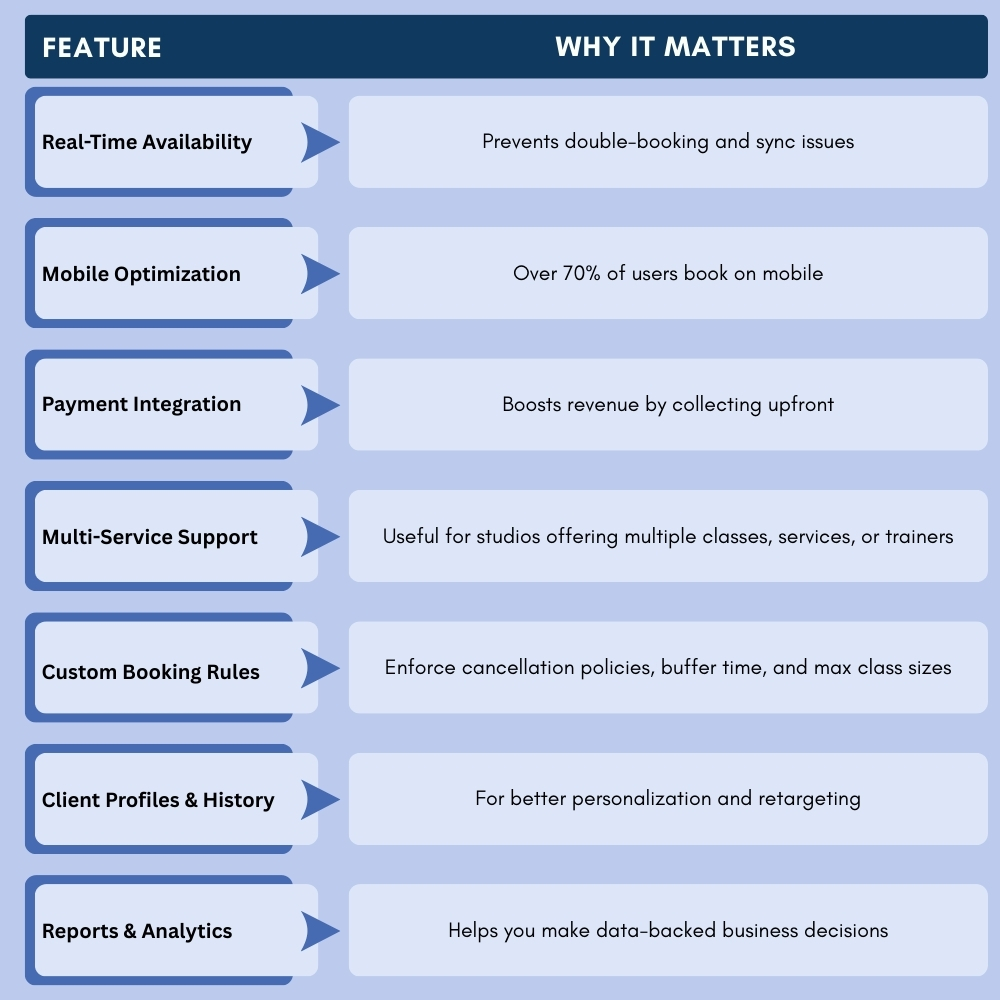
What to Look for in a Powerful Automated Booking System
Not all scheduling tools are created equal. If you’re evaluating options, make sure your chosen platform offers:
Let Dotbooker Power Your Studio’s Next Chapter
At Dotbooker, we’ve built a system specifically for fitness, wellness, grooming, and therapy-based businesses that want to scale, without scaling their chaos.
What makes Dotbooker different?
- A booking interface your clients will love using
- Real-time class, room, and trainer availability sync
- Integrated payment options and membership logic
- Waitlist and no-show automation
- Personalized reminders, loyalty options, and e-wallet features
- Detailed reports to guide your business growth
- Seamless check-in, client history, and mobile app access
Whether you’re running a single yoga studio or a chain of wellness spas, Dotbooker adapts to your needs and grows with you.
So if you're ready to reduce errors, simplify operations, and unlock serious revenue potential...
Don’t just digitize your bookings. Dotbook them.
Popular Blogs

- Oct 20, 2022
- 6200
- Sep 08, 2024
- 5688

- Nov 11, 2022
- 5059

- Oct 13, 2025
- 4122
Ready to Transform
Your Business?

Get expert guidance to streamline your business operations.