Why Manual Booking Systems Are Hurting Your Revenue in 2026
“Can You Hold On for a Second?”
You’ve heard this before.
“Can you hold on for a second? Let me check…”
Now imagine being the customer on the other side.
You’re trying to book something simple. A class. A session. A service. Instead, you’re stuck listening to keyboard clicks and background chaos.
You start thinking… “Is this really the only way they manage bookings?”
That moment right there is where the manual booking system problems quietly begin to cost you.
Not loudly.Not dramatically.But steadily.
Manual Booking System Problems Behind Busy Days
Let’s talk about Riya.
She runs a growing wellness studio. Good location. Loyal clients. Great service.
From the outside, everything looked perfect.
- Bookings were coming in
- The staff were always occupied
- The calendar looked packed
If you just glanced at her system, you’d probably think, “Nice. This place is doing really well.”
Riya thought the same… until she started noticing how her days actually felt.
- Not calm.
- Not organized.
- Just… constantly rushed.
Her mornings didn’t start with planning.They started by catching up.
- Missed calls from the night before
- Messages asking for confirmations
- Staff asking, “What’s the schedule for today?”
By 11 AM, things were already chaotic.
- Phone ringing non-stop
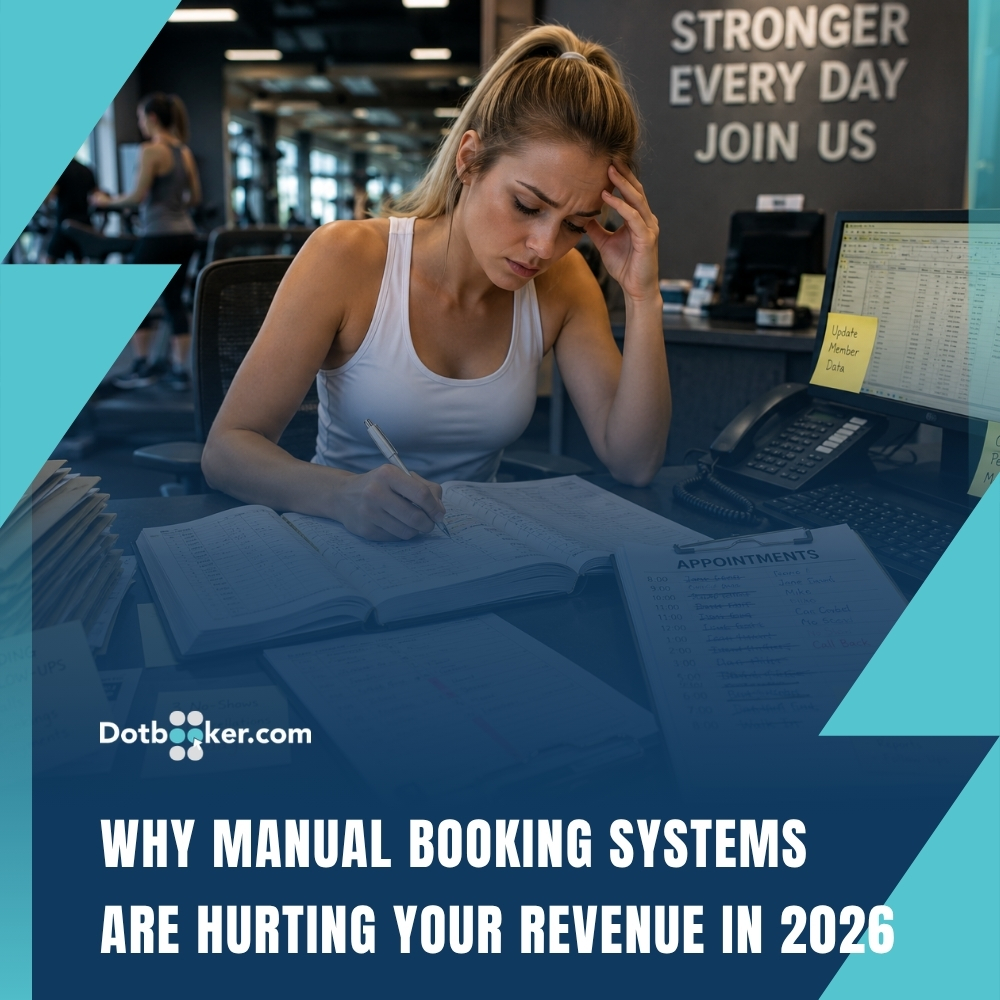
- Sticky notes covering half the desk like a decoration choice gone wrong
- A WhatsApp message asking, “Am I booked for 5 or 6?”
- Someone walking in confidently… for an appointment that didn’t exist
And then came her personal favorite moment of the day.
Two clients. One slot.
- One confused.
- One irritated.
- And Riya, trying to smile as this situation happens in five-star hotels too.
That’s the point where booking management challenges stop being “small issues.”
They become the thing that runs your day.

Appointment Scheduling Issues Go Beyond Simple Mistakes
Let’s clear one thing up.
Double bookings are annoying. But they’re not the real problem.
They’re just the part you can see.
The actual damage? It hides in the background.
It looks like this:
- That one client who called, got confused, and never tried again
- That empty 4 PM slot is because someone canceled, and no one filled it
- That staff member who spent 40 minutes fixing a scheduling mess instead of helping customers
No alarms go off for these.
No report says, “You just lost a client.”
But it happens anyway.
These appointment-scheduling issues don’t appear in your dashboard.
They quietly show up in your numbers at the end of the month.
Manual Booking System Problems Reduce Team Productivity
Here’s where it gets uncomfortable.
Manual systems are excellent at creating the illusion of productivity.
Everyone looks busy.
- Phones are ringing
- People are writing things down
- Schedules are being “managed.”
But if you zoom in, you’ll notice something strange.
A lot of effort… very little progress.
Ask yourself honestly:
Is your team growing the business Or just trying to keep things from falling apart?
Because a big chunk of the day goes into things like:
- Writing bookings in one place… and then rewriting them somewhere else
- Confirming appointments manually because “better safe than sorry.”
- Fixing errors that could have been avoided completely
It’s like trying to empty a leaking boat with a bucket.
You’re working hard.
But you’re not getting ahead.
Manual Booking Errors That Quietly Cost Revenue
Now let’s talk about the moments everyone laughs off.
- “Oops, forgot to send the reminder.”
- “Oops, client didn’t show up.”
- “Oops, that booking didn’t get noted.”
Individually, they feel small.
Almost harmless.
But here’s the problem.
They don’t happen once.
They happen repeatedly.
Take a second and think:
- How many no-shows happened this month?
- How many empty slots could have been filled?
- How many clients needed a follow-up but never got one?
Now stretch that over a year.
That’s not “oops” anymore.
That’s revenue walking out quietly.
Manual booking errors don’t create drama.
They create a slow, consistent loss.
Appointment Scheduling Issues Drive Customers Away Silently
Here’s the part most businesses underestimate.
Customers rarely complain about booking issues.
They don’t send feedback saying, “Your system confused me.”
They don’t explain why they’re leaving.
They just stop coming.
Because from their perspective, there are options.
Plenty of them.
And those options offer:
- Faster booking
- Clear confirmation
- Zero confusion
So when someone struggles to book with you, even once, they make a silent decision.
“Let me try somewhere else next time.”
No argument. No second chance.
Just gone.
Manual Booking System Problems Increase With Business Growth
Manual systems are like the one shortcut you take every day.
It works… until traffic increases.
At 10 bookings a day, things feel manageable.
- At 30, you start feeling the pressure.
- At 60, mistakes become regular.
- At 100, your entire system starts relying on guesswork.
Because here’s the truth:
Manual booking system problems don’t stay the same as you grow.
They multiply.
More bookings mean:
- More chances to miss something
- More people involved
- More coordination required
Now add staff into the mix.
- Different people handling bookings
- Different ways of writing things down
- Different interpretations of “confirmed.”
Suddenly, your entire operation runs on memory, messages, and hope.
Not exactly a reliable system.
Why Businesses Decide to Automate Bookings Today
Now imagine a completely different day for Riya.
No morning chaos.
No pile of missed calls.
- A customer books at midnight without needing anyone’s help.
- Another reschedules in seconds without calling.
- Reminders go out automatically, without anyone having to think about it.
No confusion. No “just confirming…” messages. No guessing.
Her team walks in and actually knows what the day looks like.
No surprises.
And for once, Riya isn’t fixing problems all day.
She’s focusing on improving the experience.
- Talking to clients.
- Growing her business.
- Breathing a little.
This is what happens when businesses decide to automate bookings.
Not some big dramatic shift.
Just fewer fires to put out.
Every single day.
If you want to see how automation reduces errors and improves efficiency in real scenarios, this breakdown explains it clearly.
Booking Management Challenges Businesses Keep Delaying Fixing
Here’s something almost every business says at some point:
- “It’s working for now.”
- “We’ll fix it later.”
- “It’s not that bad.”
And they’re not wrong.
It’s not that bad… today.
But “today” slowly turns into:
- More follow-ups
- More confusion
- More stress
- More lost time
Until one day, it feels overwhelming.
And by then, the cost has already piled up.
Not just in money.
In energy.
Manual Booking System Problems Versus Automated Booking Solutions
Forget tools for a second.
Ask yourself this instead:
Do you want your business to run on memory and manual effort… Or on a system that handles things without constant attention?
Because one option depends on people not making mistakes.
The other assumes mistakes will happen and prevents them anyway.
One grows with you.
The other struggles as you grow.
How Automating Bookings Improves Business Operations Fast
The surprising part?
Things don’t just improve.
They calm down.
- Your calendar finally matches reality.
- Your team stops jumping between problems
- Your customers stop double-checking everything
There’s no constant tension.
No background stress.
Just smooth, predictable operations.
And that’s when something important shows up.
Consistency.
And consistency is what builds trust.
Not marketing. Not discounts.
Just a system that works… every single time.
Manual Booking System Problems You Should Fix Now
Quick question.
If your current booking system stopped working tomorrow…
Would your business still run smoothly?
Or would everything depend on calls, messages, and memory?
If it’s the second one, then the system isn’t helping you.
It’s something you’ve just learned to manage.
And there’s a difference.

When You Finally Automate Bookings, Everything Changes
This is where tools like Dotbooker come in.
Not as “just another tool,” but as something that removes the daily friction you’ve been dealing with.
With a platform like this, you can:
- Let customers book anytime without calling
- Reduce no-shows with automated reminders
- Manage schedules without second-guessing
- Turn empty slots into actual revenue
And most importantly…
You stop spending your day fixing bookings. And start focusing on growing your business
Because booking should feel simple.
Not like a daily puzzle you have to solve.