- By Dotbooker
- Jun 22, 2026
- 504
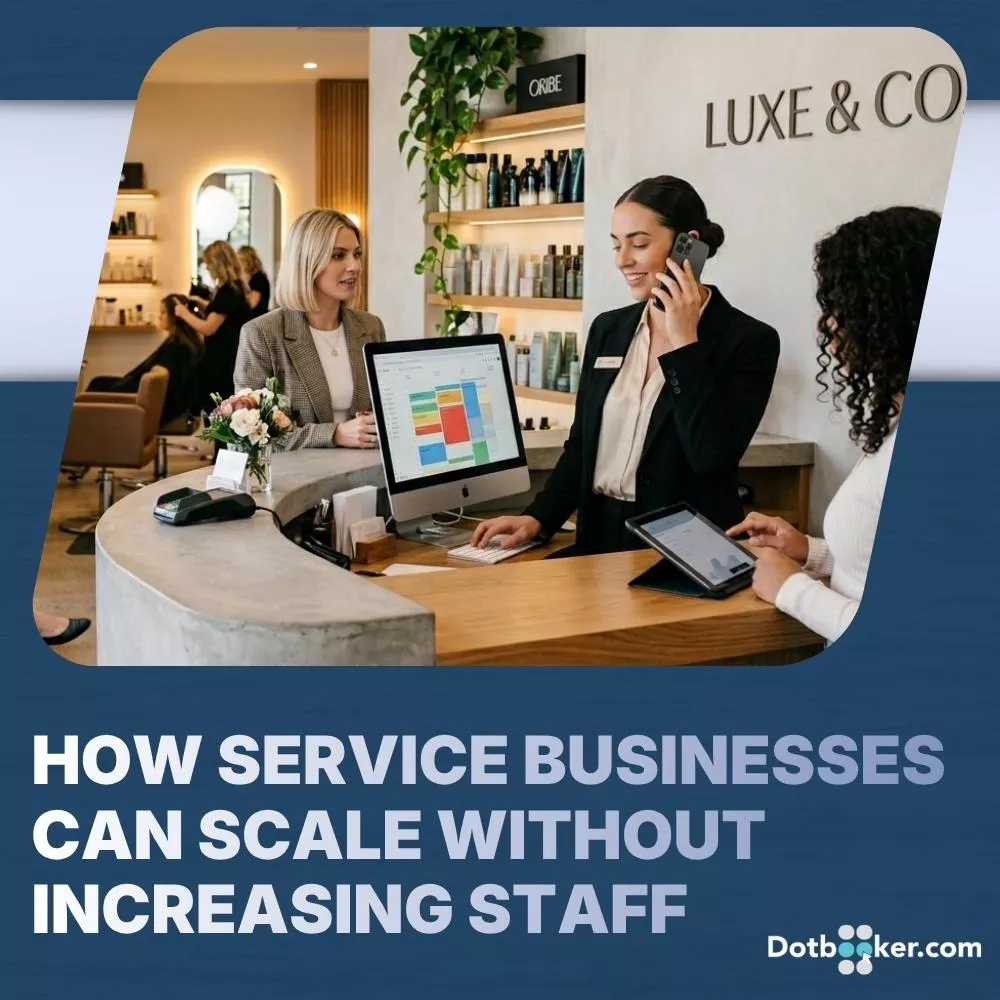
How Service Businesses Can Scale Without Increasing Staff
Running a service business can feel a bit like trying to carry ten coffee cups at once.
- One cup is booked.
- One is staff scheduling.
- One is customer follow-ups.
- One is payments.
- One is cancellations.
- One is marketing.
- One is reporting.
- One is inventory.
- One is customer complaints.
- And the last one is your own sanity.
At first, you manage it. You answer calls, reply to messages, adjust appointments, remind customers, follow up on payments, and still somehow smile when someone says, “Can I reschedule for the third time?”
Then the business grows.
More customers come in. More appointments fill the calendar. More staff members need coordination. More payments need tracking. More people ask the same question: “What times are available?”
Growth should feel good. But for many service businesses, growth starts feeling like pressure. The owner becomes busier, the staff becomes stretched, and the customer experience slowly depends on how much energy everyone has left by the end of the day.
That is when many business owners think, “Maybe I need to hire more people.”
Sometimes, yes. But not always.
Before adding more staff, the smarter question is:
Can your current team handle more work if the repetitive work is taken off their plate?
That is where the real opportunity begins.
To scale service business operations without increasing staff, you do not need to turn your team into superheroes. You need better systems, cleaner workflows, and tools that quietly handle the boring tasks no one enjoys doing anyway.
Scale Service Business With Cleaner Operations
Every service business wants more customers. More bookings. More repeat visits. More revenue. More referrals.
But more business also means more moving parts.
- For a salon, it may mean more appointment calls during peak hours.
- For a spa, it may mean more package tracking and therapist scheduling.
- For a fitness studio, it may mean more class bookings, cancellations, and waitlists.
- For a clinic, it may mean more forms, reminders, and follow-ups.
- For a repair or home service business, it may mean more job assignments and customer updates.
The problem is not that the business is growing. The problem is that many businesses are trying to grow on top of systems that were never prepared for growth.
A notebook worked when you had ten appointments a week.
A shared spreadsheet worked when only two people needed access.
Manual WhatsApp reminders worked when there were a handful of regular customers.
But once the business starts picking up speed, those small manual habits become the reason everything feels heavier.
The calendar starts looking like a puzzle. Staff members keep asking for updates. Customers wait longer for confirmation. Payments slip through the cracks. Reports are prepared only when someone has enough time, which usually means “never, unless something goes wrong.”
Growth exposes weak systems.
And when weak systems are exposed, hiring more people may only give you more hands inside the same confusion.
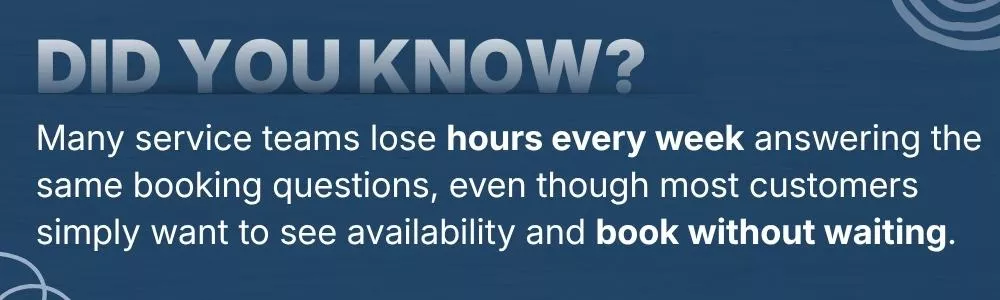
Fix Workflows Before Scaling Service Business
Let’s imagine a small wellness studio.
The owner is getting more bookings. Good news.
But the front desk is overwhelmed. Customers are calling to book sessions. Some are messaging on Instagram. Some are emailing. Some are walking in. A few are asking about the package balance. Others want to reschedule. Someone forgot to pay. Someone else says they never received a reminder.
The owner thinks, “We need another person at the front desk.”
That may help for a while. But here is the real issue:
The business does not have a staff shortage. It has a workflow shortage.
If bookings still come through five different places, another staff member will simply help manage the chaos. If reminders are still sent manually, someone still has to remember to send them. If payments are still tracked in a spreadsheet, someone still has to check the sheet. If customer information is scattered, someone still has to search for it.
Hiring more people into a broken process is like buying more buckets for a leaking roof.
You may catch more water, but the leak is still there.
Before hiring, service businesses should ask:
- What tasks are repeated every day?
- What questions do customers ask again and again?
- Where does the team lose the most time?
- Which mistakes keep happening?
- Which work can be handled by software instead of staff?
Once you answer those questions, the path becomes much clearer.
Automate Manual Work in Service Businesses
There is a difference between work that needs a human and work that only needs a good system.
- A client consultation needs a human.
- A haircut needs a human.
- A massage needs a human.
- A fitness session needs a human.
- A therapy session needs a human.
- A repair visit needs a human.
But many daily admin tasks do not need constant human attention.
Repetitive Tasks That Quietly Drain the Team
Your staff may be spending hours every week on things like:
- Checking available appointment slots
- Sending booking confirmations
- Calling customers with reminders
- Updating calendars after reschedules
- Tracking deposits and payments
- Managing package balances
- Answering basic service questions
- Creating invoices
- Preparing reports
- Following up with no-shows
- Manually entering customer details
- Checking staff availability
- Explaining cancellation rules again and again
None of these tasks is dramatic. No one writes a business horror story called “The Reminder Email That Ruined My Life.”
But these small tasks add up.
- A five-minute call here.
- A ten-minute calendar check there.
- A delayed payment follow-up.
- A missed appointment reminder.
- A staff member is waiting for confirmation.
By the end of the week, your team has lost hours to admin work that could have been handled automatically.
That is why service business automation matters. It does not make the business less personal. It gives your team more room to be personal where it counts.
Automate Booking Process to Reduce Pressure
If you want to scale service business operations without increasing staff, start with bookings.
Booking is where most service businesses lose time, energy, and customer patience.
Think about how customers behave today. They do not always want to call during business hours. They do not want to wait for someone to reply, “Let me check.” They do not want to send three messages just to find a suitable time.
They want to see availability, book, pay if needed, receive confirmation, and move on with their day.
Preferably before their coffee gets cold.
That is why the decision to automate the booking process can make a major difference.
What an Automated Booking Process Can Handle
A strong booking system can help customers:
- View available services
- Choose a date and time
- Select a staff member or provider where needed
- Book appointments online
- Pay deposits or full amounts
- Receive instant confirmation
- Get reminders before the appointment
- Reschedule within business rules
- Join a waitlist
- Receive follow-up messages
Now think about what this means for the team.
- Fewer calls asking for availability.
- Fewer manual confirmations.
- Fewer missed reminders.
- Fewer booking errors.
- Fewer awkward “Sorry, that slot was already taken” conversations.
When booking becomes smoother, the entire business feels lighter.
- The customer gets convenience.
- The staff gets breathing room.
- The owner gets better control.
That is a rare win in which nobody has to pretend to enjoy admin work.
Self-Service Booking Improves Customer Experience
Some business owners worry that automation will make their business feel less human.
That fear makes sense. Service businesses are built on relationships. Customers return because they trust the people. They remember how they were treated. They notice small details. They like feeling recognized.
But self-service does not remove the human touch. Poorly planned automation can do that, but good automation does the opposite.
It removes the dull parts of the experience so the human parts become stronger.
What Customers Actually Want to Handle Themselves
Many customers are happy to manage simple actions on their own, such as:
- Booking an appointment
- Checking available times
- Paying online
- Viewing package balance
- Rescheduling a visit
- Reading service details
- Completing basic forms
- Getting reminders
- Joining a waitlist
They do not need a staff member for every small step.
In fact, forcing customers to call for basic things can make the business feel outdated. It creates friction. It slows things down. It also puts more pressure on the team.
Self-service gives customers control without taking away care.
- The staff still delivers the service.
- The business still builds the relationship.
- The customer still feels looked after.
The difference is that no one has to spend fifteen minutes finding a slot that the customer could have selected in fifteen seconds.
Business Growth Tools That Solve Real Problems
Not every tool helps a business grow. Some tools only add more tabs, more passwords, and more reasons for staff to say, “Where did we save that again?”
The goal is not to collect software. The goal is to reduce friction.
The best business growth tools are those that make everyday work easier, clearer, and less reliant on memory.
Tools That Help Service Businesses Grow Without Extra Staff
A growing service business may need tools for:
- Online booking
- Staff scheduling
- Customer profiles
- Automated reminders
- Payment collection
- Package and membership tracking
- Point of sale
- Email communication
- Reporting
- Waitlist management
- Class scheduling
- Feedback collection
- Marketing follow-ups
- The key is connection.
If your booking system does not talk to your payment system, someone still has to bridge the gap manually.
If your customer records are separate from your appointment history, someone still has to search through them.
If your staff schedule is not connected to booking availability, someone still has to check before confirming.
Good business growth tools should reduce the number of things your team has to remember, chase, double-check, or manually update.
That is how software begins to create real capacity.
Automate Tasks to Reduce Team Interruptions
Interruptions are one of the highest hidden costs in service businesses.
- A staff member starts helping a client, then the phone rings.
- Someone begins preparing for the next appointment, then a customer asks about availability.
- A manager reviews the schedule, and then someone needs to confirm payment.
- A therapist finishes a session, then has to check the package balance.
The day becomes a chain of small interruptions.
Each one may seem harmless, but together they damage focus and service quality.
Automation Helps Protect Deep Work
When reminders, confirmations, payments, and basic updates are handled automatically, the team experiences fewer interruptions.
That means:
- Front desk staff can focus on customers in front of them
- Service providers can prepare properly between appointments
- Managers can spend less time chasing updates
- Customers get faster answers
- The business feels more organized
A service business does not always need more people. Sometimes it needs fewer interruptions.
That one change alone can make the same team feel far more capable.
Standardize Operations Before Scaling Your Business
Growth becomes risky when every employee has their own way of doing things.
- One person writes customer notes in the system.
- Another keeps them in a notebook.
- Someone confirms appointments by email.
- Someone else uses messages.
- One staff member remembers cancellation rules.
- Another explains them differently.
Customers may not see the internal mess at first, but sooner or later, it reaches them.
- They receive the wrong reminder.
- Their appointment is not updated.
- Their package balance is unclear.
- Their payment status is missing.
- Their request gets forgotten.
This is why standardization matters.
What Should Be Standardized?
Service businesses should create clear processes for:
- Booking appointments
- Rescheduling appointments
- Managing cancellations
- Collecting deposits
- Recording customer preferences
- Tracking packages
- Assigning staff
- Sending reminders
- Handling complaints
- Following up after visits
- Managing no-shows
- Preparing daily reports
Once these processes are managed through operations management software or service business management software, the business becomes less dependent on guesswork.
The system holds the process together.
That helps new staff learn faster, existing staff work better, and customers receive a more consistent experience.
As your team grows busier, scheduling mistakes can quickly turn into lost time, unhappy clients, and unnecessary stress. For a deeper look at this, read Dotbooker’s guide on multi-staff coordination and preventing double bookings.
Reduce No-Shows With Booking Automation
No-shows are painful.
They leave empty slots, lost income, frustrated staff, and that special kind of silence that happens when everyone realizes the customer is not coming.
For appointment-based businesses, no-shows can quietly damage revenue. A few missed bookings each week may not seem serious, but over a month or a year, the loss can be significant.
The good news is that no-shows are often preventable.
Not always, because life happens, and cars break down. Meetings run late. People forget. Some people also seem to believe appointment times are more of a suggestion than a commitment.
But many no-shows can be reduced with better systems.
How Automation Helps Reduce No-Shows
Service businesses can reduce no-shows by using:
- Automated appointment reminders
- Deposit collection
- Prepayment options
- Clear cancellation policies
- Easy rescheduling links
- Waitlist alerts
- Follow-up messages for missed appointments
The goal is not to punish customers. The goal is to make the commitment clear and communication easier.
When customers receive reminders at the right time, they are more likely to show up. When deposits are required, they are more likely to take the booking seriously. When rescheduling is simple, they are less likely to disappear.
That protects revenue without forcing staff to manually call everyone.
Use Data Before Hiring More Staff
Hiring should be based on evidence, not panic.
A business can feel busy for many reasons. Maybe demand is growing. Maybe the team is overloaded. Maybe the schedule is poorly arranged. Maybe certain services take too much admin time. Maybe some hours are overbooked while others are empty.
Without data, it is hard to know.
Reports That Help Service Businesses Make Better Decisions
Before hiring more staff, look at:
- Booking volume by day
- Booking volume by hour
- Most booked services
- Least booked services
- No-show rates
- Cancellation rates
- Revenue by service
- Revenue by staff member
- Staff utilization
- Customer repeat rate
- Package usage
- Payment pending reports
- Peak season trends
These reports help you see what is really happening.
For example, if Saturdays are packed but weekdays are quiet, hiring full-time staff may not be the answer. You may need better schedule planning or peak-time pricing.
If one service provider is always booked but others have space, you may need better customer routing.
If cancellations are high, you may need deposits and reminders before you need new staff.
If reports show consistent demand, full schedules, and strong revenue, then hiring may make sense.
The point is simple: let the numbers speak before payroll grows.
Increase Revenue Without Expanding Your Team
Scaling without increasing staff does not mean squeezing more work out of people.
That is not growth. That is burnout wearing a business suit.
The goal is to help the same team create more value by removing low-value admin work.
What Better Capacity Looks Like
A receptionist who no longer spends the whole day confirming appointments can focus on customer care.
A manager who no longer has to build reports manually can focus on pricing, packages, and customer retention.
A service provider who no longer has to track package details by memory can focus on delivering a better experience.
A business owner who no longer chases every small update can focus on a growth strategy.
This is where operational efficiency software, or better said, service business management software, can practically support the business.
It does not replace the people who make the business special. It gives them a better way to work.
Improve Customer Loyalty With Better Follow-Ups
Growth is not only about getting new customers. It is also about bringing back existing customers.
Many service businesses lose repeat revenue because follow-ups are inconsistent.
- A client finishes a session and never receives a follow-up.
- A package expires quietly.
- A customer who has not visited in months is forgotten.
- A birthday offer is never sent.
- A feedback request is skipped.
- A loyal client does not get a reminder to rebook.
These are missed chances.
Simple Follow-Ups That Support Growth
Service businesses can use automation to send:
- Thank-you emails
- Rebooking reminders
- Package renewal reminders
- Membership updates
- Birthday offers
- Feedback requests
- Abandoned booking reminders
- Post-visit care instructions
- Special promotions
- Seasonal campaign emails
This kind of communication keeps the business visible without forcing staff to remember every customer manually.
Customers do not always leave because they are unhappy. Sometimes they simply forget, get busy, or find another provider that makes it easier to return.
A good follow-up system helps bring them back.
Keep Human Service at the Center
The smartest systems in the world cannot replace warmth, trust, skill, and care.
Customers remember how they felt.
- They remember the receptionist who greeted them by name.
- They remember the therapist who understood their preference.
- They remember the trainer who noticed their progress.
- They remember the stylist who got the details right.
- They remember the business that made booking easy and service personal.
Technology should support that experience, not overshadow it.
The best way to scale service business operations is to keep people focused on the work that needs heart, judgment, and attention, while software handles the repetitive tasks behind the scenes.
Think of it this way:
Your team should not be spending their best energy asking, “What time works for you?”
They should be spending it making customers want to come back.
A Practical Plan to Scale a Service Business
If your business is growing but your team already feels stretched, do not rush into hiring first.
Start with a simple review.
Step 1: List the Tasks That Repeat Every Day
Write down the tasks your team handles again and again.
- Bookings
- Reminders
- Payment follow-ups
- Schedule changes
- Customer questions
- Package tracking
- Reports
- Staff coordination
This shows where time is being lost.
Step 2: Find the Tasks That Do Not Need Manual Work
Not every task needs a person.
If software can send reminders, collect deposits, update calendars, and confirm bookings, let it.
Your team should not be doing work that a system can do faster and more consistently.
Step 3: Automate the Booking Process First
Booking affects almost everything. It affects the customer experience, staff schedule, payments, reminders, and daily workload.
Improving this area usually creates the fastest relief.
Step 4: Centralize Customer and Staff Information
Keep customer records, appointment history, payments, packages, and staff schedules in one place.
Scattered information slows everyone down.
Step 5: Track the Right Reports
Use data to understand demand, revenue, cancellations, staff workload, and customer behavior.
This helps you make decisions with more confidence.
Step 6: Improve Follow-Ups
Build simple communication flows that keep customers engaged before and after appointments.
Retention is often easier and less costly than constantly chasing new customers.
Step 7: Hire Only When the System Is Ready
Once your processes are clean and the right tools support your current team, hiring becomes more effective.
New staff can step into a system that already works.
That is much better than asking them to join the circus and hoping they know how to juggle.
Smarter Growth Starts With Better Software
Scaling a service business does not always require a bigger team. Sometimes it requires a better way to run the team you already have.
When booking, payments, reminders, schedules, customer records, and reports depend on manual work, growth feels heavy. Every new customer adds more pressure. Every extra appointment creates more admin. Every missed reminder or payment follow-up becomes another small problem waiting to happen.
But when the right systems are in place, growth becomes easier to manage.
- You can automate the booking process steps.
- You can reduce no-shows.
- You can give customers self-service options.
- You can help staff work with fewer interruptions.
- You can track performance with real data.
- You can increase revenue without immediately increasing payroll.
That is where Dotbooker can help service businesses grow with more control.
Dotbooker brings booking, scheduling, payments, customer management, reminders, packages, and business reporting into one platform, making it easier for salons, spas, fitness studios, wellness centers, clinics, and other service businesses to manage daily operations without adding unnecessary workload to the team.
The goal is not to make your business feel less personal.
The goal is to remove the repetitive work that keeps your people from delivering the kind of service customers remember.
Because real growth is not just about serving more people.
It is about serving more people without losing the experience that made them choose you in the first place.
Popular Blogs

- Oct 20, 2022
- 6090
- Sep 08, 2024
- 5573

- Nov 11, 2022
- 4961
- Oct 13, 2025
- 4006
Ready to Transform
Your Business?

Get expert guidance to streamline your business operations.