Future of Fitness Challenges: How Studios Are Turning Goals Into Experiences
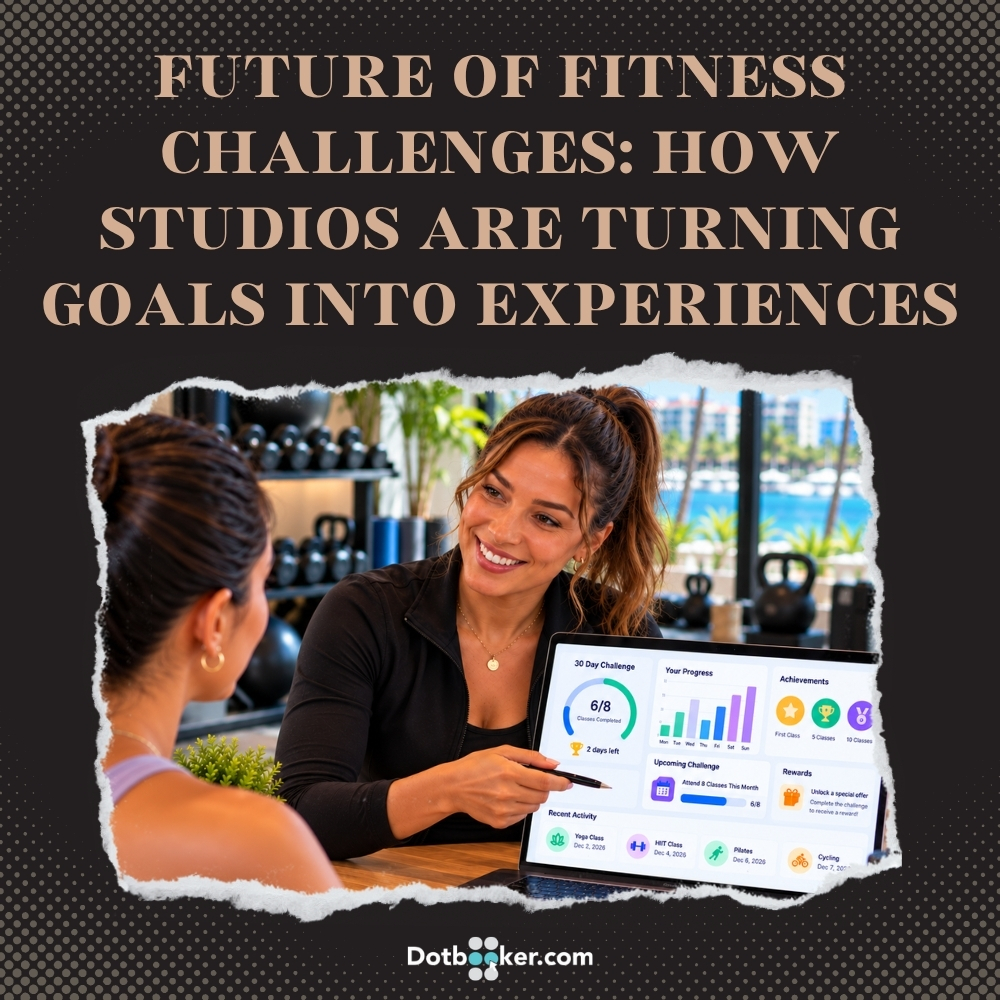
A fitness challenge used to be as simple as writing a goal on whiteboard:
"Attend 10 classes this month."
Today, studios can turn that same goal into something much more engaging. A member can see progress, reach milestones, earn a badge, collect points, complete a challenge and recognition for staying involved. The goal has not changed much. The experience around it has.
That shift is becoming interesting for gyms, Pilates studios, cycling businesses and other fitness businesses in Cayman and beyond. Customers are not only looking for a place to work out. They may also want a reason to keep participating, something to look forward to and a way to see their progress.
This is where fitness gamification software comes into the picture.
Gamification means adding game-like elements such as goals, challenges, points, badges, achievements, or leaderboards to a non-game experience. In fitness, these elements can turn routine activities such as attending a class or completing a milestone into something customers can see and celebrate.
Research on gamification in fitness apps has found that the type and design of game elements matter. One study found that gamification can influence engagement and loyalty, while also highlighting that the way these elements are designed affects how users respond to them.
For studios, the opportunity is not to turn every workout into a competition.
It is to ask a better question:
What if reaching a fitness goal felt like an experience, not just another task?
What Is Fitness Gamification Software?
Fitness gamification software uses game-inspired features to make customer participation more visible and engaging. Depending on the system, this can include points, badges, achievements, challenges, goals, progress tracking, and recognition. For a fitness studio, the action being recognized could be very simple.
A customer attends a class.
They complete a challenge.
They reach a membership milestone.
They book their tenth session.
They participate consistently for a month.
Instead of that activity disappearing into a booking history, it can become part of a visible progress journey.
That is the basic idea behind fitness gamification software.
Technology does not need to make the fitness experience complicated. In fact, the best challenge may be one that a customer understands within a few seconds.
Fitness Customers Need Reasons to Stay Engaged
Joining a fitness business is one decision. Continuing to participate is a series of decisions.
A customer might book their first class because they are curious. They may return because they enjoyed the experience. After that, the studio needs to remain relevant enough for them to keep choosing another class, another session or another challenge.
This is where a fitness rewards program can add something different to the customer's journey.
Imagine a customer who has attended four classes and discovers that five classes unlock their first achievement. Suddenly, the next class has another small reason behind it. The customer is not simply attending because they have membership. They are also working toward something they can see.
The goal should remain realistic. A challenge should encourage participation rather than make customers feel pressured to compete.
For a Cayman studio, this could be as simple as a monthly "Attend 8 Classes" challenge. A Pilates studio could recognize customers who complete a certain number of sessions, while a cycling studio could create a participation challenge around rides completed during a specific period.
The activity is ordinary. The experience around it becomes more engaging.
Why Challenges Create Stronger Participation
A good fitness challenge gives customers three things: a clear goal, a way to track progress, and a reason to celebrate completion.
Without those elements, "stay consistent" can feel vague. With them, the customer has something concrete to work toward.
For example, a fitness studio might introduce a 30-day challenge requiring eight eligible classes. A member who has completed six knows exactly where they stand and what remains. That clarity can make the goal feel more achievable.
This is where fitness challenge software can support the process. Instead of maintaining a separate spreadsheet or asking staff to manually track every participant, a digital system can connect activities with goals and achievements.
Research into gamification in fitness apps also suggests that different game elements can influence users in different ways, which means studios should think about the purpose of each challenge rather than adding points or badges simply because they are available.
A challenge should answer a simple question:
"What would make this customer's next visit feel worth coming back for?"
Turning Everyday Actions into Achievements
One of the most interesting parts of fitness gamification software is that the action being rewarded does not have to be extraordinary.
It can be something customers are already doing.
A first booking can become a welcome achievement.
Five completed classes can become a participation milestone.
Ten classes can unlock a new badge.
A membership anniversary can become a recognition moment.
A completed studio challenge can become a special achievement.
This creates a simple journey:
Participation → Progress → Achievement → Recognition
The Rewards & Recognition feature follows this type of approach by supporting points, badges, achievements, and goal-based activities, along with challenges and performance tracking. Dotbooker
The benefit is not that every customer suddenly becomes competitive. Instead, the studio has another way to recognize the actions that matter to its customer experience.
What Can Fitness Studios Turn into a Challenge?
There are plenty of possibilities, and they do not all need to involve competition.
Attendance Goals
A studio can create a goal such as attending eight classes a month. This works well when the business wants customers to focus on regular participation.
Class Completion
A challenge can encourage customers to try different classes. For example, a fitness studio could ask members to complete three different class formats within a defined period.
Membership Milestones
Not every achievement has to be based on class attendance. A membership anniversary or another customer milestone can also become an opportunity for recognition.
Seasonal Challenges
A studio could create a short-term challenge around a month, season or special occasion. A Cayman fitness business could create a local campaign around a particular period while keeping the goal simple and accessible.
Community Challenges
Instead of asking every customer to compete against one another, the studio can create a shared target. Customers contribute toward a collective goal, creating a sense of participation without requiring individual rankings.
These examples can all become part of a fitness rewards program, provided the rules are clear, and the challenge matches the type of customer the studio serves.
Rewards Do Not Always Mean Discounts
Discounts are easy to understand, but they are not the only way to recognize customers.
A reward can be something much simpler. A customer could receive a badge after completing a challenge. A milestone could appear on their profile. A studio could recognize a customer's achievement through a message or provide another benefit that fits the business.
This is where wellness rewards can become more interesting.
The reward can recognize the behavior itself rather than simply reducing the price of the next purchase.
For example: "You completed 10 classes."
That message recognizes something the customer actually achieved.
A gym loyalty program can use the same principle. Instead of making every loyalty interaction about discounts, a gym can recognize attendance milestones, challenge completion or other activities that show continued participation.
The key is relevance. If the reward has no connection to what the customer did, it can feel like a marketing gimmick. If the reward directly follows an action, the connection is much easier to understand.
How Studios Can Build Their Own Challenge Programs
A studio does not need a complicated gamification strategy to get started.
Begin with one clear behavior.
Maybe my goal is attendance.
Maybe it is trying different classes.
Maybe it is completing a specific number of sessions.
Once the behavior is selected, decide how the goal will be measured and how customers will know they are making progress.
Then decide what happens when they complete it.
For example:
Goal: Complete 10 classes.
Period: 30 days.
Progress: Each eligible class counts toward the goal.
Completion: Customer receives an achievement badge.
Next step: Customer can begin another challenge.
This structure keeps the experience easy to understand.
The studio can later introduce more challenge types as it learns what its customers enjoy.
A fitness challenge software approach can make these programs easier to manage when participation grows because customer actions, progress and achievements can be handled within the same system.
How a Gym Loyalty Program Can Go Beyond Discounts
A gym loyalty program can be much more than "spend more and receive a discount."
Consider a member who has attended regularly for several months.
The gym could recognize:
First Class
10 Classes
25 Classes
50 Classes
Membership Anniversary
Each milestone gives the customer another moment of recognition. This does not mean every milestone needs a financial reward. Some customers may appreciate visible recognition just as much as a discount.
A gym could also offer different types of challenges for different customer groups. New members could have an introductory challenge, regular members could receive monthly participation goals, and long-term members could receive anniversary recognition. That makes the experience feel less generic.
What the Future of Fitness Challenges Could Look Like
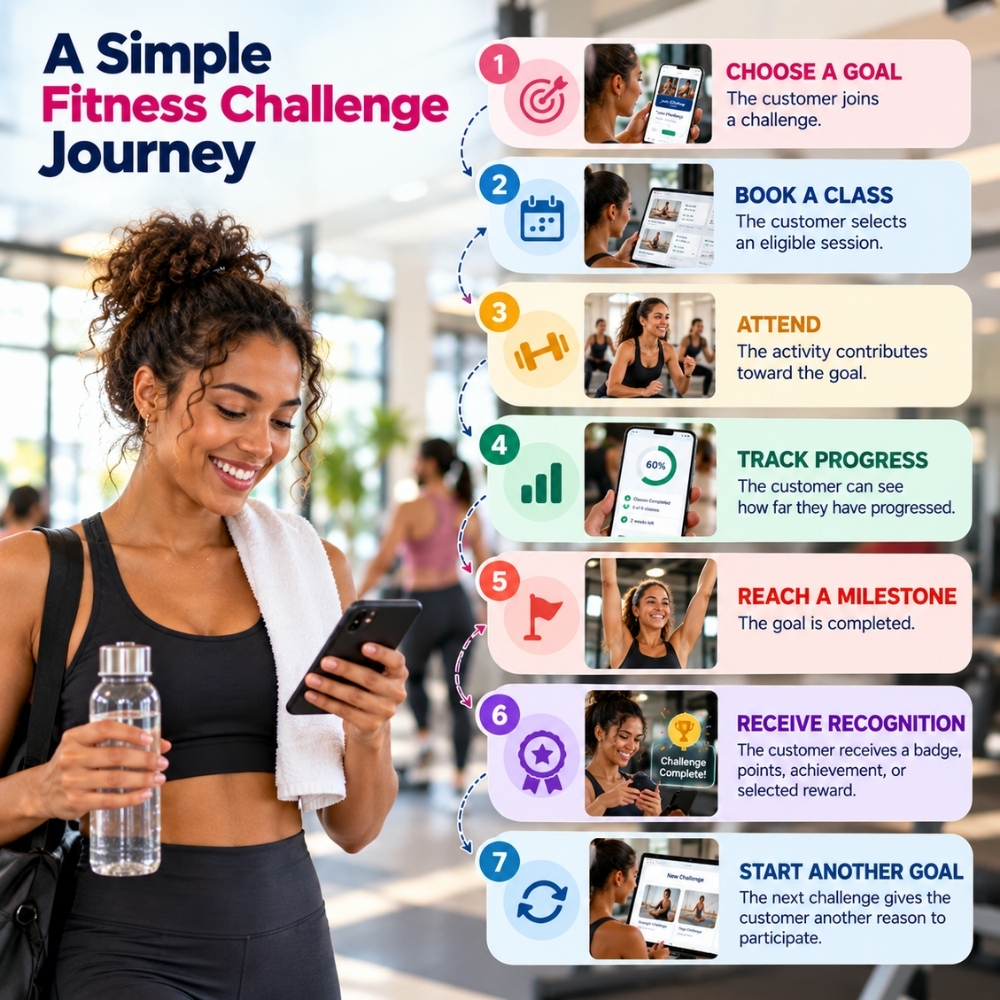
Fitness challenges can connect several parts of a studio's customer journey. A customer books a class.
The customer attends.
That activity contributes to a goal.
The customer sees progress.
The customer achieves an achievement.
The studio recognizes it.
Then another goal becomes available.
This creates a cycle:
Book → Participate → Progress → Achieve → Recognize → Return
The future is not necessarily about making fitness more complicated. It is about making routine participation more visible and giving customers small moments worth celebrating.
The referenced discussion of future fitness technology also points toward more connected studio systems, including smarter scheduling, personalized engagement, automated communication, and data-informed decision-making.
Gamification can fit into that wider customer experience without replacing the human side of a fitness business.
A trainer still motivates the customer.
A studio still creates the community.
A challenge simply gives the customer another reason to participate.
Turn Fitness Goals Into Experiences
The next generation of fitness challenges does not have to be about bigger prizes or tougher competition.
It can be about making small moments matter.
The first class becomes a milestone.
Ten classes become an achievement.
A completed challenge becomes something worth celebrating.
A membership anniversary becomes an opportunity for recognition.
For gyms, Pilates studios, cycling businesses and fitness businesses in Cayman, this creates a simple way to make routine participation more engaging without losing the personal side of the customer experience.
A fitness rewards program can recognize participation. A gym loyalty program can move beyond discounts. Fitness challenge software can help organize goals and progress, while customer engagement software can connect customer activity with recognition.
Wellness rewards can then become part of a broader experience that makes customers feel noticed.
The most effective challenge may not be the most complicated one.
It may be the one where a customer looks at their progress and thinks:
"I'm almost there. I'll come back for one more class."
Dotbooker Rewards & Recognition feature supports points, badges, achievements, goal-based activities, challenges and progress tracking. These capabilities can work alongside customer profiles, memberships, packages, bookings and reports, helping fitness businesses connect everyday customer activity with recognition.
Frequently Asked Questions
What is fitness gamification?
Fitness gamification means using game-inspired elements such as challenges, points, badges, achievements and goals within a fitness experience. The purpose is to make participation and progress more visible and engaging.
How can a fitness rewards program engage customers?
A fitness rewards program can recognize actions such as attending classes, completing challenges, or reaching milestones. Recognition can take the form of badges, points, achievements, special benefits, or other rewards selected by the business.
Can a fitness studio create its own challenges?
Yes. A studio can create challenges around attendance, completed sessions, class participation, membership milestones, or other activities that make sense for its customers. The rules should be simple enough for customers to understand.
What are examples of fitness rewards?
Fitness rewards can include points, badges, achievement recognition, certificates, special access, selected benefits, or other rewards. A studio does not have to rely entirely on discounts.