- By Dotbooker
- Dec 10, 2025
- 995
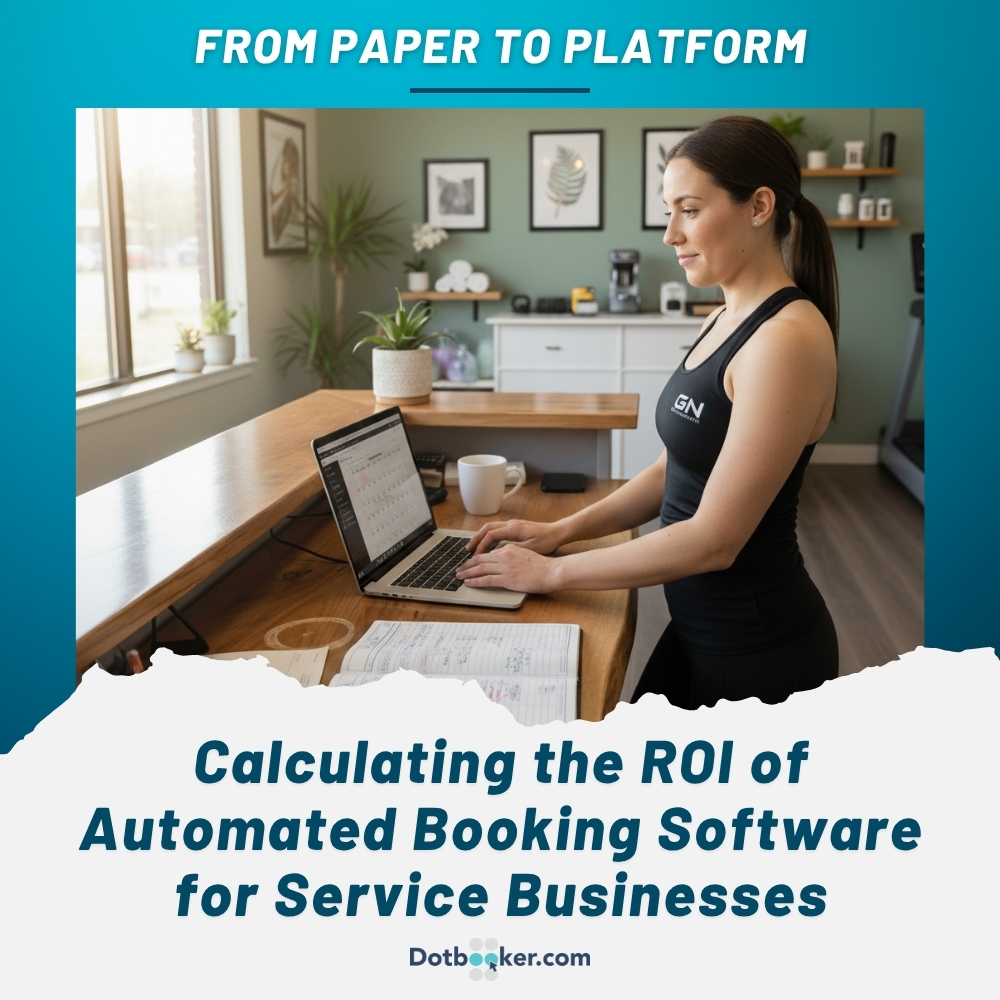
From Paper to Platform: Calculating the ROI of Automated Booking Software for Service Businesses
Appointment books used to control every front desk. A business day was depicted on pages full of names, scrawled times, crossed-out slots, and coffee stains. From a distance, everything appeared well-organized, but then the inevitable call came in: "Can I reschedule my 2 p.m.?"
That’s when chaos usually began.
Fast-forward to now, where those same businesses are run from screens, not binders. Bookings confirm themselves. Reminders are sent automatically. Cancellations are logged without panic. And the best part? Every action leaves behind data, data that tells you exactly how efficiently your business runs.
The transition from paper to platform is more than just a fad; it's a change that pays for itself more quickly than most people think.
Understanding ROI Before You Begin
Before diving into automation, it’s important to understand what ROI, Return on Investment, really means for a service business. In simple terms, ROI measures how much value or profit you gain compared to what you spend. For a salon, spa, fitness studio, or wellness center, that “return” could come from saved time, reduced manual errors, higher bookings, or improved customer loyalty.
When you invest in new technology like an automated booking system, ROI helps you see whether that investment is actually working for you. It shifts your focus from cost to value created. Instead of asking “How much will it cost?”, you start asking “How much more will I earn or save with it?”
How to Calculate ROI in Simple Terms?
Understanding ROI isn’t about complex spreadsheets; it’s about seeing where your business gains value. For service-based businesses, every hour saved, every missed appointment avoided, and every new client retained translates into measurable returns.
Think of ROI (Return on Investment) as the yardstick that tells you how well your investment, in this case, an automated booking system, is performing. It connects the dots between what you spend and what you get back in time, money, and peace of mind.
Here’s the simple formula to remember:
ROI = (Total Gains from Automation – Software Cost) ÷ Software Cost × 100
This equation helps you turn invisible savings into visible proof. Your total gains include any cost savings (like reduced admin hours), recovered revenue (from fewer no-shows), and even incremental sales (from repeat or referral clients).
Let’s visualize it with a realistic example.
Suppose you run a spa or wellness center with 25 daily appointments. Before automation, your team spent at least an hour a day managing bookings, confirming slots, and handling cancellations; roughly 25 hours a month. If your staff’s time is valued at $20 per hour, that’s $500 in labor spent purely on scheduling.
Now add the revenue lost from no-shows.
Let’s say you lose five appointments a week, each worth $70; that’s $1,400 gone every month. Automated reminders can cut that in half, saving you $700. Add another $200 earned from loyal clients who rebook more easily thanks to the smooth digital experience, and your total monthly gain now stands at $1,400 ($500 + $700 + $200).
If your booking software costs $100 per month, here’s your ROI:
ROI = (1,400 – 100) ÷ 100 × 100 = 1,300 %
That’s a thirteenfold return on your investment, and this doesn’t even account for intangible benefits like happier clients, smoother workflows, or reduced stress for your team.
When viewed this way, automation stops being an expense and becomes a strategic growth driver. It’s not about cutting costs; it’s about multiplying outcomes. The more your system integrates into your daily operations, the higher your ROI climbs month after month.

The Silent Killer of Profit: Missed Appointments
Service companies have strict deadlines. Every time a slot is unfilled, money is lost. Even though a single no-show might not seem like much, it can add up to hundreds or even thousands of dollars in lost revenue over the course of a month.
Reminders in conventional setups rely on the customer's memory, last-minute calls, or sticky notes. The odds of a forgotten appointment are high. An automated booking software, however, completely changes this dynamic.
It sends timely reminders through email, SMS, or push notifications. If a client cancels, the slot instantly reopens for someone else. Some systems even allow wait-listed clients to auto-fill the gap. These subtle automations can reduce no-shows by 30 to 50 percent.
Take an average spa that charges $70 per session. If it loses five appointments per week to no-shows, that’s $1,400 per month down the drain. Cutting that in half recovers $700, enough to cover the software’s subscription several times over. In simple math, your system has already paid for itself before even factoring in time savings.
Turning Everyday Data into Business Decisions
A significant difference between paper and platform isn’t just convenience, it’s visibility.
With manual bookings, you might know how busy last week felt, but you can’t pinpoint which days performed best or which service brought in the most revenue. An online booking system changes that. Every click, booking, and cancellation becomes data that paints a clear picture of your operations.
You begin to see trends:
- Fridays are fully booked by 3 p.m., but Mondays are slow.
- Hair coloring brings in more first-time customers than any other service.
- A particular stylist or therapist gets more repeat bookings than others.
This data isn’t trivia; it’s a roadmap. You can shift marketing spend to slower days, adjust staff scheduling, or bundle popular services to improve margins. Decisions stop being reactive guesses and become proactive strategies, each adding to your long-term ROI.
The Customer Experience That Feels Effortless
Numbers aside, the most powerful outcome of automation is emotional, the experience it creates for customers.
Waiting for a callback to schedule a haircut seems archaic in a time when people use their phones to get groceries, coffee, and movie tickets. Customers desire clarity, control, and promptness. An automated booking system provides that.
They can browse available slots, choose their favorite staff member, pay online, and receive instant confirmation, all without waiting in line or making a single phone call. It feels personal even though it’s digital because it respects their time.
And when customers feel cared for, they return. A smooth digital journey often translates into higher retention, better reviews, and organic referrals, three growth levers that outperform any paid marketing campaign. Over months, this consistent satisfaction forms a steady stream of recurring revenue that compounds the software’s ROI.
Integration: The Secret to Compounding Returns
Automation doesn’t end with scheduling. The true power of modern systems lies in their integrations.
A fully equipped booking system for service businesses connects with your payment gateway, CRM, email marketing tool, and even accounting software. That means when a booking is confirmed, the payment logs are automatically updated, the client profile is updated, and the marketing database gets smarter.
This connected ecosystem eliminates repetitive work. You no longer have to manually reconcile payments or copy client details between systems. Errors drop, efficiency soars, and your team finally has time to focus on value-driven activities instead of data entry.
In financial terms, integration compounds ROI. It doesn’t just save costs once; it keeps multiplying them across every function that touches your booking process.
Scaling Without Stretching Your Team
Growth is a double-edged sword. As your bookings increase, so does your workload, unless your system scales with you. Paper processes buckle under pressure. Even spreadsheets reach their limit.
Conversely, an automated platform scales easily. The system adjusts if you add more services, hire more employees, or create new branches. Diverse teams, numerous locations, and thousands of appointments may all be managed via a single dashboard without confusion.
Scalability is more than just convenience for expanding service companies; it's sustainability. It ensures that as your revenue increases, your coordination costs don’t follow the same curve. That gap between the two lines? That’s your ROI growing in real time.
The Psychological ROI: Confidence in Control
There’s a form of return that can’t be plotted on a chart, the peace of mind that comes from control.
When your schedule, payments, and client data live in a single digital environment, there’s no fear of losing pages, missing numbers, or forgetting follow-ups. Reports are generated with a click. You know your busiest hours, top clients, and most profitable services without sifting through files.
This clarity empowers better leadership. Owners make decisions faster. Teams operate independently. Consumers see professionalism. The entire operation feels more regimented yet lighter, and this psychological shift often marks the difference between a corporation barely surviving and one flourishing.
The Digital Edge That Keeps You Ahead
As the service industry continues to evolve, the businesses that thrive will be those that adapt early and adapt smartly. That’s where platforms like Dotbooker make a difference.
Designed for fitness studios, salons, spas, wellness centers, and other service-based brands, Dotbooker brings together everything a business needs: a unified online booking system, integrated payment processing, membership management, staff dashboards, e-wallets, and detailed analytics.
It doesn’t just help you book appointments; it enables you to run the entire customer experience from a single screen. The platform turns scattered data into strategy, manual hours into automation, and everyday interactions into insights.
In other words, it’s the very embodiment of what “return on investment” means in the modern service economy, not just saving money but making your operations intelligent, responsive, and ready for growth.
So the next time you flip through an old appointment book, remember: every crossed-out name was once a missed opportunity. With the right system in place, those opportunities don’t slip away; they compound. And that’s when your business truly moves from paper to platform.
Popular Blogs

- Oct 20, 2022
- 6200
- Sep 08, 2024
- 5689

- Nov 11, 2022
- 5060
- Oct 13, 2025
- 4123
Ready to Transform
Your Business?

Get expert guidance to streamline your business operations.