
- By Dotbooker
- Mar 20, 2026
- 651
Predictive Revenue: Using AI to Fill Gaps Before They Happen
At 2:15 PM on a Wednesday, your treatment room is empty.
At 6:30 PM on Friday, you turn away three booking requests.
One hour bleeds revenue. The other leaves money unmaximized.
Most studios accept this imbalance as normal. But what if those gaps were not random? What if they were predictable patterns hiding in plain sight?
Across the Cayman Islands, the US, and Canada, wellness and fitness studios are discovering something powerful: revenue does not have to fluctuate unthinkingly. With Predictive churn analysis and Dynamic time-slot pricing, AI is quietly transforming empty hours into opportunities long before they become problems.
Let us step into what that really looks like.
The Silent Cost of Empty Slots and the Role of Revenue Leakage Prevention
An empty time slot is never just an empty slot.
It is:
- A therapist on standby
- A room with overhead costs
- A missed product upsell
- A lost referral opportunity
- A weaker retention cycle
But the impact runs even deeper than that.
Staff morale suffers when an hour is unfulfilled. It throws out daily revenue estimates. Commission payments become inconsistent as a result. The accuracy of forecasts is distorted. Recurrence of these gaps leads to instability, which gradually reduces profitability.
Think about this. Even two empty slots per day at $120 per service can add up to thousands of dollars in unrealized revenue for a studio each month. That has a substantial financial impact when multiplied by the number of rooms or practitioners.
Over time, these so-called “small gaps” form a recognizable pattern. Certain days dip. Certain services underperform. Certain instructors experience higher cancellation rates. That pattern is where AI thrives.
Studios that embrace Revenue leakage prevention stop viewing cancellations and slow days as unfortunate surprises. Instead, they treat them as behavioral signals. Why are weekday evenings slowing down? Why do certain members cancel more frequently after three months? Why does one service consistently underperform in a particular season?
Revenue gaps are not accidents. They are forecasts waiting to be decoded. And once decoded, they can be managed strategically rather than emotionally.

Predictive Churn Analysis: How AI Identifies Client Drop-Off Before It Happens
Clients rarely disappear overnight.
- They taper.
- They skipped one appointment.
- Then another.
- Then they stop responding.
The relationship has already deteriorated by the time they formally end it.
This is where the game is altered via predictive churn analysis.
AI tracks trends such as declining visit frequency, reduced spending, a shift to discounted services, reduced engagement with promotions, or longer booking intervals, rather than waiting for a cancellation email.
These indications often appear weeks or months before an official cancellation. They may be invisible to the naked eye. AI doesn't.
Imagine this scenario:
Once a week, a devoted member now books once every three weeks. They switch from expensive evening programs to less expensive midday timeslots. They stop buying add-ons. The AI system instantly detects this deviance. An automatic retention procedure may include a personalized service recommendation, a loyalty award, early access to a new class, or even a check-in message from the studio manager.
This is not guesswork. It is behavioral pattern recognition at scale.
Retaining an existing customer is far more cost-effective than finding a new one for studios in competitive areas like Toronto, Miami, or Grand Cayman. Staff time, onboarding discounts, marketing expenditures, and promotions raise acquisition expenses. Predictive churn analysis makes sure you take action while it's still possible to maintain the relationship and safeguard recurring income.
Retention becomes proactive, not reactive.
Dynamic Time-Slot Pricing: Using AI to Align Pricing with Real-Time Demand
Not all hours are equal.
Tuesday at 11 AM does not have the same level of demand as Saturday at 5 PM. Yet many studios price them identically.
That rigidity quietly limits profitability.
With Dynamic time-slot pricing, AI continuously analyzes demand signals, booking velocity, historical patterns, seasonality, and real-time occupancy levels to determine optimal pricing for each slot.
When demand spikes, premium slots can command slightly higher rates.
When slower periods approach, subtle, time-sensitive incentives activate automatically.
This does not mean random discounting. It means strategic revenue alignment.
For example:
- If Friday evenings consistently sell out two weeks in advance, pricing can reflect that high demand.
- If mid-week afternoons remain underutilized, limited-time price adjustments can stimulate bookings without affecting peak margins.
Demand for spas in tourist-heavy areas, such as the Cayman Islands, fluctuates according to weather patterns, peak vacation seasons, and ship arrivals. In cities in the US and Canada, it could change in response to long weekends, school breaks, or business schedules.
Instead of remaining constant, dynamic time-slot pricing ensures prices respond appropriately. It protects overall revenue performance while mitigating occupancy volatility.
Demand Forecasting for Spas: Predicting Booking Trends Before Revenue Dips
Every studio has experienced it.
- A week that should have been busy is not.
- A typically quiet month suddenly surges.
Without visibility, these shifts feel unpredictable.
Through Demand forecasting for spas, AI combines booking history, client behavior, local events, seasonal trends, tourism cycles, and even external data points to project future occupancy with impressive accuracy.
Instead of asking why revenue dipped after the fact, owners can prepare in advance.
This allows studios to:
- Adjust staffing levels before paying for idle hours
- Launch targeted campaigns before bookings slow
- Align inventory orders with projected service demand
- Plan maintenance during expected low-demand windows
- Schedule high-performing instructors during projected peak periods
For example, marketing campaigns can be launched promptly rather than reactively if the algorithm predicts a drop in bookings in three weeks.
Revenue is stabilized, and operational stress is decreased by this change from reactive to predictive thinking. Owners switch from fighting fires to making strategic plans.
Automated Last-Minute Filler: Turning Cancellations into Revenue Opportunities
Cancellations are inevitable. What defines profitability is how quickly the gap is filled.
An Automated last-minute filler system activates the moment a cancellation occurs. It identifies clients who:
- Frequently book at short notice
- Live or work nearby
- Have flexible schedules
- Prefer that specific service or practitioner
The approach sends individualized notifications rather than bulk discounts. A customized notice is sent to a client who frequently schedules express facials. When a prime-time slot becomes available, a member who enjoys evening yoga is notified.
This accuracy preserves brand value while significantly increasing fill rates.
This response highlights impulsive demand in crowded US cities where last-minute reservations are typical. Filling cancellations rapidly becomes particularly crucial in smaller island markets, where each slot carries greater revenue weight.
An Automated last-minute filler transforms what would have been lost revenue into real income.
Smart Studio Occupancy Optimization: Maximizing Every Room, Service, and Hour
Most studio dashboards show total bookings. That view is incomplete.
Smart studio occupancy optimization evaluates performance at multiple levels:
- Room utilization
- Instructor performance
- Service category demand
- Time-slot profitability
- Repeat client ratios
This layered analysis reveals insights that manual tracking cannot.
- Which room consistently underperforms despite similar pricing?
- Which therapist drives the highest repeat bookings?
- Which services peak seasonally and which remain steady year-round?
For example, if weekday afternoons show low occupancy in a specific treatment room, AI may suggest introducing express services, corporate wellness packages, or beginner-friendly classes during that time.
Operational adjustments become precise rather than experimental.
That is operational intelligence in action.
Revenue Leakage Prevention Strategies Powered by Predictive Churn Analysis
Revenue rarely disappears in dramatic ways. It leaks gradually.
- Expired memberships.
- Unused prepaid packages.
- Unredeemed promotions.
- Underutilized instructors.
- Misaligned pricing.
Revenue leak prevention technologies regularly monitor these micro-losses. The method turns into a complete revenue protection when combined with demand forecasting for spas, dynamic time-slot pricing, and predictive churn analysis.
- If package utilization declines, alerts can trigger reminders.
- If instructor occupancy falls below a benchmark, scheduling adjustments are recommended.
- If certain services consistently underperform, bundling or repricing strategies are suggested.
- It identifies risk, suggests corrective action, and often executes them automatically.
- The result is a studio that feels steady and controlled even when market conditions shift.
From Instinct to Intelligence: Combining Predictive Churn Analysis and Dynamic Time-Slot Pricing
For years, studio owners relied on instinct.
- “We usually slow down in August.”
- “Evenings are always full.”
- “People cancel more during holidays.”
Despite their value, these insights are constrained by vision and memory.
AI turns intuition into quantifiable knowledge.
By combining Predictive churn analysis, Dynamic time-slot pricing, Smart studio occupancy optimization, and intelligent revenue protection systems, studios gain a data-driven roadmap.
Instead of hoping next month will perform better, they can see trends forming weeks in advance.
The emotional stress of unpredictability begins to fade. Decision-making becomes calm, informed, and deliberate.
For a deeper understanding of how AI and advanced booking systems are reshaping client experiences and operational efficiency, check out this insightful article on how AI is elevating spa experiences.
How Smart Studio Occupancy Optimization Drives Consistent and Scalable Growth
Studios that implement predictive revenue strategies often experience:
- Higher occupancy consistency
- Stronger client retention
- Increased revenue per available hour
- Reduced operational waste
- More targeted marketing investments
- Improved staff utilization
Complexity is not AI's real power. It's lucidity.
It brings to light the unseen cues that dictate whether your schedule fills consistently or erratically.
Predictive system adoption is no longer experimental for wellness brands in the Caribbean and North America. It is increasingly the distinguishing factor between resilient and reactive enterprises.
Growth ceases to be an accident when revenue is directed by intellect rather than chance. It becomes scalable, repeatable, and purposeful.
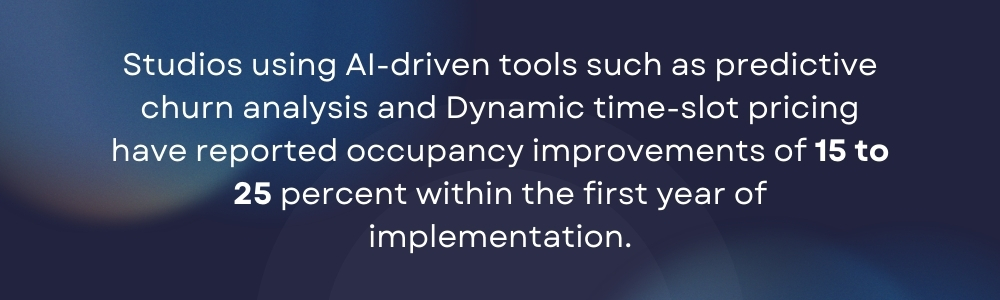
The Predictive Revenue Edge: Integrating Demand Forecasting for Spas and Dynamic Time-Slot Pricing for Long-Term Profitability
Revenue does not have to fluctuate unpredictably. It does not have to depend solely on promotions or seasonal luck.
- With Predictive churn analysis, you retain clients before they drift away.
- With Dynamic time-slot pricing, you align value with demand in real time.
- With Revenue leakage prevention, you seal the silent cracks.
- With Demand forecasting for spas, you see slowdowns before they appear.
- With an Automated last-minute filler, cancellations become opportunities.
- With Smart studio occupancy optimization, every room and hour works harder.
These features are combined into a single intelligent ecosystem by platforms such as Dotbooker. Dotbooker enables studios in the US, Canada, and the Cayman Islands to go from reactive scheduling to predictive revenue control by fusing booking management, AI-driven analytics, and real-time optimization tools.
Filling holes after they occur is not the way to go for future studio growth.
The goal is to make sure they don't occur very often.
Popular Blogs

- Oct 20, 2022
- 6075

- Sep 08, 2024
- 5556

- Nov 11, 2022
- 4933

- Oct 13, 2025
- 3989
Ready to Transform
Your Business?

Get expert guidance to streamline your business operations.