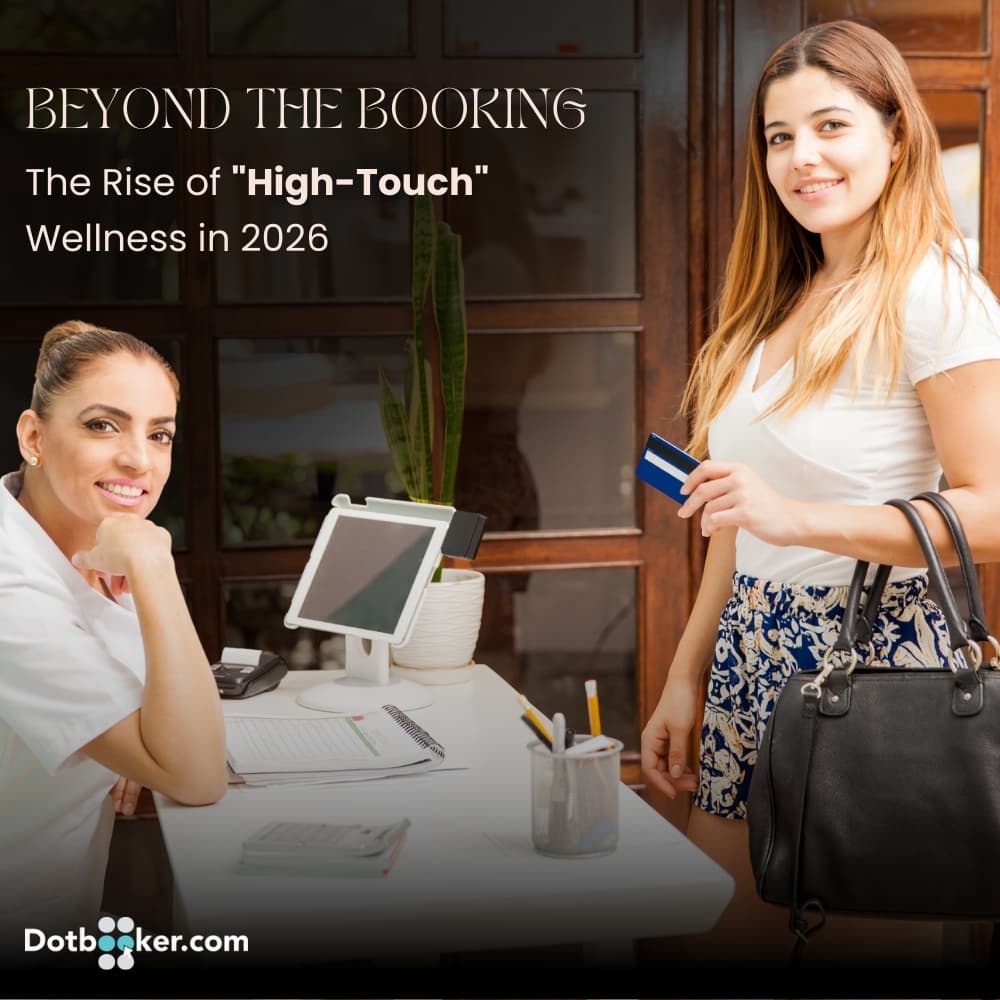
Beyond the Booking: The Rise of "High-Touch" Wellness in 2026
Here’s the common scenario:
- You can book a massage in eight seconds.
- You can pay with one tap.
- You can reschedule without speaking to anyone.
And yet, clients are walking away from places that make it easy.
Why?
Because convenience without connection feels empty.
Across the Cayman Islands, the US, and Canada, wellness businesses are discovering something powerful in 2026. Clients no longer remember how quickly the booking was made. They remember how they felt when they walked in. They remember whether they were seen.
That shift is redefining the industry. And at the center of it is Human-centric wellness technology.
When Booking Became Basic: Why Human-Centric Wellness Technology Is Redefining Client Experience in 2026
Not long ago, having online scheduling was a competitive advantage. Studios proudly advertised “Book Online” as if it were a luxury feature. Today, it is simply expected. If a wellness business does not offer seamless digital booking, clients quietly move on.
But here is the turning point. Booking is no longer the experience. It is just the entry.
What truly separates businesses now is what happens after the booking confirmation email lands in the inbox.
- Does the system remember the client’s shoulder injury from last year and automatically block deep-pressure add-ons?
- Does the therapist see that the client prefers quieter rooms and dim lighting?
- Does the front desk greet them by name, already aware that they are celebrating a birthday or recovering from a stressful week?
Customers want your system to know them by 2026. The experience seems generic if it doesn't.
This is where human-centric wellness technologies alter the discussion. For speed, it doesn't automate. It serves as the company's memory layer. It helps teams provide continuity of care by capturing comments, patterns, and preferences.
It arranges client histories so that employees don't have to make educated guesses. It presents insights without requiring staff members to search through numerous screens. It guarantees that returning customers feel appreciated rather than treated as a repeat customer.
Digital brilliance is invisible in 2026. Customers are unaware of the software. They observe that the therapist recalled their previous exchange. They observe that the checkout process was seamless. They realized they didn't need to say the same thing again and again.
The presence advances when technology regresses.
Soft-Care Optimization and Human-Centric Wellness Technology: The Missing Strategy for Premium Wellness Brands
Tighter timetables, fewer gaps, and quicker payments were once associated with operational optimization. Yes, it is important. However, it is not complete.
Without emotional awareness, efficiency can come across as clinical.
This is where Soft-care optimization comes in.
This is the art and science of improving the emotional component of the client journey without causing the business to lag. It emphasizes the minute features that most dashboards miss:
- Is the client journey calming or rushed?
- Does communication feel warm or templated?
- Are reminders helpful or overwhelming?
- Does rebooking feel supportive or transactional?
- Is the waiting area experience aligned with the brand's promise?
Soft-care optimization looks at timing, tone, and flow. It evaluates whether automated messages sound human. It measures whether staff transitions between clients feel smooth or chaotic. It considers how much mental effort the client must exert during their visit.
These nuances shape brand impression in high-value markets like the Cayman Islands, where expectations for quality service are ingrained. They affect retention in highly competitive cities in the US and Canada.
Soft-care optimization combines sensitivity with structured systems. It guarantees that comfort is not sacrificed for efficiency. It guarantees that data enhances empathy rather than replaces it.
When done correctly, clients leave feeling lighter, not processed.
Reducing Digital Friction with Soft-Care Optimization: Creating Seamless Yet Personal Client Journeys
Every extra click is a moment of hesitation. Every confusing instruction creates a silent drop-off.
That is why reducing digital friction has become one of the most strategic priorities for wellness operators in 2026.
But reducing friction does not mean removing personality. It means removing obstacles.
Clients should not have to:
- Fill out the same health form every visit
- Search through menus to rebook a favorite therapist
- Manually track remaining sessions in a package
- Struggle to apply credits or gift cards
- Navigate multiple payment portals
The process feels natural when technologies are purposefully created to minimize digital friction. The booking flow predicts probable choices. Preferred payment methods are remembered on the checkout page. It only takes a few seconds to rebook.
Personalization, however, remains. It's still possible for confirmation messages to feel cozy. Thoughtful notes can still be included in follow-ups. The mechanics, not the relationship, are freed from friction.
When tension disappears, trust increases. And when trust increases, loyalty follows.
Tech-Enabled Hospitality Powered by Human-Centric Wellness Technology: Anticipation as the New Luxury Standard
Luxury once focused on aesthetics. Today, luxury focuses on anticipation.
This is where Tech-enabled hospitality transforms the wellness space from functional to unforgettable.
Imagine this scenario in 2026:
A repeat customer schedules a facial. The system flags their past sensitivity to specific substances. Before the session starts, the therapist is informed. The client's known preferences are reflected in the room arrangement. Personalized aftercare guidance is included in a post-treatment email rather than a generic one.
This doesn't feel robotic at all. It seems focused.
Tech-enabled hospitality equips teams with context before interaction begins. It ensures that no client arrives as a blank slate. It allows managers to track service consistency across locations. It connects membership data, appointment history, and feedback into one cohesive picture.
Anticipation boosts brand trust in tourist-driven destinations like the Cayman Islands, where customers compare experiences worldwide. This degree of knowledge is expected in North American markets, where users are accustomed to customized digital platforms.
Reacting is no longer the essence of hospitality. It's about being aware.
For a deeper look at how wellness technology can personalize experiences and create seamless, thoughtful journeys for your clients, explore this in-depth discussion on wellness tech for spas.
Emotional Intelligence in Business and Soft-Care Optimization: Turning Data into Meaningful Client Relationships
Data can tell you what happened. Only awareness can tell you why.
A client who reduces visit frequency may be busy or stressed. Or adjusting budgets. A system will reveal the pattern. It takes Emotional intelligence in business to approach that pattern with sensitivity rather than pressure.
In 2026, leading wellness operators are investing in both analytics and people development. Staff are trained to interpret signals thoughtfully. Managers review trends not just to increase revenue, but also to improve the experience.
For example:
- A client who frequently reschedules may need flexible membership terms.
- A client who books late-night sessions may benefit from stress-focused packages.
- A client who leaves shorter feedback comments may require proactive engagement.
In the commercial world, emotional intelligence turns information into conversation. It guarantees that upselling never comes out as hostile. It guarantees that automatic follow-ups don't feel predetermined but rather encouraging.
Loyalty naturally becomes stronger when empathy and intelligence are in harmony.
Wellness Business Efficiency Through Human-Centric Wellness Technology: Scaling Operations Without Losing Warmth
There is a persistent myth that personalization slows operations.
In reality, structured systems improve both care and Wellness business efficiency.
When repetitive tasks are automated, teams regain mental space. Smart scheduling reduces therapist idle gaps while preventing burnout. Automated billing reduces reconciliation errors. Centralized reporting highlights peak hours and underperforming services.
With better visibility, managers make informed decisions about staffing, pricing, and promotions. With fewer administrative burdens, therapists can focus fully on client care.
True Wellness business efficiency is not about squeezing more appointments into a day. It is about creating operational clarity. It is about reducing chaos behind the scenes so the front-of-house feels calm.
When teams are less overwhelmed, service quality improves. And clients sense that calm immediately.
Why 2026 Marks a Defining Shift Toward Human-Centric Wellness Technology and Reducing Digital Friction
Three powerful forces are shaping the wellness landscape across the Cayman Islands, the US, and Canada:
- Clients are more digitally fluent than ever.
- Competition is expanding in every niche.
- Retention drives profitability more than acquisition.
High-touch wellness is not a passing idea. It is a response to over-automation.
After years of rapid digital expansion, the industry is rediscovering something simple. People visit wellness spaces to feel better, not to interact with complicated systems.
That is why Human-centric wellness technology and Soft-care optimization are rising together. One provides structure. The other protects experience.
Together, they represent balance and intention.
The Future Belongs to the Attentive: Emotional Intelligence in Business Meets Tech-Enabled Hospitality
In 2026, the real question is no longer whether you offer online booking.
The real question is whether your systems make clients feel understood.
Businesses that master reducing digital friction, implement thoughtful Tech-enabled hospitality, prioritize Emotional intelligence in business, and maintain strong Wellness business efficiency will not compete on price alone.
They will compete on presence. On continuity. On attentiveness.
And in a world where convenience is common, presence becomes rare.
Presence wins.
Where High-Touch Wellness Meets Smart Systems: Driving Wellness Business Efficiency with Human-Centric Wellness Technology
The next chapter of wellness belongs to businesses that understand this balance. That is where platforms like Dotbooker step in.
Dotbooker is not just a scheduling tool. It is built around how real wellness businesses operate. It connects appointments, memberships, payments, staff management, and performance insights into one operational ecosystem. It supports Human-centric wellness technology by allowing businesses to remember client preferences, simplify workflows, and reduce operational stress without sacrificing personalization.
With tools that help reduce digital friction, enable tech-enabled hospitality, and strengthen the efficiency of wellness businesses, Dotbooker empowers studios, spas, gyms, and service businesses across the Cayman Islands, the US, and Canada to deliver care that feels intentional.
In 2026, the most successful wellness brands will not be the ones that automate everything.
They will be the ones who automate wisely, so that what remains is unmistakably human.