Customer Rewards Program: Turning Small Customer Milestones into Loyalty
What makes a customer come back to the same fitness studio, wellness center or service business?
Sometimes it is the service. Sometimes it is the staff. Sometimes it is simply the feeling that the business remembers them.
A customer who completes their fifth class, reaches their tenth visit or finishes a challenge has already shown that they are engaging with the business. Recognizing that moment can make the experience feel more personal.
This is where a customer rewards program can become useful.
Instead of waiting for customers to become long-term loyal customers, businesses can recognize the small actions that happen along the way. Points, badges, achievements and milestone rewards can turn ordinary customer activity into something worth noticing.
For Cayman fitness and wellness businesses, this can be especially useful because customers may have different routines. Some may visit several times a week, while others may fit their visits around work, travel, or personal commitments.
A good rewards program does not need to make every visit complicated. It simply needs to make progress visible and give customers a reason to look forward to the next milestone.
Loyalty Often Starts With “One More Visit”
Think about a customer who walks into a yoga studio for the first time.
They booked one class.
Then they return the following week.
A few weeks later, they have completed five classes without really thinking about it. If the business simply records those visits, the milestone passes quietly.
But imagine the customer sees: 5 Classes Completed
Next Milestone: 10 Classes
Suddenly, their activity feels more visible.
That is one of the simple ideas behind a customer loyalty program. It gives customers something they can see and work toward while the business recognizes their continued engagement.
The reward does not have to be expensive. The important part is that it feels connected to something the customer did.
Customers may remember a milestone more clearly when they can see their progress. Completing "10 classes" feels different from simply knowing that you have attended several times. That is one reason progress-based rewards can work well for fitness and wellness businesses.
Rewards Don't Always Need to Be Discounts
Discounts are easy to understand, but they are not the only type of reward. A customer rewards program can recognize customers through:
- Points
- Badges
- Achievement levels
- Early access
- Complimentary add-ons
- Special recognition
- Exclusive experiences
- Challenge completion rewards
For example, a Pilates studio might give a customer a "10 Classes Completed" badge rather than a price discount.
A spa could recognize a long-term customer with an exclusive add-on.
A fitness studio could offer early access to a popular class after a customer reaches a particular milestone.
The reward should make sense for the business and the customer. The objective is not to train customers to wait for discounts. It is to give them another reason to feel connected to the business.
Make Progress Visible
A reward has more value when customers can understand how close they are to achieving it.
Imagine a customer sees: 7 of 10 Classes Completed
They immediately know how far they have come and what remains. The same principle can work with points, badges, and challenges. This is where loyalty rewards software can make the process easier to manage. Instead of staff manually tracking every visit or milestone, the business can use a structured system to connect customer activity with rewards.
For a fitness business, this could mean connecting bookings, attendance, memberships, and achievements.
For a wellness business, it could mean connecting appointments with customer milestones.
The experience becomes easier for staff to manage and easier for customers to understand.
How Can Gamification Rewards Work for Fitness Businesses?
Gamification does not mean turning a yoga class into a competition. It can simply give customers small goals to work toward.
For example:
Challenge 1: First Five
Complete five classes.
Reward: Achievement badge
Challenge 2: Consistency
Attend one class each week for four weeks.
Reward: Loyalty points
Challenge 3: Try Something New
Book three different class types.
Reward: Special recognition or perk
Challenge 4: Membership Milestone
Complete six months as an active member.
Reward: Exclusive benefit
This approach makes gamification rewards part of the customer journey rather than a separate marketing campaign. The customer knows what they are working toward, while the business can choose milestones that support the behaviors it wants to recognize.
Avoid Turning Loyalty into a Gimmick
A rewards program should feel useful, not forced. If customers receive badges for every tiny action, the system can quickly lose meaning. The same is true when businesses create complicated reward rules that customers cannot understand. A good customer loyalty program should answer three simple questions:
- What did I achieve?
- What did I receive?
- What can I work toward next?
Keep the milestones clear. Keep the rewards relevant. And make sure the program supports the experience rather than distracting from it. For a Cayman wellness or fitness business, the reward should feel like an extension of the relationship.
Connect Recognition With the Customer Journey
A rewards program works better when it is connected to what customers already do. Consider a customer journey:
Discover → Book → Visit → Return → Reach Milestone → Receive Recognition → Continue
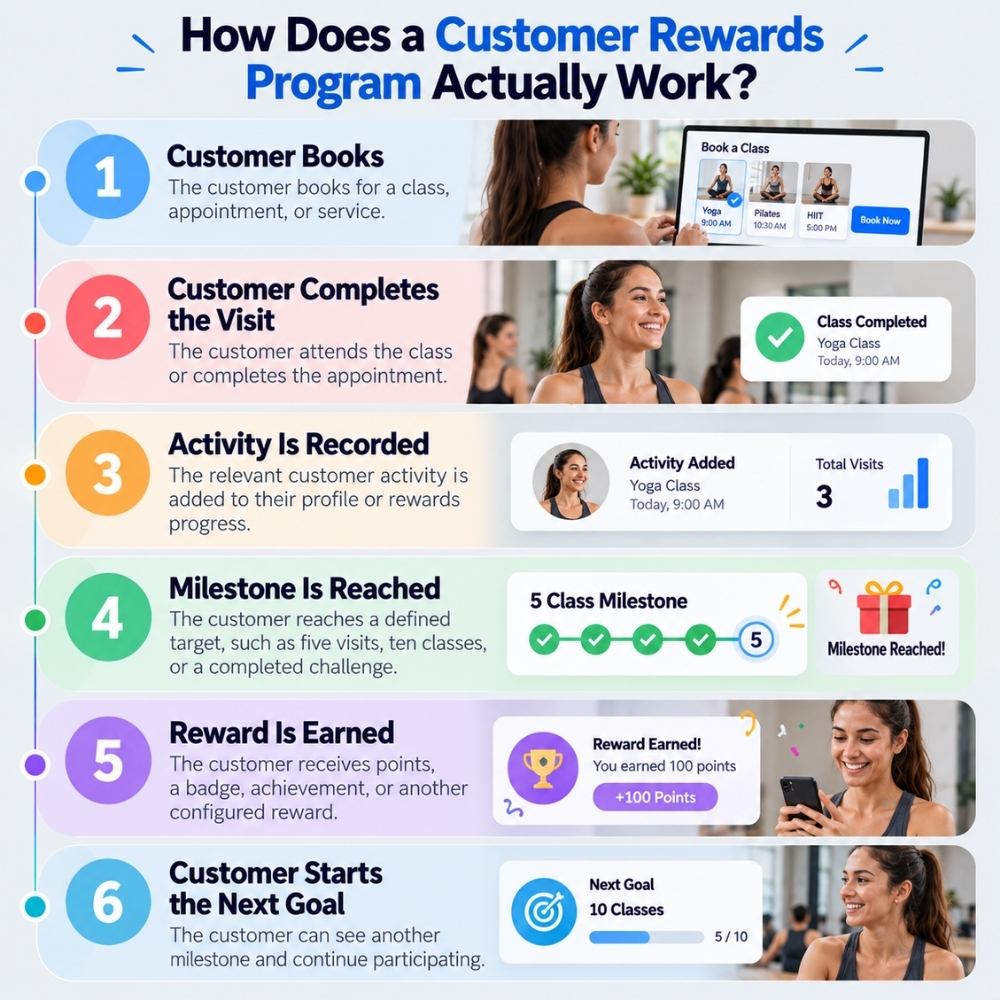
The reward should not feel like something completely separate. For example, a customer books through the business booking system. Their visit is recorded. Their progress toward a milestone is updated. Once they reach the milestone, they receive recognition.
That creates a continuous experience. Rewards and recognition functionality supports gamification through points, badges, achievements and goal-based activities, giving businesses ways to connect recognition with customer engagement.
This can be particularly useful for fitness businesses where customers naturally complete repeat activities such as classes, sessions, and membership periods.
Why Should Fitness Businesses Consider a Fitness Rewards Program?
A fitness rewards program can give customers another reason to pay attention to their own progress. Consider a member who has attended eight classes. Without a rewards system, those eight visits may simply disappear into their booking history. With a milestone system, the member might see:
8 Classes Completed
2 More to Reach Your Next Milestone
That small message changes how the customer sees the activity. It makes progress visible. The customer is not necessarily attending because of the reward. The reward simply gives progress more meaning.
For fitness businesses, this can also create more opportunities to recognize regular customers without constantly relying on promotions.
5 Simple Reward Ideas for Fitness and Wellness Businesses
1. Visit Milestones: Reward customers after their fifth, tenth, or twentieth visit.
2. Class Completion Badges: Give customers achievements for completing a specific number of classes.
3. Challenge Rewards: Create short challenges such as completing five classes a month.
4. Membership Milestones: Recognize customers when they reach six months or one year.
5. Points for Meaningful Activities: Give points for selected activities that support the customer journey.
These ideas can be adjusted for yoga studios, Pilates businesses, gyms, wellness centers, and other service businesses.
How Can Rewards Work With Memberships and Packages?
Rewards do not have to exist separately from memberships.
A fitness business may connect milestones with membership activity.
For example: Membership Started → Classes Booked → Sessions Attended → Milestone Reached → Reward Earned
A customer with a 10-class package might receive recognition after completing all 10 sessions.
A monthly member might receive an achievement after reaching a specific attendance milestone.
A long-term member might receive recognition on their membership anniversary.
This can make the customer rewards program feel more connected to the services the customers are already purchasing.
What Makes a Reward Feel Meaningful?
The best reward is not necessarily the most expensive one.
It is the one that feels relevant.
For a fitness studio, an achievement badge may be enough for one customer. Another might value early booking access. A wellness customer may appreciate a complimentary service add-on.
The business should consider its customer base before deciding what to offer.
What Should a Cayman Business Decide Before Starting?
Before creating a customer loyalty program, businesses should first decide what they want to recognize.
Ask:
- Which customer actions matter to our business?
- Which milestones feel meaningful?
- What type of reward suits our customers?
- How often should customers receive recognition?
- Can customers easily see their progress?
- Can staff manage the program without extra manual work?
For a Cayman fitness or wellness business, the answers may be different from those of a traditional retail store.
A yoga studio might focus on class attendance.
A Pilates studio may focus on completed sessions.
A spa might recognize repeat visits.
A wellness business could create service-based milestones.
The best program is the one that fits the customer journey already happening inside the business.
How Can Businesses Keep Rewards Personal?
Recognition becomes more meaningful when it reflects what customers actually do.
A customer who frequently attends morning classes could receive a milestone related to attendance. A customer who regularly books wellness treatments could have a different type of recognition.
This is where customer profiles become useful.
Instead of treating every customer the same, businesses can use customer activity and history to understand how they interact with the business.
Dotbooker connects customer information with bookings, memberships, packages and other service activities, helping businesses maintain a clearer view of the customer relationship.
That information can support more relevant recognition rather than sending the same reward to everyone.
Frequently Asked Questions
What is a customer rewards program?
A customer rewards program is a structured way for a business to recognize customers for repeat visits, purchases, participation or other meaningful activities. Rewards can include points, badges, achievements, perks or exclusive benefits.
What rewards work well for fitness businesses?
Fitness businesses can use class milestones, attendance achievements, points, badges, challenge rewards, early access or small service-related perks. The best option depends on the business and its customers.
Does a loyalty program have to offer discounts?
No. A loyalty program can use recognition, points, badges, achievements, access or experiences instead of relying only on discounts.
How can a fitness rewards program encourage engagement?
A fitness rewards program can make progress visible through milestones, challenges, and achievements. Customers can see what they have completed and what they can work toward next.