
Top Tips to Choose the Best Physiotherapy Practice Management Software in 2026

Imagine walking into a clinic where everything goes smoothly: patients arrive, check in digitally, the therapist pulls thorough treatment notes in a matter of seconds, invoicing happens in the background, and no one is managing paper files or contacting to confirm appointments.
That's what the top physiotherapy clinics are currently doing in 2026; it's not some ideal clinic from the future. At the heart of this smooth operation? The right physiotherapy practice management software.
Let’s uncover what really sets a great system apart, not just in terms of features, but in how it elevates your entire practice.
1. Start With the End in Mind: What Problem Are You Solving?
Before you start comparing feature lists or pricing plans, step back and examine how your clinic actually operates day to day. Most clinics don’t struggle because they lack software; they struggle because their systems don’t address the real bottlenecks slowing them down.
- Is your front desk constantly juggling phone calls, walk-ins, and rescheduling requests?
- Do therapists spend more time completing notes after sessions than on recovery strategies?
- Does the lack of automated reminders lead to follow-ups being overlooked?
- Are billing inconsistencies leading to uncomfortable patient talks or late payments?
- Or if you intend to expand and find that your existing configuration won't hold up?
The ideal software for managing a physiotherapy practice doesn't attempt to address every issue at once. Instead, it focuses on the particular sites of friction that impact productivity, earnings, and patient satisfaction.
You're not just investing in technology when you select software with a well-defined goal, such as improved documentation, more efficient scheduling, or scalable operations. You are eliminating a barrier that is preventing your clinic from progressing.
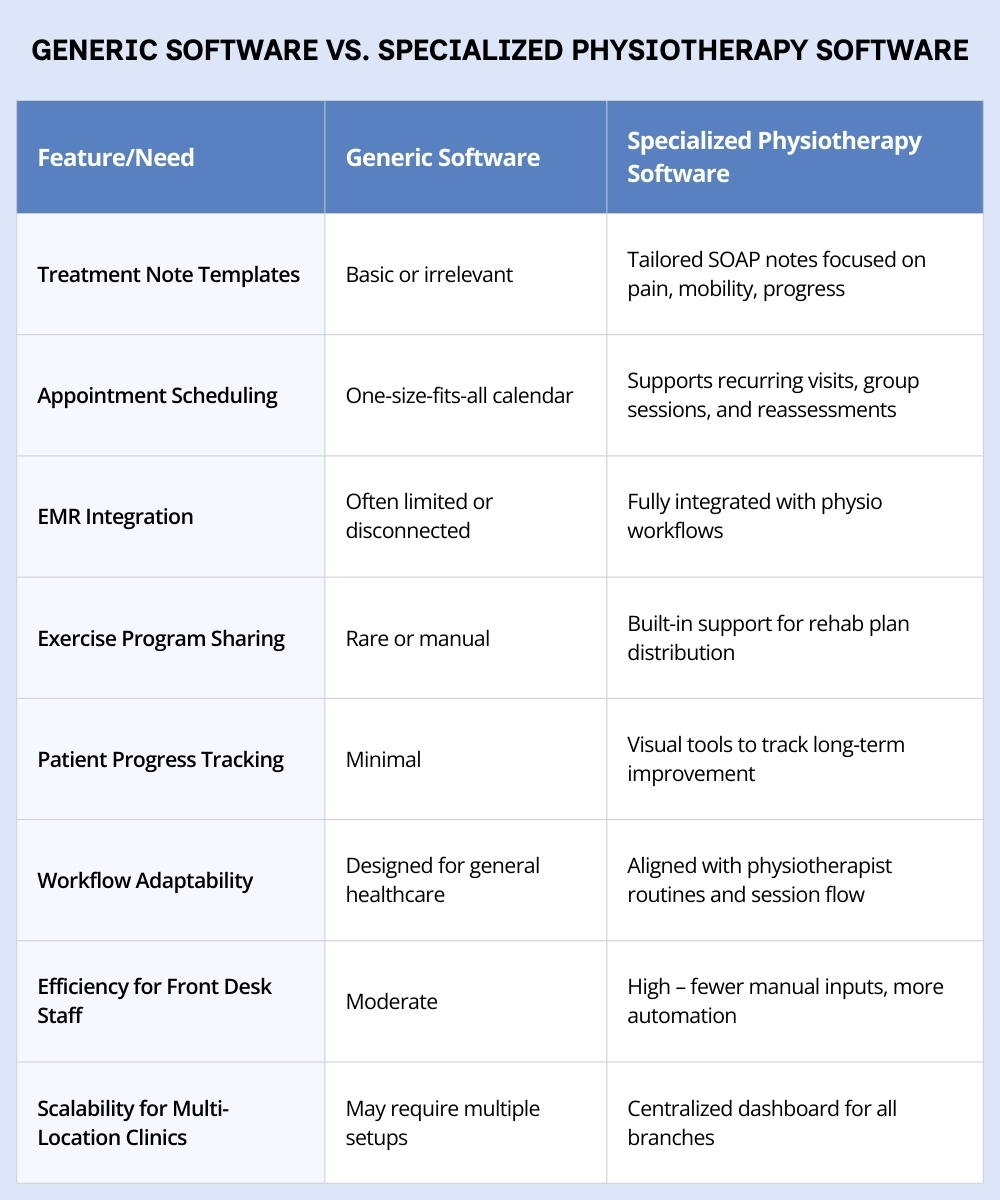
Generic Software vs. Specialized Physiotherapy Software
2. Choose Specialized Physiotherapy Clinic Software Over Generic Options
Physiotherapy is not transactional healthcare. It's a voyage. Patients return several times, their improvement is slow, and each session builds on the one before. This is where generic medical software frequently fails.
Tools that accommodate lengthy treatment durations, accommodate changing care plans, and support outcome-based tracking are necessary for a physiotherapy clinic. This is why purpose-built physiotherapy clinic software matters so much.
Seek out systems that inherently facilitate:
- Comprehensive SOAP notes organized according to functional improvement, pain levels, and movement
- Monitoring long-term development via graphics that demonstrate progress over time
- Exercise regimens and home rehabilitation programs are simple to post and share.
- Flexible scheduling for group therapy sessions and recurring appointments
- Reassessment templates that correspond with actual clinical procedures
Software created especially for physiotherapy feels natural rather than forced. Your patients receive more consistent care, your therapists record more quickly, and your administrative staff spends less time filling in gaps.
3. Why Integrated Physio EMR Software is Critical for Modern Clinics
Modern clinics cannot afford disconnected systems. When scheduling, documentation, billing, and medical records live in separate silos, inefficiency becomes inevitable.
A well-integrated physio practice management software solution works seamlessly with your EMR, creating a single source of truth across your clinic. This eliminates the need for therapists to transfer platforms or search for documents to quickly access treatment histories, diagnostic reports, and imaging files.
Integration allows:
- Real-time updates to patient records during or immediately after sessions
- Secure collaboration between therapists, assistants, and billing teams
- Reduced duplication of data entry across systems
- Easier adherence to healthcare data regulations in the US, Canada, and the Cayman Islands
If your team is still exporting spreadsheets, emailing documents internally, or manually syncing records, the software is working against you, not for you.
4. Not Just Scalable, It Should Evolve With Your Clinic’s Vision
Many clinics choose software based on their current size rather than their future direction. That’s a costly mistake.
What works for a single-location clinic may completely break down when you add more therapists, introduce mobile services, or open new branches. The right physiotherapy software should grow alongside your ambitions.
A future-ready platform supports:
- Rapid practitioner onboarding or dismissal without technological difficulties
- Centralized management from a single dashboard across several locations
- Role-based access that empowers teams while protecting data
- Comparative reporting between services, therapists, and branches
Growth ought to be thrilling rather than daunting. Expansion becomes a strategic decision rather than an operational hassle when your software evolves alongside your clinic.
5. Boosting Profitability with Automated Clinic Management Software Billing
By its very nature, physiotherapy billing is complicated. Even minor inefficiencies can escalate into cash flow issues due to insurance claims, self-paying patients, partial payments, and repeating sessions.
By automating the most error-prone aspects of billing, sophisticated clinic management software eliminates this friction.
A strong system will:
- Automatically apply correct CPT and ICD-10 codes
- Generate clean digital invoices for patients and insurers.
- Accept multiple payment methods without manual reconciliation.
- Track unpaid balances and notify staff before sessions.
- Support region-specific billing formats and insurance workflows.
When billing works smoothly, revenue becomes predictable, admin workload drops, and your team can focus on delivering care instead of chasing payments.
Learn more about how wellness business software saves time, grows revenue, and enhances client experience.
6. Elevate the Entire Patient Journey with Front-End Features
Patients today evaluate clinics long before their first session, often through booking experiences, communication clarity, and convenience. Your software plays a significant role in shaping that perception.
Strong physiotherapy clinic software enhances the patient journey by removing friction at every step:
- Online booking that reflects real-time availability
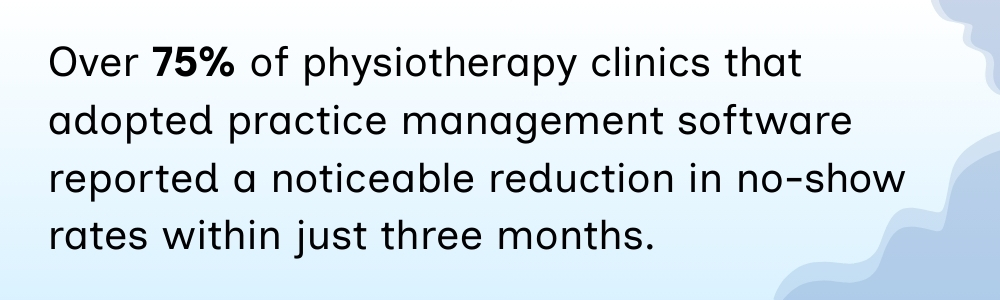
- Automated confirmations and reminders that reduce no-shows
- Digital intake forms that eliminate waiting room paperwork
- Secure portals for accessing progress notes and exercise plans
- Post-session check-ins that reinforce care continuity
When patients feel informed and supported outside the clinic, engagement improves. Engaged patients are more likely to complete treatment plans and recommend your services.
7. Security Is Not a Feature, It’s a Responsibility
Healthcare data is deeply personal. A single security lapse can damage trust that took years to build.
Whether you operate in the US, Canada, or the Cayman Islands, your software must treat data protection as a core responsibility, not an add-on.
Reliable systems ensure:
- Strong encryption for all stored and transmitted data
- Role-based access so sensitive information is visible only to the right people
- Complete audit logs for accountability
- Regular automated backups and disaster recovery readiness
- Compliance with regional healthcare privacy regulations
Security isn’t just about avoiding penalties; it’s about protecting your patients and your reputation.
8. Workflows Should Be Mobile-Friendly and Intuitive
Physiotherapy is active. Therapists move between rooms, work with equipment, and sometimes provide off-site or virtual care. Software that demands constant desk time simply doesn’t fit.
Modern physio practice management software supports mobility by offering:
- Full functionality on tablets and smartphones
- Instant syncing across all devices
- Minimal learning curves for new staff
- Quick documentation tools like templates or voice notes
- Built-in support for tele-physio sessions
When technology adapts to how therapists work, productivity naturally increases without forcing behavioral changes.
9. Test the Software in Real-World Conditions, Not Just Demos
Best-case possibilities are displayed in a polished demo. Actual clinics are completely chaotic.
To replicate real clinic days, use trials:
- Make actual appointments rather than using sample data.
- Allow each role to test the everyday workflows they will utilize.
- Keep an eye out for instances of uncertainty or delays.
- Calculate the actual duration of routine chores.
A system won't get better after deployment if it falters during a trial under typical clinic conditions. Realistic testing saves months of frustration down the road.
10. Insights Are the New Currency, Choose a Platform That Shows You More
Data is only valuable when it leads to better decisions. Your software should help you understand what’s happening inside your clinic, not just record it.
High-quality physiotherapy software provides insights such as:
- Revenue trends and appointment utilization
- Cancellation and no-show patterns
- Practitioner performance and workload balance
- Referral sources that drive the most value
- Forecasts for staffing and equipment needs
These insights turn guesswork into strategy. And strategy is what separates clinics that survive from clinics that lead.
The global physiotherapy software market is projected to exceed $1.2 billion by 2030, driven by rising demand for digital health solutions, especially in North America and the Caribbean.

The Smartest Clinics Are Switching to Dotbooker
Your clinic deserves more than a patchwork of tools and paperwork.
It deserves a platform that brings order to the chaos, connects all your workflows, and enhances both patient experience and profitability.
Physiotherapy clinics and other health and wellness enterprises are the target market for Dotbooker. It provides all the capabilities a contemporary clinic requires in 2026, including online booking, progress tracking, EMR connectors, multi-location management, mobile access, real-time reporting, and secure billing.
Clinics throughout the US, Canada, and the Cayman Islands already rely on Dotbooker, which is more than just software; it's the quiet backbone of your clinic. Additionally, it is designed to grow with you, adapt to local regulations, and support your development at every turn.
Future-Proofing Your Practice Starts with the Right Software
There’s no single “best” physiotherapy practice management software, but there is a best-fit for your clinic’s goals, workflows, and ambitions.
In 2026, choosing the right platform is no longer optional; it’s a competitive advantage.
So take the time. Ask the hard questions. And when you’re ready to streamline, scale, and succeed, Dotbooker will be prepared to help you lead the way.